

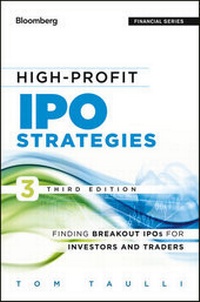
High-Profit IPO Strategies
Finding Breakout IPOs for Investors and Traders
3rd Edition
Published on 17. October 2012
304 pages
978-1-118-42033-1 (ISBN)
Description

A detailed guide to the new era of IPO investing
Typically generating a great deal of interest, excitement, andvolatility, initial public offerings (IPOs) offer investors andtraders with opportunities for both short-term and long-termprofits. In the Third Edition of High-Profit IPOStrategies, IPO expert Tom Taulli explains all facets of IPOinvesting and trading, with a particular emphasis on the industriesthat are fueling the next generation of IPOs, from socialnetworking and cloud computing to mobile technology.
In the past year alone, many of these types of IPOs haveprovided enormous opportunities for nimble traders as prices havefluctuated widely for several months following the offering. Thisnew edition reflects the new IPO environment and presents you withthe insights needed to excel in such a dynamic arena.
* Discusses more sophisticated IPO trading strategies, exploresthe intricacies of the IPO process, and examines the importance offocused financial statement analysis
* Contains new chapters on secondary IPO markets, reversemergers, and master limited partnerships
* Provides in-depth analysis of other major industries generatingworthwhile IPOs
* Covers IPO investing from basic terms to advanced investingtechniques
Comprehensive in scope, the Third Edition ofHigh-Profit IPO Strategies offers investors and traders withactionable information to profit in this lucrative sector of thefinancial market.
Reviews / Votes
"A concise introduction to IPOs for the uninitiated, thisbook is also an excellent resource for finance professors wishingto supplement investment textbooks that touch only briefly on theIPO process, professionals at the outset of their careers whocontemplate moving into IPO investing, and owners of newbusinesses."-Reviewed by Ronald L. Moy, CFA, for CFAInstituteMore details
Other editions
Additional editions
Book
12/2012
3rd Edition
Bloomberg Press
€56.00
Shipment within 15-20 days
Person
TOM TAULLI writes about venture capital and IPOs forForbes.com as well as the IPOPlaybook.com. He has been involved inthe financial markets since the mid-1990s when he launched WebIPO.It was a place where investors could go for research and access todeals during the dot-com boom. He has written several books,including Investing in IPOs, Investing in IPOs Version2.0, The Complete M&A Handbook, All About ShortSelling, and All About Commodities. Besides hiswritings, Taulli is routinely quoted in the media about upcomingdeals with his interviews on CNBC and Bloomberg TV. He can bereached at tom@taulli.com or on Twitter at @ttaulli.
Content
- Cover Page
- Title Page
- Copyright
- Contents
- Foreword
- Introduction
- Part I: IPO Fundamentals
- Chapter 1: Getting IPO Shares
- Risk
- The Calendar
- Online Brokers
- Build Relationships with the Syndicate Firms
- Dutch Auction
- Buy on Secondary Markets
- Private Placements
- IPO Mutual Funds
- Directed Share Program
- Follow-On Offerings
- Direct Public Offerings
- IPOs to Avoid
- Conclusion
- Chapter 2: IPO Basics
- Why Do Companies Go Public?
- Prestige
- Getting Rich
- Cash Infusion
- Lower Cost of Capital
- Easier to Raise More Capital
- Stock as Currency
- Liquidity for Investors
- Reasons Not to Go Public
- Expense
- Managerial Distraction
- Short-Term Focus
- Loss of Control
- Loss of Privacy
- Stock Restrictions
- Shareholder Litigation
- Sarbanes-Oxley
- JOBS Act
- Cast of Characters
- Angel Investors and Venture Capitalists
- Strategic Investors
- Auditor
- Attorneys
- Financial Printer
- Public Relations Firms
- Transfer Agent/Registrar
- Underwriters
- Conclusion
- References
- Chapter 3: IPO Process
- Laws That Impact IPOs
- Steps of the IPO Process
- Pre-IPO Preparation
- The Bake Off
- Organizational Meeting
- Due Diligence
- Letter of Intent
- Drafting and Filing the Registration Statement
- The Road Show
- Securing Investors
- Choosing a Market to List On
- Finalization of the Offering
- Conclusion
- Part II: IPOs for Investors
- Chapter 4: Finding the Best IPO Information
- Information to Get Your Feet Wet
- The Wall Street Journal
- Reuters, Bloomberg and the Deal Pipeline (www.thedeal.com)
- IPO Playbook
- Google News
- IPO Home
- RetailRoadshow
- In-Depth IPO Information
- IPOBoutique.com
- IPODesktop.com
- IPOCentral.com
- IPO Financial Network
- IPOMonitor.com
- EDGAR Resources
- Other IPO Information Resources
- Twitter and Stocktwits
- Discussion Groups
- Industry Publications
- Company Websites
- Your Broker
- Conclusion
- Chapter 5: Making Sense of the Prospectus
- Getting a Copy of the Prospectus
- Main Sections
- Front Matter
- Graphic Material
- Qualification Requirements
- Prospectus Summary
- Core Focus
- Growth Metrics
- Business Model
- Market Size and Growth
- Place of Incorporation
- Risk Factors
- Letter from Our Founder
- Market Data and User Metrics
- Use of Proceeds
- Dividend Policy
- Capitalization
- Dilution
- Selected Consolidated Financial Data
- Management's Discussion and Analysis of Financial Condition and Results of Operations
- Business
- Management
- Executive Compensation
- Certain Relationships and Related-Person Transactions
- Principal and Selling Stockholders
- Description of Capital Stock
- Shares Eligible for Future Sale
- Index to Consolidated Financial Statements
- Miscellaneous Sections
- Conclusion
- Chapter 6: Balance Sheet
- Some Fundamentals
- Historical Costs
- Accrual Accounting
- Balance Sheet Overview
- The Assets
- Cash and Cash Equivalents
- Marketable Securities
- Accounts Receivable
- Allowance for Doubtful Accounts
- Inventory
- Taxes
- Prepaid Expenses
- Property and Equipment
- Restricted Cash
- Goodwill
- The Liabilities
- Analyzing Debt
- Equity
- Conclusion
- Chapter 7: Income Statement
- Management's Discussion and Analysis of Financial Condition and Results of Operations
- Sales
- Revenue Recognition
- Cost of Sales
- Gross Profit
- Selling, General, and Administrative Expenses
- Charges
- Earnings
- Pro Forma Earnings
- Taxes
- Common-Size Financials
- Conclusion
- Chapter 8: Statement of Cash Flows
- Background
- Cash Flows from Operating Activities
- Cash Flows from Investing Activities
- Cash Flows from Financing Activities
- Focus on Operating Cash Flows
- Free Cash Flow
- Stock Options
- Factoring
- Footnotes
- Fraud and Misrepresentation
- Conclusion
- Chapter 9: Risk Factors
- Inexperienced Management Team
- Need for More Financing
- Legal Proceedings
- Market and Customer Base
- Going Concern
- Competition
- Dual-Share Structure
- CEO Dependence
- Reliance on the Government
- Unproven Business Model
- Limited History of Profitable Operations
- Small Market Potential
- Cyclical Businesses
- Conclusion
- Chapter 10: IPO Investment Strategies
- Neighborhood Investing
- Invest in What You Know
- Study Mutual Fund Holdings
- Strong Backers
- Analyst Coverage
- IPO Rules of Thumb
- Buy on the Opening or Wait for the Lockup to Expire?
- Buying on Margin
- Options
- Covered Call
- Straddle
- Credit Spreads
- Conclusion
- Chapter 11: Short Selling IPOs
- How Short Selling Works
- Mechanics
- IPO Shorts
- Margin Calls
- Short Selling Increases Outstanding Shares
- Risks of Short Selling
- Taxes
- Finding IPOs to Short
- Conclusion
- Part III: IPO Sectors
- Chapter 12: Tech IPOs
- The Cloud
- Social Networking
- Mobile
- Marketplaces
- Security
- Big Data
- Evaluating a Tech IPO
- Conclusion
- Reference
- Chapter 13: Biotech IPOs
- FDA Approval
- Analyzing Biotech IPOs
- Conclusion
- References
- Chapter 14: Finance Sector IPOs
- Banking
- Asset Managers
- Private Equity Firms
- Online Brokerages
- Insurance
- Specialized Online Financial Services
- Zillow
- FinancialEngines
- Conclusion
- References
- Chapter 15: Retail Sector IPOs
- Brand
- Disruptive Threats
- Major Consumer Changes
- Timing
- Check Out the Store
- Financial Metrics
- Narrow Base
- Conclusion
- References
- Chapter 16: Foreign IPOs
- Advantages of Foreign IPOs
- Risks
- Risk of Political Strife
- Currency Risk
- Copycat IPOs
- Aftermarket Support
- Fraud
- Risk of Default
- IPO Process for Foreign Deals
- American Depositary Receipts
- Direct Investments in Foreign IPOs
- Conclusion
- Chapter 17: Energy IPOs
- Crude Oil
- Natural Gas
- Coal
- Alternative Energy
- Solar
- Ethanol
- Geothermal Energy
- Biomass
- Wind Power
- Types of Energy Companies
- Evaluating an Energy Company IPO
- Master Limited Partnerships
- Conclusion
- Chapter 18: REIT IPOs
- Trends in the Real Estate Market
- Basics of REITs
- Yields
- Analyzing REITs
- Funds
- Conclusion
- Part IV: Other IPO Investments
- Chapter 19: IPO Funds
- Types of Funds
- Mutual Funds
- Exchange-Traded Funds
- Closed-End Funds
- Hedge Funds
- Fund Strategies
- Conclusion
- References
- Chapter 20: Spin-Offs
- The Basics
- Traditional Spin-Off
- Spin-Off with Equity Carve-Out
- Split-Off
- Tracking Stock
- Investing in Spin-Offs
- Conclusion
- References
- Chapter 21: Fad IPOs
- Spotting the Fads
- Consumer Technologies
- Restaurants
- Toys
- Apparel
- Knowing When to Get Out of Fad IPOs
- Conclusion
- References
- Chapter 22: Secondary Markets, Angel Investing, and Crowd Funding
- Pre-IPO Funding Process
- Accredited Investor
- How to Become an Angel Investor
- Angel Deal Structures
- Strategies for Angel Investing
- Understanding Markets
- Advice
- Valuation
- Dilution
- Market Opportunity
- Executive Summary
- Go-to-Market Strategy
- Due Diligence and the Term Sheet
- Secondary Markets
- The Operators
- The Process
- The Risks
- Crowd Funding
- Fraud
- Conclusion
- Chapter 23: The 100x IPO
- The Amazon.com IPO
- Why Amazon.com?
- Conclusion
- Conclusion
- Appendix A: The Underwriting Process
- Underwriting Options
- Firm Commitment
- Best Efforts
- Self-Underwritten Offerings
- Appendix B: Analyzing the Financial Statement Items
- Liquidity Ratios
- Activity Ratios
- Profitability Ratios
- Price-Earnings Ratio
- Debt Ratio
- Glossary
- About the Author
- Index
- EULA
