

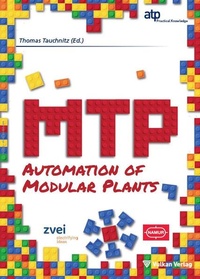
MTP
Automation of Modular Plants
1st Edition
Published on 10. November 2022
312 pages
978-3-8356-7468-4 (ISBN)
Description

After an introduction, a review of the DIMA concept (chapter 3) and considerations on modularization from a process engineering point of view (chapter 4), chapter 5 gives an overview of the automation of modular plants with the MTP. Chapter 6 describes the building blocks of the MTP concept that have already been completed or are currently being developed and are published in sheets of the VDI/VDE/NAMUR guideline. Chapter 7 shows developments in the environment of the MTP. Already created demonstrators and industrial applications are described in chapter 8. After an outlook (chapter 9), many suppliers of modular automation solutions present their approaches and products in chapter 10 with sole responsibility for the content.
More details
Other editions
Additional editions
Book
11/2022
1st Edition
Vulkan-Verlag
€79.00
Shipment within 5-7 days
Person
Content
- Intro
- Forword
- 1. Preface
- 1.1 Introduction
- 1.2 Objectives for the book
- 1.3 Application of modular automation outside of process industries
- 1.4 Overview of the book
- 1.5 Acknowledgements
- 2. Requirements for modular Automation
- 2.1 General Requirements for modular Automation
- 2.2 Requirement for the Module Type Package
- 2.2.1 Requirements to the Human Machine Interface
- 2.2.2 Diagnosis and Maintenance
- 2.2.3 Modeling of Services
- 2.2.4 Alarm Management
- 2.2.5 Safety
- 3. How the MTP started - a short History
- 4. Modular Plants
- 4.1 Drivers for the application of the modular plant concept
- 4.2 The structure of modular plants
- 4.3 The design of modular plants
- 4.4 Changing roles and business models
- 5. Automation of Modular Plants
- 5.1 Concept of modular automation
- 5.1.1 Modular process development
- 5.1.2 Engineering phases using MTP
- 5.1.3 Communication architecture
- 5.2 Standardization approach
- 5.2.1 Agile standardization
- 5.2.2 Overview of the parts
- 5.3 Orchestration
- 5.4 Summary
- 6. Standardisation of the MTP
- 6.1 General Concept and Interfaces, VDI/VDE/NAMUR 2658 Part 1
- 6.1.1 Purpose
- 6.1.2 Scope
- 6.1.3 Used standards / technical commonalities
- 6.1.4 Excerpt of the fundamental modelling concepts
- 6.1.4.1 Packaging conventions
- 6.1.4.2 Manifest structure
- 6.1.4.3 Linked Object Concept and the Aspect Matrix Model
- 6.1.5 Excerpt of the fundamental communication concept
- 6.1.5.1 Mapping-Concept for communication protocols
- 6.1.5.2 Information element type - DataItem
- 6.1.5.3 Information element type - ObjectItem
- 6.1.5.4 Information element type - MethodItem
- 6.1.6 Excerpt of the fundamental workflow definitions
- 6.1.6.1 Two stage engineering process
- 6.1.6.2 Versioning concept and version verification
- 6.1.6.3 Type verification
- 6.1.6.4 Instance verification
- 6.1.7 Summary
- 6.2 Modelling of human machine interfaces, VDI/VDE/NAMUR 2658 Part 2
- 6.2.1 Purpose - Why is an HMI required in modular plants?
- 6.2.2 Scope - What is described in the HMI aspect of the MTP?
- 6.2.3 Used standards / Technical commonalities
- 6.2.4 How to comply with part two?
- 6.2.4.1 As a PEA automation system vendor
- 6.2.4.2 As a POL vendor
- 6.2.5 What tasks should be performed?
- 6.2.5.1 As a PEA vendor
- 6.2.5.2 As a system integrator
- 6.2.5.3 As a plant operator
- 6.2.6 Excerpt of the modelling methods
- 6.2.6.1 Objects/Symbols
- 6.2.6.2 Pipes and measurement lines
- 6.2.6.3 Terminations
- 6.2.6.4 Grouping of objects
- 6.2.6.5 Other objects
- 6.2.7 Summary
- 6.3 Library for data objects, VDI/VDE/NAMUR 2658 Part 3
- 6.3.1 Purpose - Why is a description on Control Module Level required?
- 6.3.2 Scope - What is described with the library of data objects
- 6.3.3 Used Standard / Technical Commonalities
- 6.3.4 How to comply with part 3?
- 6.3.4.1 As an equipment assembly vendor
- 6.3.4.2 As a POL system vendor
- 6.3.5 What tasks should be performed?
- 6.3.5.1 As an equipment assembly vendor
- 6.3.5.2 As a system integrator
- 6.3.5.3 As a plant operator
- 6.3.6 Modelling Methods
- 6.3.6.1 Introduction of general definitions
- 6.3.6.2 Interface families and definitions
- 6.3.6.3 Tempering Indication Modelling Example
- 6.3.7 Summary
- 6.4 Functional Encapsulation in MTP Services, VDI/VDE/NAMUR 2658 Part 4
- 6.4.1 Purpose
- 6.4.2 Scope of the MTP Service Concept
- 6.4.3 Used standards / Technical commonalities
- 6.4.4 MTP Service Elements
- 6.4.5 MTP Service Interfaces
- 6.4.6 MTP Service modelling on semantic level
- 6.4.7 Service identification and design
- 6.4.7.1 Functionality in service states
- 6.4.7.2 Service or Service Procedure?
- 6.4.7.3 Services for batch operation
- 6.4.7.4 Services for continuous operation
- 6.4.8 Service-based process control
- 6.4.8.1 Embedded, decentral orchestration
- 6.4.8.2 Step-transition-based, central orchestration
- 6.4.8.3 Recipe-based, central orchestration
- 6.4.8.4 Workflow-based, central orchestration
- 6.4.8.5 Service Choreography
- 6.4.9 Summary
- 6.5 Runtime and Communication Aspects, VDI/VDE/NAMUR 2658 Part 5
- 6.5.1 Purpose
- 6.5.2 Scope
- 6.5.3 Technical basics of the communication
- 6.5.3.1 Used standards
- 6.5.3.2 How to connect PEA with POL
- 6.5.3.3 How to handle communication errors
- 6.5.4 How to comply with part 5
- 6.5.4.1 As a PEA automation vendor
- 6.5.4.2 As a POL vendor
- 6.5.5 What tasks should be performed?
- 6.5.5.1 As a system integrator
- 6.5.5.2 As a plant operator
- 6.6 Concept of modular alarm management
- 6.6.1 Purpose - Why is a Modular Alarm Management required in MTP?
- 6.6.2 Scope - What is described in an Alarm Management Aspect?
- 6.6.3 Used standards / Technical commonalities
- 6.6.4 How to comply with the alarm concept
- 6.6.4.1 As a PEA automation system vendor
- 6.6.4.2 As a POL vendor
- 6.6.5 What tasks should be performed?
- 6.6.5.1 As a PEA vendor
- 6.6.5.2 As a system integrator
- 6.6.5.3 As a plant operator
- 6.6.6 Excerpt of the modelling methods
- 6.6.7 Summary
- 6.7 Safety for modular Automation
- 6.7.1 Challenges of modular Safety
- 6.7.2 Safety Hierarchy in Modular Plants
- 6.7.3 Intra- and Intermodular Safety
- 6.7.4 Safety Life-Cycle for Modular Process Plants
- 6.7.5 Safety-MTP
- 6.7.6 Summary
- 6.8 Diagnosis and Maintenance
- 6.8.1 Purpose - Why is standardized Diagnostics and Maintenance required in modular plants?
- 6.8.2 Scope - What will be described in the Diagnostics and Maintenance aspect of the MTP?
- 6.8.3 Used standards / Technical commonalities
- 6.8.4 How to be compliant to these concepts
- 6.8.4.1 As a PEA automation system vendor
- 6.8.4.2 As a POL or MOL vendor
- 6.8.5 What tasks should be performed?
- 6.8.5.1 As a PEA vendor
- 6.8.5.2 As a system integrator
- 6.8.5.3 As a plant operator
- 6.8.5.4 As a plant maintainer
- 6.8.6 Excerpt of the diagnostic concepts
- 6.8.6.1 Interfaces Extension
- 6.8.6.2 Functional diagnostic
- 6.8.6.3 Interlock diagnostic
- 6.8.6.4 Service diagnostic
- 6.8.6.5 Component diagnostic
- 6.8.6.6 System diagnostic
- 6.8.7 Summary
- 6.9 Concepts of Peer-to-Peer Cross-Communication
- 6.9.1 Purpose
- 6.9.2 Concept Overview
- 6.9.2.1 Evolutionary Concept - Process Value Interconnections
- 6.9.2.2 Revolutionary Concept - Automation Service Choreography
- 6.9.3 Summary
- 7. Further MTP Guidelines and Developments
- 7.1 Requirements for Process Orchestration of modular production plants (NE 187)
- 7.1.1 Introduction and Overview
- 7.1.2 Role of Process Orchestration Layer in a modular plant lifecycle
- 7.1.3 POL Functions for the Engineering Phase
- 7.1.4 POL Functions for the Operational Phase
- 7.1.5 POL Requirements due to the nature of PEA Types
- 7.1.6 Status models of the Process Orchestration Layer
- 7.2 Use Cases for Plug&Produce (NE 187)
- 7.2.1 PEA State model from the view of a process orchestration layer
- 7.2.2 Use Cases for Plug&Produce
- 7.2.2.1 Use Case 1: Connection of a PEA to a POL
- 7.2.2.2 Use Case 2: Modular production with PEA and POL
- 7.2.2.3 Use Case 3: Disconnecting a PEA for maintenance from a POL
- 7.3 Qualification of modular automation in GMP environments (NAMUR NE 185)
- 7.3.3 Introduction
- 7.3.4 Classification of modular plant elements in terms of qualification / validation strategy
- 7.3.5 Multi Product Modular Plant Approach and Recipe Driven Operation on Asset Lifecycle: Engineering, Installation, Commissioning, Qualification and Validation (CQV) in GMP-Environments
- 7.3.5.1 IT or OT organisation (responsibility in Level 3)
- 7.3.5.2 OT organisation (responsibility for RIB / Level 2 / Level 1 / Level 0)
- 7.3.6 Conclusion and Outlook
- 7.4 The Open Process Automation Standard and the Module Type Package - Friends or Enemies?
- 7.4.1 Open Process Automation Standard (O-PAS)
- 7.4.2 Comparison of O-PAS and MTP concepts
- 7.4.2.1 Modularity
- 7.4.2.2 Interoperability
- 7.4.2.3 Plant Coordination
- 7.4.2.4 Configuration
- 7.4.3 Alignment of O-PAS and MTP concepts
- 7.4.3.1 Modularity
- 7.4.3.2 Interoperability
- 7.4.3.3 Plant Coordination
- 7.4.3.4 Configuration
- 7.4.4 Conclusion - Friends or Enemies?
- 7.5 MTP and NAMUR Open Architecture (NOA)
- 7.5.1 The architecture of NAMUR Open Architecture
- 7.5.2 How NOA benefits a plant
- 7.5.3 How to examine compatibility of NOA with modular Automation
- 7.5.4 Compatibility of overlapping architectures
- 7.5.5 Compatibility by use case
- 7.5.5.1 Using NOA components in conjunction with VDI 2776
- 7.5.5.2 Using NOA components with modular automation
- 7.5.6 Conclusion
- 7.6 MTP as Submodel of the Industry 4.0 Asset Administration Shell
- 7.6.1 Asset Administration Shell
- 7.6.2 MTP and AAS integration
- 7.7 Modular Production-related Logistics
- 7.7.1 The way to modular production-related logistics
- 7.7.2 Analysis of a modular packaging system
- 7.7.3 Physically linked Packaging Lines
- 7.7.3.1 LEA Automation
- 7.7.3.2 Coordination of a Packaging Line
- 7.7.4 Loosely coupled Logistics Areas
- 7.7.4.1 LEA Automation
- 7.7.4.2 Coordination of a Logistics Area
- 7.7.5 Summary and Outlook
- 7.8 Modularisation in Laboratories
- 7.8.1 Digitization and modularisation in laboratories
- 7.8.2 Standards for connectivity of laboratories
- 7.8.2.1 SILA 2
- 7.8.2.2 LADS
- 7.8.3 MTP applications in laboratories
- 7.8.4 Outlook
- 7.9 MTP in Shipbuilding
- 7.9.1 Challenges of shipbuilding
- 7.9.2 Modularization approach
- 7.9.2.1 Stakeholders in shipbuilding
- 7.9.2.2 Characteristics of modularization in shipbuilding
- 7.9.2.3 Standardization of MTP in shipbuilding
- 7.9.3 Outlook
- 8. Demonstrators and Pilot Projects
- 8.1 First MTP implementation in an industrial environment - Seamless HMI integration of a package unit into a DCS in 2019
- 8.1.1 Introduction
- 8.1.2 Project setup and technical implementation
- 8.1.3 Challenges and test results
- 8.1.4 Commissioning and Start-up at Evonik Site
- 8.1.5 Conclusion and outlook
- 8.2 Pilot Installation with BioPhorum
- 8.2.1 General introduction
- 8.2.2 MTP supporting modular pilot installations and testing approach
- 8.2.3 Technical use case for MTP implementation
- 8.2.4 Modular build Pilot Installations and Testing Results
- 8.2.5 Summary & key take aways
- 8.3 Test Lab for MTPs at IGR (Interessengemeinschaft Regelwerke Technik e.V.)
- 8.3.1 Test Lab "IDEA 4.0"
- 8.3.2 Docking the PEAs
- 8.3.3 Structure of a biocide dosing PEA
- 8.3.4 Summary and outlook
- 8.4 The ORCA Project and resulting Demonstrators
- 8.4.1 The ORCA Project
- 8.4.2 The First Demonstrator
- 8.4.2.1 Direct Process Function - PEA Mapping
- 8.4.2.2 Hierarchical Process Function - PEA/FEA Mapping
- 8.4.2.3 Distributed Process Function - PEA Mapping
- 8.4.2.4 First Plant Setup
- 8.4.3 The Process Orchestration Layer
- 8.4.4 Second Generation Demonstrators
- 8.5 IIoT Platform as Process Orchestration Layer
- 8.5.1 Introduction
- 8.5.2 Project setup and technical implementation
- 8.5.3 Challenges and tests
- 8.5.4 Conclusion and outlook
- 8.6 "Yesterday we tied cables, now we just run."
- 9. Outlook for MTP
- 9.1 Modular automation is reality based on MTP
- 9.2 Establish MTP as global standard
- 9.3 Short term targets
- 10. Products (sponsored)
- 10.1 ABB Modular Automation brings unmatched agility and flexibility to production
- 10.1.1 Why MTP holds the key to optimum performance
- 10.1.2 ABB's Offering for Modular Automation
- 10.1.3 Module Designer
- 10.1.4 Orchestration Design
- 10.1.5 ABB is a leader and is recognized in the community as a standardization driver
- 10.1.6 Enabling the future of process automation
- 10.2 How module type package helps companies stay ahead of the competition with modular production
- 10.2.1 Increase innovation capability
- 10.2.2 Reduce production costs by 40 %
- 10.2.3 Decrease time to market by 50 %
- 10.2.4 Maximum production flexibility
- 10.3 Bringing automation to the laboratory - with MTP standards and zenon
- 10.3.1 Merck modularizes its process development
- 10.3.2 Dynamic solutions require great flexibility
- 10.3.3 Plug & produce for laboratory personnel
- 10.3.4 High rate of reproducibility for trial setups
- 10.3.5 Agile project management to develop a POL
- 10.3.6 Leading the way into the future
- 10.3.7 About COPA-DATA
- 10.4 Pit stop in the pilot plant - safety and MTP compliance
- 10.4.1 MTP accelerates modifications in a pilot plant
- 10.4.2 Encapsulated temperature control on customer request
- 10.4.3 Typical box similar to the customer solution
- 10.4.4 Well-planned design prevents incorrect operation
- 10.4.5 Outlook
- 10.4.5.1 Safety in MTP
- 10.4.5.2 Scalability for large and small solutions
- 10.4.5.3 Monitoring options via NOA
- 10.4.6 Conclusion
- 10.5 MTPower up your tools.
- 10.5.1 About us.
- 10.5.2 Our products and services.
- 10.5.3 Our workshop portfolio.
- Modularization Evaluation Workshop
- MTP Workshop
- Conceptual Design
- Implementation
- 10.5.4 Our solution portfolio.
- MTPlatform
- 10.5.5 Application Use Cases.
- MTP-Engine
- MTP-ControlEngine
- Contact.
- 10.6 How to stay one step ahead of the competitors but also to embarce them with modular production
- 10.6.1 Plug & produce with Module Type Package (Figure 10.6.2)
- 10.6.2 Innovative web-based process orchestration
- 10.6.3 Power-up modular production (Figure 10.6.4)
- 10.6.4 Function blocks for quick engineering
- 10.6.5 Keep your existing plant untouched
- 10.6.6 Collaboration is the key to the modular production of the future
- 10.6.7 Machine and plant constructor GEA focuses on standards
- 10.6.8 Merck focuses on flexibility via modular production (Figure 10.6.6)
- 10.6.9 Improving efficiency at Evonik (Figure 10.6.7)
- 10.6.10 Use the full potential of MTP for your own production
- Authors
- Abbreviations (in alphabetic order)
- Index
