

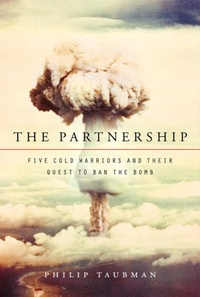
The Partnership
Description

Offering a clear analysis of the danger of nuclear terrorism and how it can be prevented, The Partnership sheds light on one of the most divisive security issues facing Washington today. Award-winning New York Times journalist Philip Taubman illuminates our vulnerability in the face of this pressing terrorist threat-and the unlikely efforts of five key Cold War players to eliminate the nuclear arsenal they helped create. Bob Woodward calls The Partnership a "brilliant, penetrating study of nuclear threats, present and past," and David Kennedy writes that it is "indispensable reading for all who would understand the desperate urgency of containing the menace of nuclear proliferation."
This indispensable study of American foreign policy reveals:
- An Unlikely Bipartisan Partnership: The untold story of how former secretaries of state Henry Kissinger and George Shultz joined with defense secretary William Perry and Senator Sam Nunn to dismantle the very nuclear arsenal they helped build.
- Twenty-First-Century Nuclear Dangers: A clear-eyed analysis of the shift from Cold War deterrence to the urgent, modern danger of nuclear materials falling into the hands of terrorists.
- A Quest for Disarmament: Follows the five Cold Warriors on their personal journeys, tracing how they came to believe the only way to ensure global security was to pursue a world free of nuclear weapons.
- High-Stakes Diplomacy: An insider's account of their campaign, from the landmark Wall Street Journal op-ed to private meetings in Washington, Moscow, and beyond.
More details
Other editions
Additional editions
Person
Philip Taubman worked for The New York Times for thirty years as a reporter and editor, including stints as chief of both the Washington and Moscow bureaus. He has also worked at Esquire and Time magazines. He was twice awarded the George Polk Award?for National Reporting in 1981 and for Foreign Affairs Reporting in 1983. Since retiring from the Times in 2008, he has been a consulting professor at Stanford University's Center for International Security and Cooperation. He lives in the San Francisco Bay Area.
Content
- Intro
- Cover
- Title Page
- Dedication
- Contents
- Preface
- Part I: Confronting the Threat
- Chapter One
- Chapter Two
- Chapter Three
- Chapter Four
- Part II: Pathways to Power
- Chapter Five
- Chapter Six
- Chapter Seven
- Chapter Eight
- Chapter Nine
- Chapter Ten
- Chapter Eleven
- Part III: Manning America's Nuclear Arsenal
- Chapter Twelve
- Chapter Thirteen
- Chapter Fourteen
- Chapter Fifteen
- Chapter Sixteen
- Chapter Seventeen
- Chapter Eighteen
- Chapter Nineteen
- Chapter Twenty
- Chapter Twenty-One
- Chapter Twenty-Two
- Part IV: Going to Zero
- Chapter Twenty-Three
- Chapter Twenty-Four
- Chapter Twenty-Five
- Chapter Twenty-Six
- Chapter Twenty-Seven
- Bibliography
- Index
- Acknowledgments
- About the Author
- Notes
- Credits
- Copyright
- About the Publisher
