

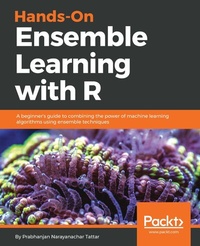
Hands-On Ensemble Learning with R
A beginner's guide to combining the power of machine learning algorithms using ensemble techniques
1st Edition
Published on 23. September 2024
376 pages
978-1-78862-917-1 (ISBN)
Description

Explore powerful R packages to create predictive models using ensemble methodsKey Features - Implement machine learning algorithms to build ensemble-efficient models
- Explore powerful R packages to create predictive models using ensemble methods
- Learn to build ensemble models on large datasets using a practical approach
Book DescriptionEnsemble techniques are used for combining two or more similar or dissimilar machine learning algorithms to create a stronger model. Such a model delivers superior prediction power and can give your datasets a boost in accuracy. Hands-On Ensemble Learning with R begins with the important statistical resampling methods. You will then walk through the central trilogy of ensemble techniques - bagging, random forest, and boosting - then you'll learn how they can be used to provide greater accuracy on large datasets using popular R packages. You will learn how to combine model predictions using different machine learning algorithms to build ensemble models. In addition to this, you will explore how to improve the performance of your ensemble models. By the end of this book, you will have learned how machine learning algorithms can be combined to reduce common problems and build simple efficient ensemble models with the help of real-world examples. What you will learn - Carry out an essential review of re-sampling methods, bootstrap, and jackknife
- Explore the key ensemble methods: bagging, random forests, and boosting
- Use multiple algorithms to make strong predictive models
- Enjoy a comprehensive treatment of boosting methods
- Supplement methods with statistical tests, such as ROC
- Walk through data structures in classification, regression, survival, and time series data
- Use the supplied R code to implement ensemble methods
- Learn stacking method to combine heterogeneous machine learning models
Who this book is forThis book is for you if you are a data scientist or machine learning developer who wants to implement machine learning techniques by building ensemble models with the power of R. You will learn how to combine different machine learning algorithms to perform efficient data processing. Basic knowledge of machine learning techniques and programming knowledge of R would be an added advantage.
- Explore powerful R packages to create predictive models using ensemble methods
- Learn to build ensemble models on large datasets using a practical approach
Book DescriptionEnsemble techniques are used for combining two or more similar or dissimilar machine learning algorithms to create a stronger model. Such a model delivers superior prediction power and can give your datasets a boost in accuracy. Hands-On Ensemble Learning with R begins with the important statistical resampling methods. You will then walk through the central trilogy of ensemble techniques - bagging, random forest, and boosting - then you'll learn how they can be used to provide greater accuracy on large datasets using popular R packages. You will learn how to combine model predictions using different machine learning algorithms to build ensemble models. In addition to this, you will explore how to improve the performance of your ensemble models. By the end of this book, you will have learned how machine learning algorithms can be combined to reduce common problems and build simple efficient ensemble models with the help of real-world examples. What you will learn - Carry out an essential review of re-sampling methods, bootstrap, and jackknife
- Explore the key ensemble methods: bagging, random forests, and boosting
- Use multiple algorithms to make strong predictive models
- Enjoy a comprehensive treatment of boosting methods
- Supplement methods with statistical tests, such as ROC
- Walk through data structures in classification, regression, survival, and time series data
- Use the supplied R code to implement ensemble methods
- Learn stacking method to combine heterogeneous machine learning models
Who this book is forThis book is for you if you are a data scientist or machine learning developer who wants to implement machine learning techniques by building ensemble models with the power of R. You will learn how to combine different machine learning algorithms to perform efficient data processing. Basic knowledge of machine learning techniques and programming knowledge of R would be an added advantage.
More details
Other editions
Additional editions
Prabhanjan Narayanachar Tattar
Hands-On Ensemble Learning with R
A beginner's guide to combining the power of machine learning algorithms using ensemble techniques
Book
07/2018
Packt Publishing
€56.70
Shipment within 3-4 weeks
Person
Tattar Prabhanjan Narayanachar :
Prabhanjan Narayanachar Tattar is a lead statistician and manager at the Global Data Insights & Analytics division of Ford Motor Company, Chennai. He received the IBS(IR)-GK Shukla Young Biometrician Award (2005) and Dr. U.S. Nair Award for Young Statistician (2007). He held SRF of CSIR-UGC during his PhD. He has authored books such as Statistical Application Development with R and Python, 2nd Edition, Packt; Practical Data Science Cookbook, 2nd Edition, Packt; and A Course in Statistics with R, Wiley. He has created many R packages.
Prabhanjan Narayanachar Tattar is a lead statistician and manager at the Global Data Insights & Analytics division of Ford Motor Company, Chennai. He received the IBS(IR)-GK Shukla Young Biometrician Award (2005) and Dr. U.S. Nair Award for Young Statistician (2007). He held SRF of CSIR-UGC during his PhD. He has authored books such as Statistical Application Development with R and Python, 2nd Edition, Packt; Practical Data Science Cookbook, 2nd Edition, Packt; and A Course in Statistics with R, Wiley. He has created many R packages.
Content
Table of Contents - Introduction to Ensemble Techniques
- Bootstrapping
- Bagging
- Random Forests
- The Bare Bones Boosting Algorithms
- Boosting Refinements
- The General Ensemble Technique
- Ensemble Diagnostics
- Ensembling Regression Models
- Ensembling Survival Models
- Ensembling Time Series Models
- What's Next?
- Bootstrapping
- Bagging
- Random Forests
- The Bare Bones Boosting Algorithms
- Boosting Refinements
- The General Ensemble Technique
- Ensemble Diagnostics
- Ensembling Regression Models
- Ensembling Survival Models
- Ensembling Time Series Models
- What's Next?
