

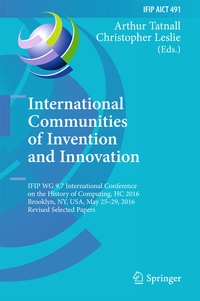
International Communities of Invention and Innovation
IFIP WG 9.7 International Conference on the History of Computing, HC 2016, Brooklyn, NY, USA, May 25-29, 2016, Revised Selected Papers
Published on 30. November 2016
XII, 193 pages
978-3-319-49463-0 (ISBN)
Description

This book contains revised selected papers presented at the IFIP WG 9.7 International Conference on the History of Computing, HC 2016, held in Brooklyn, NY, USA, in May 2016.
The 13 full papers included in this volume were carefully reviewed and selected from numerous submissions. The papers cover a wide range of topics related to the history of computing and focus on the history of pre-existing relationships and communities that led to triumphs (and dead-ends) in the history of computing. This broad perspective helps to tell a more accurate story of important developments like the Internet and provide a better understanding of how to sponsor future invention and innovation. They reflect on histories that foreground the international community along four broad themes: invention, policy, infrastructure, and social history.
The 13 full papers included in this volume were carefully reviewed and selected from numerous submissions. The papers cover a wide range of topics related to the history of computing and focus on the history of pre-existing relationships and communities that led to triumphs (and dead-ends) in the history of computing. This broad perspective helps to tell a more accurate story of important developments like the Internet and provide a better understanding of how to sponsor future invention and innovation. They reflect on histories that foreground the international community along four broad themes: invention, policy, infrastructure, and social history.
More details
Series
Edition
1st ed. 2016
Language
English
Place of publication
Cham
Switzerland
Publishing group
Springer International Publishing
Target group
Professional and scholarly
Product notice
Reflowable
Illustrations
XII, 193 p. 57 illus.
ISBN-13
978-3-319-49463-0 (9783319494630)
DOI
10.1007/978-3-319-49463-0
Schweitzer Classification
Other editions
Additional editions
Arthur Tatnall | Christopher Leslie
International Communities of Invention and Innovation
IFIP WG 9.7 International Conference on the History of Computing, HC 2016, Brooklyn, NY, USA, May 25-29, 2016, Revised Selected Papers
Book
11/2016
Springer
€53.49
Shipment within 10-15 days
Content
- Intro
- Preface
- Organization
- Contents
- The Route Less Taken: The Homegrown Los Alamos Integrated Computer Network
- Abstract
- 1 Introduction
- 2 Early Lab Computing
- 3 C Division and Custom Lab Networking
- 4 Hydra
- 4.1 The Homegrown Tradition
- 5 The Integrated Computer Network
- 5.1 ICN Security in the Late 1970s
- 5.2 The Los Alamos High-Speed Parallel Interface
- 5.3 CFS and the ICN of the 1980s
- 6 The "Lunatic Fringe" and the HIPPI Standard
- 7 The ICN2
- 8 New Custom Solutions
- 9 Conclusion
- Acknowledgements
- References
- MONET - Monash University's Campus LAN in the 1980s - A Bridge to Better Networking
- Abstract
- 1 Introduction
- 2 Early Computer Networks in Australia
- 3 The Development of Computing at Monash University
- 4 MONET
- 5 Theoretical Underpinnings - State of Knowledge and Technology at the Time
- 5.1 The Need ('Business Driver')
- 5.2 The Gap
- 5.3 The Knowledge Base
- 5.4 The Predecessor Project - Terminal Concentrator
- 6 The Components of the MONET Solution
- 6.1 Dual Port Memory (DPM) Architecture
- 6.2 Synchronous Data Link Control (SDLC) Card
- 6.3 Bus Interface Module (BIM) Card
- 6.4 Node Adaptor Backplane (NAB) - Synchronous Backplane Bus
- 6.5 Micro Processor Unit (MPU) Card
- 6.6 Octal Serial Interface (OSI) Card and Adaptors
- 6.7 Logic Implementation - PROM Logic and Finite State Machines
- 7 End-User Interface - MONET Session Control
- 8 Subsequent Embellishments
- 8.1 MONET Unibus Interface
- 9 Circuit Board Fabrication
- 10 From Early Tests to Patent
- 11 Monash University and RACAL-Milgo Australia Pty Ltd
- 12 MONET and Ethernet
- 13 Conclusion
- Acknowledgements
- References
- Technology vs. Political Conflict - How Networks Penetrate the Iron Curtain
- Abstract
- 1 Introduction-Experimental Data Transmission Line in 1977
- 2 The Location - The International Institute for Applied Systems Analysis (IIASA)
- 3 The Origin - Wide Area Computer Networks for Military Purposes
- 4 The Team - High-Ranking Scientists from East and West
- 5 The Idea-Computer Centres Interconnected via Data Transmission Lines
- 6 Summary-International Contacts Across the Iron Curtain Never Stops
- There and Back Again - Andrew Booth, a British Computer Pioneer, and his Interactions with US and Ot ...
- Abstract
- 1 Background
- 2 First Visit to the USA 1946
- 3 Back in the UK 1946
- 4 Second Visit to USA 1947
- 5 The Challenge of Memory
- 6 Building Electronic Computers
- 7 Booth Multiplier
- 8 Natural Language Translation
- 9 Commercial Success
- 10 End of the Story
- 11 Conclusions
- References
- 'Machines à Comparer les Idées' of Semen Korsakov: First Step Towards AI
- Abstract
- 1 Introduction
- 2 Semen Korsakov: Biography
- 3 Semen Korsakov as Researcher
- 4 The Letter to St. Petersburg Academy of Science
- 5 Machines à Comparer les Idées, or Machines Intellectuelles
- 6 Academy Commission Decided.
- 7 The Fate of Korsakov's Heritage
- References
- Towards Machine Independence: From Mechanically Programmed Devices to the Internet of Things
- Abstract
- 1 Introduction
- 2 Machine Independence
- 3 Early Automated Devices - Mechanically Programmed Robots
- 4 Robots, Artificial Intelligence and Science Fiction
- 5 Actor-Network Theory as a Conceptual Lens: People and Things
- 6 Computers and the Trend Towards Machine Independence
- 6.1 Babbage's Difference Engine
- 6.2 Early Computing Machines and the First Digital Computers
- 6.3 Early Digital Computers
- 6.4 More Recent Computers
- 7 Independence Trends in the History of the Internet and the World Wide Web
- 8 The Internet of Things
- 9 The Internet of Things, Machine Independence and Human Issues
- 10 Conclusion
- References
- The Global Virtual Museum of Information Science & Technology, a Project Idea
- Abstract
- 1 Introduction
- 2 Localization vs Internationalization: IST as a Case Study
- 3 IST, Revolutions and Evolutions
- 4 A Knowledge Base for the History of IST
- 5 Enhanced Storytelling: From the Apple-1 to the KIM-1
- 6 Technical Feasibility
- 7 Conclusions: A Possible Mission
- Acknowledgments
- References
- Why not OSI?
- Abstract
- 1 Introduction
- 2 A Quick Timeline of the Internet
- 2.1 Discarded Alternatives
- 2.2 OSI vs TCP/IP vs the Bad Guys
- 3 Research Method
- 3.1 The History of OSI and TCP/IP
- 3.2 The Demise of OSI
- 3.3 Format Wars
- 4 Conclusion
- References
- Flame Wars on Worldnet: Early Constructions of the International User
- Abstract
- 1 Introduction
- 2 A Genealogy of CSNET
- 3 Flaming on Worldnet
- 4 From ARPANet to CSNET
- 5 Conclusion
- Acknowledgement
- References
- The Code of Banking: Software as the Digitalization of German Savings Banks
- Abstract
- 1 Software and the Contemporary History of Computing
- 1.1 A Conceptual History of Software
- 1.2 Banking Software
- 1.3 The Producers of Software
- 2 Information Systems
- 2.1 Applied Information Systems: SODIS and How the Bank Came into the Computer
- 2.2 TELDAS as Consultancy: The Making of Path Dependencies
- 2.3 Informational Socialism: The Information System of the Central Bank of the GDR
- 3 Conclusion
- References
- Electronic "Ambassador": The Diplomatic Missions of IBM's RAMAC 305
- Abstract
- 1 Warm-Up Act
- 2 Act I: Sokolniki Park, Moscow, USSR, July 24, 1959
- 3 Act II: IBM Corporation Plant, San Jose, California, USA, September 21, 1959
- 4 Denouement: Reconnaissance in Public
- The Birth of Artificial Intelligence: First Conference on Artificial Intelligence in Paris in 1951?
- Abstract
- 1 1951 Paris International Computer Conference
- 2 Famous Participants from Europe and USA
- 3 Demonstration of Several Automata
- 4 Papers on Computers and Human Brain
- 5 Turing's Revolution?
- 6 Conclusions
- Acknowledgment
- References
- The World's Smallest Mechanical Parallel Calculator: Discovery of Original Drawings and Patent Docum ...
- Abstract
- 1 Herzstark's Legacy: Discovery of Unknown Machine
- 2 Characteristic Features of the Multiple Calculating Machine
- 3 Double, Fourfold and Fivefold Curta
- 4 Acceleration of the Arithmetic Operations
- 5 The World's Smallest Mechanical Parallel Calculator
- 6 Notes
- Acknowledgment
- Author Index
