

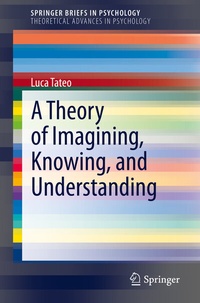
A Theory of Imagining, Knowing, and Understanding
1st Edition
Published on 9. March 2020
XIX, 87 pages
978-3-030-38025-0 (ISBN)
Description

This is a book about imaginative work and its relationship with the construction of knowledge. It is fully acknowledged by epistemologists that imagination is not something opposed to rationality; it is not mere fantasy opposed to intellect. In philosophy and cognitive sciences, imagination is generally "delimiting not much more than the mental ability to interact cognitively with things that are not now present via the senses." (Stuart, 2017, p. 11) For centuries, scholars and poets have wondered where this capability could come from, whether it is inspired by divinity or it is a peculiar feature of human mind (Tateo, 2017b).
The omnipresence of imaginative work in both every day and highly specialized human activities requires a profoundly radical understanding of this phenomenon. We need to work imaginatively in order to achieve knowledge, thus imagination must be something more than a mere flight of fantasy. Considering different stories in the field of scientific endeavor, I will try to propose the idea that the imaginative process is fundamental higher mental function that concurs in our experiencing, knowing and understanding the world we are part of. This book is thus about a theoretical idea of imagining as constant part of the complex whole we call the human psyche . It is a story of human beings striving not only for knowledge and exploration but also striving for imagining possibilities.More details
Series
Language
English
Place of publication
Cham
Switzerland
Publishing group
Springer International Publishing
Target group
Professional and scholarly
Product notice
Reflowable
Illustrations
XIX, 87 p. 19 illus., 10 illus. in color.
File size
2,60 MB
ISBN-13
978-3-030-38025-0 (9783030380250)
DOI
10.1007/978-3-030-38025-0
Schweitzer Classification
Other editions
Additional editions
Book
03/2020
Springer
€53.49
Shipment within 7-9 days
Person
Luca Tateo is Associate Professor at the University of Oslo and Visiting Associate Professor at the Federal University of Bahia, Brazil. He is also Associate Professor in Epistemology and History of Cultural Psychology at Aalborg University, Denmark and Honorary Associate Professor at University of Sydney, Australia. His research interests are the study of imagination as higher psychological function, the cultural psychology of education, and the epistemology and history of psychological sciences in order to reflect upon the future trends of psychological research and related methodological issues. He is editor in chief of the book series "Innovations in qualitative research", IAP and co-editor in chief of the peer-reviewed journal "Human Arenas. An Interdisciplinary Journal of Psychology, Culture, and Meaning", Springer.
Content
Chapter 1. A glance on imaginative processes.- Chapter 2. Imagination in Science.- Chapter 3. A brief history of a unachieved definition.- Chapter 4. Imaginative processes and generalization.- Chapter 5. Thought experiments and utopias.
