

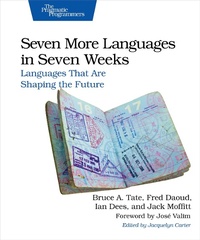
Seven More Languages in Seven Weeks
Description

Great programmers aren''t born--they''re made. The industry is moving from object-oriented languages to functional languages, and you need to commit to radical improvement. New programming languages arm you with the tools and idioms you need to refine your craft. While other language primers take you through basic installation and "Hello, World," we aim higher. Each language in Seven More Languages in Seven Weeks will take you on a step-by-step journey through the most important paradigms of our time. You''ll learn seven exciting languages: Lua, Factor, Elixir, Elm, Julia, MiniKanren, and Idris. Learn from the award-winning programming series that inspired the Elixir language. Hear how other programmers across broadly different communities solve problems important enough to compel language development. Expand your perspective, and learn to solve multicore and distribution problems. In each language, you''ll solve a non-trivial problem, using the techniques that make that language special. Write a fully functional game in Elm, without a single callback, that compiles to JavaScript so you can deploy it in any browser. Write a logic program in Clojure using a programming model, MiniKanren, that is as powerful as Prolog but much better at interacting with the outside world. Build a distributed program in Elixir with Lisp-style macros, rich Ruby-like syntax, and the richness of the Erlang virtual machine. Build your own object layer in Lua, a statistical program in Julia, a proof in code with Idris, and a quiz game in Factor. When you''re done, you''ll have written programs in five different programming paradigms that were written on three different continents. You''ll have explored four languages on the leading edge, invented in the past five years, and three more radically different languages, each with something significant to teach you.
More details
Other editions
Additional editions
Content
- Cover
- Table of Contents
- Foreword
- Acknowledgments
- The Languages
- The Authors
- The Book
- Introduction
- The Lay of the Land
- Bruce Tate (Elixir, Elm)
- Fred Daoud (Factor)
- Ian Dees (Lua, Idris)
- Jack Moffit (Julia, miniKanren)
- Who Should Read This Book
- A Final Charge
- Online Resources
- 1. Lua
- Day 1: The Call to Adventure
- Day 2: Tables All the Way Down
- Day 3: Lua and the World
- Wrapping Up Lua
- 2. Factor
- Day 1: Stack On, Stack Off
- Day 2: Painting the Fence
- Day 3: Balancing on a Boat
- Wrapping Up Factor
- 3. Elm
- Day 1: Handling the Basics
- Day 2: Taming Callbacks
- Day 3: It's All a Game
- Wrapping Up Elm
- 4. Elixir
- Day 1: Laying a Great Foundation
- Day 2: Controlling Mutations
- Day 3: Spawning and Respawning
- Wrapping Up Elixir
- 5. Julia
- Day 1: Resistance Is Futile
- Day 2: Getting Assimilated
- Day 3: Become One with Julia
- Wrapping Up Julia
- 6. miniKanren
- Day 1: Unified Theories of Code
- Day 2: Mixing the Logical and Functional
- Day 3: Writing Stories with Logic
- Wrapping Up miniKanren
- 7. Idris
- Day 1: The Basics
- Day 2: Getting Started With Dependent Types
- Day 3: Dependent Types in Action
- Wrapping Up Idris
- 8. Wrapping Up
- The Origins
- The Central Expressway
- The Frontier
- The Dirty Map
- A Final Challenge
- Bibliography
- Index
- - A -
- - B -
- - C -
- - D -
- - E -
- - F -
- - G -
- - H -
- - I -
- - J -
- - K -
- - L -
- - M -
- - N -
- - O -
- - P -
- - Q -
- - R -
- - S -
- - T -
- - U -
- - V -
- - W -
- - X -
- - Z -
