

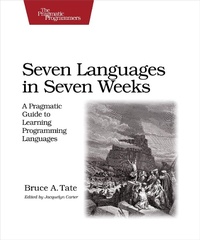
Seven Languages in Seven Weeks
Description

You should learn a programming language every year, as recommended by The Pragmatic Programmer. But if one per year is good, how about Seven Languages in Seven Weeks? In this book you''ll get a hands-on tour of Clojure, Haskell, Io, Prolog, Scala, Erlang, and Ruby. Whether or not your favorite language is on that list, you''ll broaden your perspective of programming by examining these languages side-by-side. You''ll learn something new from each, and best of all, you''ll learn how to learn a language quickly. Ruby, Io, Prolog, Scala, Erlang, Clojure, Haskell. With Seven Languages in Seven Weeks, by Bruce A. Tate, you''ll go beyond the syntax-and beyond the 20-minute tutorial you''ll find someplace online. This book has an audacious goal: to present a meaningful exploration of seven languages within a single book. Rather than serve as a complete reference or installation guide, Seven Languages hits what''s essential and unique about each language. Moreover, this approach will help teach you how to grok new languages. For each language, you''ll solve a nontrivial problem, using techniques that show off the language''s most important features. As the book proceeds, you''ll discover the strengths and weaknesses of the languages, while dissecting the process of learning languages quickly--for example, finding the typing and programming models, decision structures, and how you interact with them. Among this group of seven, you''ll explore the most critical programming models of our time. Learn the dynamic typing that makes Ruby, Python, and Perl so flexible and compelling. Understand the underlying prototype system that''s at the heart of JavaScript. See how pattern matching in Prolog shaped the development of Scala and Erlang. Discover how pure functional programming in Haskell is different from the Lisp family of languages, including Clojure. Explore the concurrency techniques that are quickly becoming the backbone of a new generation of Internet applications. Find out how to use Erlang''s let-it-crash philosophy for building fault-tolerant systems. Understand the actor model that drives concurrency design in Io and Scala. Learn how Clojure uses versioning to solve some of the most difficult concurrency problems. It''s all here, all in one place. Use the concepts from one language to find creative solutions in another-or discover a language that may become one of your favorites.
More details
Other editions
Additional editions
Content
- Cover
- Table of Contents
- Dedication
- Acknowledgments
- Foreword
- 1. Introduction
- Method to the Madness
- The Languages
- Buy This Book
- Don't Buy This Book
- A Final Charge
- 2. Ruby
- Quick History
- Day 1: Finding a Nanny
- Day 2: Floating Down from the Sky
- Day 3: Serious Change
- Wrapping Up Ruby
- 3. Io
- Introducing Io
- Day 1: Skipping School, Hanging Out
- Day 2: The Sausage King
- Day 3: The Parade and Other Strange Places
- Wrapping Up Io
- 4. Prolog
- About Prolog
- Day 1: An Excellent Driver
- Day 2: Fifteen Minutes to Wapner
- Day 3: Blowing Up Vegas
- Wrapping Up Prolog
- 5. Scala
- About Scala
- Day 1: The Castle on the Hill
- Day 2: Clipping Bushes and Other New Tricks
- Day 3: Cutting Through the Fluff
- Wrapping Up Scala
- 6. Erlang
- Introducing Erlang
- Day 1: Appearing Human
- Day 2: Changing Forms
- Day 3: The Red Pill
- Wrapping Up Erlang
- 7. Clojure
- Introducing Clojure
- Day 1: Training Luke
- Day 2: Yoda and the Force
- Day 3: An Eye for Evil
- Wrapping Up Clojure
- 8. Haskell
- Introducing Haskell
- Day 1: Logical
- Day 2: Spock's Great Strength
- Day 3: The Mind Meld
- Wrapping Up Haskell
- 9. Wrap-Up
- Programming Models
- Concurrency
- Programming Constructs
- Finding Your Voice
- A1. Bibliography
- Index
