

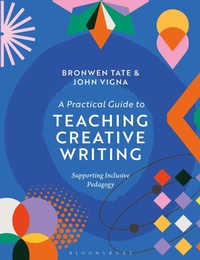
A Practical Guide to Teaching Creative Writing
Supporting Inclusive Pedagogy
1st Edition
Published on 22. January 2026
256 pages
978-1-350-42774-7 (ISBN)
Description

Grounded in progressive pedagogy, this essential resource leads creative writing instructors through each step of designing, teaching, and trouble-shooting a course. A Practical Guide to Teaching Creative Writing offers applied strategies and innovative insights equally valuable for novice and seasoned instructors. Tate and Vigna share tried and tested approaches to online, in-person, and hybrid classes from 6 to 300+ students, attentive to the specific opportunities and challenges of genres from fiction to comics, poetry to TV, creative nonfiction to lyric writing. This lively and accessible book includes timely and inclusive recommendations, enlightening interviews with a diverse lineup of writers and teachers, hands-on examples, and actionable interventions to help instructors create rich and meaningful courses that challenge and support students.
A Practical Guide to Teaching Creative Writing provides:
- Interviews with guest authors and instructors who share classroom strategies, pedagogical provocations, and proven practices-including Felicia Rose Chavez on inclusive course design, Liz Lerman on developing Critical Response Process, Nalo Hopkinson on research and speculative fiction, and many more.
- Approaches to active learning in undergraduate and graduate classrooms ranging in size and institutional context.
- Guidance on creating effective and meaningful assignments in writing, reading, research, and revision that scaffold learning and build capacity.
- Best practices for creating community and navigating the ever-evolving needs of students.
- Exploration of thorny topics like workshop conflict, assessment, and GenAI.
- Chapters devoted to supporting thesis and capstone work and navigating classroom challenges.
With a strong ethos of openness, mutual discovery, and exchange of ideas and expertise, A Practical Guide to Teaching Creative Writing invites instructors to experiment with new ways of thinking, creating, writing, and teaching memorable courses.
A Practical Guide to Teaching Creative Writing provides:
- Interviews with guest authors and instructors who share classroom strategies, pedagogical provocations, and proven practices-including Felicia Rose Chavez on inclusive course design, Liz Lerman on developing Critical Response Process, Nalo Hopkinson on research and speculative fiction, and many more.
- Approaches to active learning in undergraduate and graduate classrooms ranging in size and institutional context.
- Guidance on creating effective and meaningful assignments in writing, reading, research, and revision that scaffold learning and build capacity.
- Best practices for creating community and navigating the ever-evolving needs of students.
- Exploration of thorny topics like workshop conflict, assessment, and GenAI.
- Chapters devoted to supporting thesis and capstone work and navigating classroom challenges.
With a strong ethos of openness, mutual discovery, and exchange of ideas and expertise, A Practical Guide to Teaching Creative Writing invites instructors to experiment with new ways of thinking, creating, writing, and teaching memorable courses.
More details
Edition
1. Auflage
Language
English
Place of publication
London
United Kingdom
Publishing group
Bloomsbury Publishing PLC
Target group
College/higher education
Professional and scholarly
Illustrations
41 bw illus
ISBN-13
978-1-350-42774-7 (9781350427747)
Copyright in bibliographic data and cover images is held by Nielsen Book Services Limited or by the publishers or by their respective licensors: all rights reserved.
Schweitzer Classification
Other editions
Additional editions
Bronwen Tate | John Vigna
A Practical Guide to Teaching Creative Writing
Supporting Inclusive Pedagogy
Book
approx. 02/2026
Bloomsbury Academic
€25.00
Not yet published
Persons
Bronwen Tate is Assistant Professor of Teaching and Undergraduate Chair in School of Creative Writing at the University of British Columbia, Canada, where she teaches poetry, creative nonfiction, and creative writing pedagogy. She is the author of the poetry collection The Silk the Moths Ignore, and her essays have appeared in venues including Contemporary Literature and Journal of Modern Literature. Bronwen has taught courses in literature, composition, interdisciplinary critical thinking, and creative writing across genres at institutions ranging from community colleges and a scrappy liberal arts college to large private and public R1 universities.
John Vigna is Associate Professor of Teaching and Teaching & Learning Chair in the School of Creative Writing at the University of British Columbia Creative Writing program, Canada, where he teaches fiction. His focus is on pedagogical and curricular strategies for 5000 Creative Writing students across the MFA, BFA Major, and Undergrad Minor programs, including online edX innovations. His first book of fiction, Bull Head, was received with critical acclaim in Canada and the US in 2012 and was also published in France in 2017. It was selected by Quill & Quire as an editor's pick of the year and was a finalist for the Danuta Gleed Literary Award. John was named one of 10 writers to watch by CBC Books. His novel, No Man's Land, was published in Fall 2021.
John Vigna is Associate Professor of Teaching and Teaching & Learning Chair in the School of Creative Writing at the University of British Columbia Creative Writing program, Canada, where he teaches fiction. His focus is on pedagogical and curricular strategies for 5000 Creative Writing students across the MFA, BFA Major, and Undergrad Minor programs, including online edX innovations. His first book of fiction, Bull Head, was received with critical acclaim in Canada and the US in 2012 and was also published in France in 2017. It was selected by Quill & Quire as an editor's pick of the year and was a finalist for the Danuta Gleed Literary Award. John was named one of 10 writers to watch by CBC Books. His novel, No Man's Land, was published in Fall 2021.
Content
Interviews
Sample Assignments
Acknowledgments
Chapter 1: The Narrative of Your Course
Chapter 2: Assignment Design
Chapter 3: Structured Experiments and Generative Writing
Chapter 4: In-class Activities and Active Learning
Chapter 5: Craft, Culture, Context
Chapter 6: Working with Models and Mentor Texts
Chapter 7: Workshop Approaches and Alternatives
Chapter 8: Revision and Iterative Practice
Chapter 9: Inquiry and Research
Chapter 10: Assessment and Grading
Chapter 11: Supporting Thesis and Capstone Work
Chapter 12: Navigating Classroom Challenges
Works Cited
Index
Sample Assignments
Acknowledgments
Chapter 1: The Narrative of Your Course
Chapter 2: Assignment Design
Chapter 3: Structured Experiments and Generative Writing
Chapter 4: In-class Activities and Active Learning
Chapter 5: Craft, Culture, Context
Chapter 6: Working with Models and Mentor Texts
Chapter 7: Workshop Approaches and Alternatives
Chapter 8: Revision and Iterative Practice
Chapter 9: Inquiry and Research
Chapter 10: Assessment and Grading
Chapter 11: Supporting Thesis and Capstone Work
Chapter 12: Navigating Classroom Challenges
Works Cited
Index
