

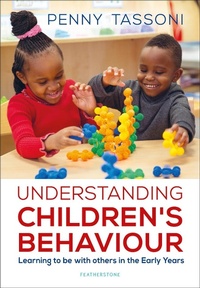
Understanding Children's Behaviour
Learning to be with Others in the Early Years
1st Edition
Published on 20. September 2018
144 pages
978-1-4729-5268-4 (ISBN)
Description

A thorough exploration of children's behaviour from a child-centred point of view, showing how children learn to be with others, and strategies practitioners can use to support this development.
Many Early Years settings are taking in children for longer periods and at a younger age. However, their day-to-day practice has not necessarily changed and instead leads to the 'management' of behaviour, rather than investigating why the behaviour is taking place.
Through a combination of practice, theory and reflection, leading Early Years education consultant Penny Tassoni explores children's behaviour from a child-centred point of view. In doing so, she shows how, over time, children learn to be with others and the strategies that adults can use to positively support this development.
Understanding Children's Behaviour is a practical handbook that is accessible and adaptable for Early Years practitioners looking to support children's behaviour by focusing on their personal and social skills. It includes a useful A-Z problem-solving section about dealing with unwanted behaviours for analysis and to guide practice.
Many Early Years settings are taking in children for longer periods and at a younger age. However, their day-to-day practice has not necessarily changed and instead leads to the 'management' of behaviour, rather than investigating why the behaviour is taking place.
Through a combination of practice, theory and reflection, leading Early Years education consultant Penny Tassoni explores children's behaviour from a child-centred point of view. In doing so, she shows how, over time, children learn to be with others and the strategies that adults can use to positively support this development.
Understanding Children's Behaviour is a practical handbook that is accessible and adaptable for Early Years practitioners looking to support children's behaviour by focusing on their personal and social skills. It includes a useful A-Z problem-solving section about dealing with unwanted behaviours for analysis and to guide practice.
More details
Series
Edition
1. Auflage
Language
English
Place of publication
London
United Kingdom
Publishing group
Bloomsbury Publishing PLC
Target group
Professional and scholarly
ISBN-13
978-1-4729-5268-4 (9781472952684)
Copyright in bibliographic data and cover images is held by Nielsen Book Services Limited or by the publishers or by their respective licensors: all rights reserved.
Schweitzer Classification
Other editions
Additional editions
Book
09/2018
Featherstone
€44.75
Shipment within 10-20 days
Person
Penny Tassoni MBE is an education consultant, author and trainer who specialises in the whole spectrum of learning and play. Penny began her career as an early years teacher, before training nursery nurses. She has also worked for a large daycare chain as their education and training manager.
Penny has written forty books many of which are core textbooks in the UK for training nursery nurses and early years teachers. In February 2013, she was asked to take on the role of President of the Professional Association of Early Years and Childcare - an organisation with over 35,000 members in the UK. Penny is a well known speaker and trainer. She regularly visits and supports nurseries and pre-schools which allows her to maintain regular contact with babies and young children. She also works regularly in Turkey but has supported nurseries in China, Dubai and Hong Kong.
Penny has written forty books many of which are core textbooks in the UK for training nursery nurses and early years teachers. In February 2013, she was asked to take on the role of President of the Professional Association of Early Years and Childcare - an organisation with over 35,000 members in the UK. Penny is a well known speaker and trainer. She regularly visits and supports nurseries and pre-schools which allows her to maintain regular contact with babies and young children. She also works regularly in Turkey but has supported nurseries in China, Dubai and Hong Kong.
Content
- Cover
- Title
- Copyright
- Dedication
- Contents
- Introduction: Learning to be With Others
- Chapter 1. Developing a Shared Understanding
- The difference between customs and pro-social behaviours
- The dangers of a highly authoritarian regime
- What does it mean to be child centred?
- Developing a behaviour policy
- Chapter 2. Understanding Children's Behaviour and Responses
- Operant conditioning
- Social learning theories
- Developing responses towards others through social learning
- Brain maturation and development
- Attachment theory
- Self-identity and self-esteem
- Temperament
- Chapter 3. Factors Affecting Children's Behaviour and Responses
- Basic needs
- Stress
- Stimulation
- Developmental or medical factors
- Chapter 4. Top Tips to Create a Positive Environment
- 1. Fair expectations, consistency and clear messages
- 2. Accentuate the positive
- 3. Be organised!
- Advantages and disadvantages of some commonly used strategies
- Chapter 5. Practical Ways to Support Children's Behaviour
- Being a behaviour detective
- Chapter 6. An A-Z of Behaviours
- Afraid of getting dirty/sensory activities
- Aggression
- Anxious or lacking in confidence
- Attention seeking
- Biting
- Concentration
- Following instructions
- Interrupting
- Lining up
- Listening
- Losers (and winners)
- Lying
- Mealtimes (Food refusers, Fussy eaters, Slow eaters, Table manners)
- Running indoors
- Sharing (not)
- Shyness
- Squealing or screaming
- Sulkiness or stroppiness
- Swearing
- Tantrums
- Tidying up
- Toileting
- Turn taking
- Responding to children who are showing several behaviours
