

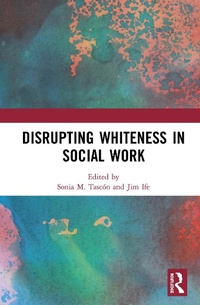
Disrupting Whiteness in Social Work
1st Edition
Published on 27. November 2019
212 pages
978-1-000-76647-9 (ISBN)
Description

Focussing on the epistemic - the way in which knowledge is understood,
constructed,
transmitted and used - this book shows the way social work
knowledge has been constructed from within a white western paradigm, and
the need for a critique of whiteness within social work at this epistemic level.
Social work, emerging from the western Enlightenment world, has privileged
white western knowledge in ways that have been, until recently, largely unexamined
within its professional discourse. This imposition of white western
ways of knowing has led to a corresponding marginalisation of other forms
of knowledge. Drawing on views from social workers from Asia, the Pacific
region, Africa, Australia and Latin America, this book also includes a glossary
of over 40 commonly used social work terms, which are listed with their epistemological
assumptions identified. Opening up a debate about the received
wisdom of much social work language as well as challenging the epistemological
assumptions behind conventional social work practice, this book will be
of interest to all scholars and students of social work as well as practitioners
seeking
to develop genuinely decolonised forms of practice.
constructed,
transmitted and used - this book shows the way social work
knowledge has been constructed from within a white western paradigm, and
the need for a critique of whiteness within social work at this epistemic level.
Social work, emerging from the western Enlightenment world, has privileged
white western knowledge in ways that have been, until recently, largely unexamined
within its professional discourse. This imposition of white western
ways of knowing has led to a corresponding marginalisation of other forms
of knowledge. Drawing on views from social workers from Asia, the Pacific
region, Africa, Australia and Latin America, this book also includes a glossary
of over 40 commonly used social work terms, which are listed with their epistemological
assumptions identified. Opening up a debate about the received
wisdom of much social work language as well as challenging the epistemological
assumptions behind conventional social work practice, this book will be
of interest to all scholars and students of social work as well as practitioners
seeking
to develop genuinely decolonised forms of practice.
More details
Edition
1. Auflage
Language
English
Place of publication
London
United Kingdom
Publishing group
Taylor & Francis Ltd
Target group
College/higher education
Product notice
Reflowable
ISBN-13
978-1-000-76647-9 (9781000766479)
Copyright in bibliographic data and cover images is held by Nielsen Book Services Limited or by the publishers or by their respective licensors: all rights reserved.
Schweitzer Classification
Other editions
Additional editions
Sonia M. Tascon | Jim Ife
Disrupting Whiteness in Social Work
Book
06/2021
1st Edition
Routledge
€63.10
Shipment within 10-20 days
Sonia M. Tascon | Jim Ife
Disrupting Whiteness in Social Work
Book
12/2019
1st Edition
Routledge
€206.20
Shipment within 15-20 days
Persons
Sonia Tascon is a Lecturer in Social Work at Western Sydney University. A descendant of the Chilean Indigenous Mapuche Nation, a fact she discovered later in life, she is now committed to understanding and incorporating her indigeneity into her self-identification. Her lengthy academic career has almost completely focused on issues of race, whiteness, diaspora, and refugee and migrant rights. As a social work/ human rights practitioner her practice incorporated Indigenous health, youth and child mental health, as well as child protection, always with a concern for race as a dimension of inequality. In her later academic life, she took a turn towards the creative visual arts, always maintaining a race analysis and focus on communities as sources of sustenance. Her current interest lies on disrupting white epistemologies in social work and beyond, as a foundational means of achieving decolonisation.
Jim Ife is Professor of Social Work at Western Sydney University. He has previously been Professor of Social Work and Social Policy at The University of Western Australia and at Curtin University, and was Head of the Centre for Human Rights Education at Curtin, where is he Emeritus Professor. He has written extensively in the areas of community development, social work and human rights, and is the author of Community Development (Cambridge University Press, latest edition 2016), Human Rights and Social Work (Cambridge University Press, 3rd edition 2013), Human Rights from Below (Cambridge University Press, 2010) and Rethinking Social Work (Pearson, 1997). He is also co-editor of Radicals in Australian Social Work: Stories of Life-Long Activism (Conor Court, 2017).
Jim Ife is Professor of Social Work at Western Sydney University. He has previously been Professor of Social Work and Social Policy at The University of Western Australia and at Curtin University, and was Head of the Centre for Human Rights Education at Curtin, where is he Emeritus Professor. He has written extensively in the areas of community development, social work and human rights, and is the author of Community Development (Cambridge University Press, latest edition 2016), Human Rights and Social Work (Cambridge University Press, 3rd edition 2013), Human Rights from Below (Cambridge University Press, 2010) and Rethinking Social Work (Pearson, 1997). He is also co-editor of Radicals in Australian Social Work: Stories of Life-Long Activism (Conor Court, 2017).
Content
PART 1
Introduction: Sonia Tascon and Jim Ife
Chapter 1: Critical Whiteness: Communicating Social Work: Sonia Tascon
Chapter 2: Whiteness from Within: Jim Ife
PART 2
Chapter 3: The white saviour complex: The danger of the "single story" about Africa & Africans in Social work Practice: Kathomi Gatwiri
Chapter 4: Straddling the Gap: Australian Social Work and First People: Sue Green
Chapter 5: Decolonising Social work in Uganda by Starting from the Community: Sharlotte Tusasiirwe
Chapter 6: Refractory inventions: The incubation of Rival Epistemologies on the Margins of Brazilian Social Work: Iris Silva Brito, Goetz Ottmann
Chapter 7: Mutuality and creativity: Knowing and Being as a Pasifika social work scholar: Tracie Mafile'o
Chapter 8: Supporting the development of Pacific Social Work across Oceania - critical reflections and lessons learnt towards disrupting whiteness in the region: Jioji Ravulo
Chapter 9: Una aproximacion al trabajo social desde la decolonialidad y la interseccionalidades: Larry Alicea Rodriguez
Chapter 10: Islamic and Local Knowledge on Social Work in Malaysia: Zulkarnain A. Hatta, Isahaque Ali, Mohd Haizzan Yahaya, Mat Saad
PART 3
Decolonising the Language of Social Work
Introduction: Sonia Tascon and Jim Ife
Chapter 1: Critical Whiteness: Communicating Social Work: Sonia Tascon
Chapter 2: Whiteness from Within: Jim Ife
PART 2
Chapter 3: The white saviour complex: The danger of the "single story" about Africa & Africans in Social work Practice: Kathomi Gatwiri
Chapter 4: Straddling the Gap: Australian Social Work and First People: Sue Green
Chapter 5: Decolonising Social work in Uganda by Starting from the Community: Sharlotte Tusasiirwe
Chapter 6: Refractory inventions: The incubation of Rival Epistemologies on the Margins of Brazilian Social Work: Iris Silva Brito, Goetz Ottmann
Chapter 7: Mutuality and creativity: Knowing and Being as a Pasifika social work scholar: Tracie Mafile'o
Chapter 8: Supporting the development of Pacific Social Work across Oceania - critical reflections and lessons learnt towards disrupting whiteness in the region: Jioji Ravulo
Chapter 9: Una aproximacion al trabajo social desde la decolonialidad y la interseccionalidades: Larry Alicea Rodriguez
Chapter 10: Islamic and Local Knowledge on Social Work in Malaysia: Zulkarnain A. Hatta, Isahaque Ali, Mohd Haizzan Yahaya, Mat Saad
PART 3
Decolonising the Language of Social Work
