

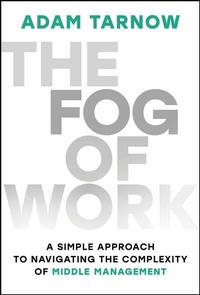
The Fog of Work
Description

A comprehensive playbook for mid-level leaders and managers who want to excel and achieve - without burning out
In The Fog of Work: A Simple Approach to Navigating the Complexity of Middle Management, author, podcast host, and management consultant, Adam Tarnow, delivers a transformative guide for mid-level leaders doing their best to traverse the modern workplace. The heart of this book is one life-changing question that empowers managers to gain traction in environments that often seem designed to confuse and disorient even the most experienced leaders.
This book is not filled with unsustainable tips and tricks. There are no calls to level up, step up, own up, or suck it up. Today's mid-level leaders don't need a pep talk; they need a plan that works. They need practical ideas that can be implemented into their professional lives immediately, regardless of their industry. The Fog of Work provides that plan.
Inside the book:
- A comprehensive new way to think about work that will have you acting - and feeling - like a consummate and capable professional
- Proven tactics for discovering sustained motivation
- An effective toolkit for mid-level leaders interested in achieving consistent, daily progress without risking burnout or feeling overwhelmed
Perfect for managers negotiating the complexities of mid-level organizational leadership, The Fog of Work is your personal guide to making consistently sound decisions, generating professional momentum, and accurately measuring success.
More details
Other editions
Additional editions
Person
ADAM TARNOW is a partner at PeopleWorks International, a management consulting firm, co-author of The Edge: How to Stand Out By Showing You're All In (with David Morrison), and co-host of the How To Lead podcast with his friend and bestselling author Clay Scroggins.
Content
Prologue: Welcome to the Valley! vii
Introduction: Not All Middles Are Miserable xxi
Part I Why Is Middle Management So Difficult? 1
1 This Is All Dilbert's Fault 3
2 Wait, Where's My Porsche? 21
3 I Never Liked Hiking Anyway 35
Part II How Do You Find a Way When the Path Isn't Clear? 55
4 Two Paths Diverged in a Valley 59
5 Now I See a Third Path (and It's Made All the Difference) 73
6 In the Valley, Scorecards Are Better Than Scoreboards 87
Part III What Happens When You Don't Want to Do What Needs to Be Done? 105
7 You Don't Need More Serenity 109
8 How to B.Y.O.P.R. (Bring Your Own Pep Rally) 125
9 Resistance Training 145
Epilogue: Welcome to Leadership! 159
Appendix A: Recommended Resources 165
Appendix B: Twelve Guiding Principles from Three Great Middle Managers 169
Notes 181
Acknowledgments 189
About the Author 193
Index 195
Chapter 1
This Is All Dilbert's Fault
"Love the idea. However, how about not using the term 'middle manager?' It's kind of cringey." While writing this book, that was the most common type of feedback I received. So many people had thoughts about the term "middle manager." Why does this term often generate a fingernails-on-chalkboard kind of response? You might have experienced something happening inside you as you read the prologue and introduction. Maybe a mixture of distain and anxiety that caused a sudden bout of eye-rolling, or even an impetuous urge to throw this book across the room. If so, I totally understand. And I'm grateful that you either resisted the urge to throw the book or you walked over and picked it up again. Good on you.
As a teacher and author, I'm intrigued by responses like this. Why is calling someone a middle manager borderline offensive? Why does no one proudly display "Middle Manager" in their LinkedIn profile?
In this chapter, I'll explore those questions and show you why this negative view of middle management is a relatively recent development. You've heard it said that middle management is a season that breaks you, but I'm here to tell you that it's a season that makes you. You can't become the professional, the leader, and - yes, I'll say it - the person you're meant to be without going through this season. I know it's hard. But within the hardship is a hidden opportunity. And by opportunity, I don't mean a chance "embrace the suck" or develop a "what doesn't kill you makes you stronger" mentality. The opportunity middle management gives you isn't a veiled form of some crazy workout routine or a strict diet. No, it's the opportunity to upgrade your approach to work in a way that pays real dividends.
Like Your Parents, Middle Management Used to Be Cool
Do you remember the first time you saw a photo of your parents on their wedding day? My parents kept a framed photo from their wedding day on their dresser. Every time I looked at it, I was shocked. They looked so young. So happy. So . normal. Maybe all the stories they've been telling me about how popular they were in high school were true? Maybe they did, in fact, used to be cool? It's a strange thing to realize that the people you've only known as "mom" and "dad" were once the life of the party, full of big dreams and late nights. They weren't always the responsible grown-ups reminding you to turn off the lights and flush the toilet.
Middle management is similar. It too used to be young, hip, cool, and . normal. Middle management's roots can be traced back to the late 1850s in what F.W. Taylor called "The Functional Supervisor."1 According to Taylor, the middle manager's role was primarily about control and execution. A manager's job was simply to make sure the right process was followed, and everything was done on time. As organizational life evolved, so did the idea of middle management. The role quickly moved from efficiency enforcer to team overseer. Managers were responsible for problem-solving, relationship building, influencing, and communicating. Said another way, what started as a primarily technical role turned into a supervisory role. They were not responsible for doing the work, but rather responsible for making sure the team was doing the work.
I witnessed a classic middle manager while I was in college. After my sophomore year, I took a seven-month internship at Walt Disney World as part of their college program. I was an accounting clerk on a team called revenue control, which at the time was part of the accounting department. Our team was responsible for entering noncash transactions into the accounting system. As a college student, I found that everything about this job felt important. I had to show up on time. I worked with adults. I learned how to use a ten-key calculator. I wore a tie every day. I was a briefcase and mortgage away from officially turning into my dad. The job was certainly not as exciting as working in the parks, but the job was indoors. If you've ever been to Orlando in the summer, you know that's a good thing.
The entire seven months while working in revenue control, I never one time saw the department manager doing the actual work. I saw him facilitate our daily departmental meetings, I saw him walk around the cubicle farm checking in on everyone, and I saw him go upstairs for important meetings with his boss. But I never saw him enter noncash transactions into the general ledger. That is not a critique; it's just an observation. For decades, that's what middle managers did. They supervised those doing the work. This manager wasn't lazy; he was crushing his job.
For most of the twentieth century, middle manager as supervisor was the dominant model. This wasn't just a stepping stone or a box on the org chart; it was a respected, necessary role that held organizations together. In some ways, it was a reward for doing the actual work really well. You were such an expert that you no longer had to do the work; you just had to make sure the work was getting done.
All of this began to change in the 1990s. As technology advanced, communication became more direct, profit margins were being squeezed, and the perceived need for a human bridge between executives and frontline employees who only supervised started to fade. What was once a vital supervisory role was viewed as redundant, bureaucratic, or - at worst - an obstacle to innovation. During the wide-scale "downsizing" of the 1980s and 1990s, the first victims were often middle managers.
Ironically, even though consultants came after middle management with a vengeance, middle management didn't shrink. It grew. In 2022, middle managers made up 13% of the workforce in the United States, up from 9.2% in 1983.2 The "downsizing era" didn't eliminate the role; it redefined it. It didn't die; it multiplied. Middle management turned out to be a lot like dandelions. The more you try to get rid of them, the more they show up.
Today there are more middle managers than ever, and their role is no longer just an enforcer of efficiency or a supervisor who watches over the team. Now, they have to do it all. This is the era of what I like to call the "player-coach." The burden placed on today's middle manager has greatly expanded from the 1850s. And with that expanded burden has come almost unbearable expectations. They're expected to play the game and coach the team. To be an individual contributor and a team leader. To manage their own to-do list and the to-do list of everyone else. The function wasn't downsized away. They were asked to do more. The result? A role that is more demanding than ever. All of those "ands" make it incredibly difficult. And while the responsibilities have multiplied, the credibility has unfortunately been divided.
I Want to Climb My Way Up to Middle Management
How did a position that was so respected for so long become a place no one wants to land? How did a position that came with status, influence, and pride suddenly become viewed as a dead end? What happened? From my perspective, the answer, in one word, is "Dilbert."
On April 16, 1989, middle management began its fall from grace, slipping quietly from dignity into parody. On that date Scott Adams published the first Dilbert cartoon, and the slow assault on middle management began. That's the day middle management lost its dignity. That's the day middle managers went from hero to zero. Ever since that fateful day, popular culture has persistently poked fun at middle management. Let me share a few more examples:
- January 1999: "When I Grow Up" (Monster.com TV Commercial)
- Seen by millions during the Super Bowl, young kids say things like "I want to climb my way up to middle management." This was certainly meant as satire, but the message hit hard. Middle management became the symbolic embodiment of selling out.
- February 1999: Office Space (film)
- A cult classic. Lumbergh becomes the epitome of the lifeless, passive-aggressive boss. TPS reports, endless meetings, and meaningless work all symbolize the drudgery of office life, and middle managers are the villains.
- July 2001: The Office (UK TV series)
- David Brent becomes the face of cringeworthy leadership: delusional, self-absorbed, lacking self-awareness. A middle manager who wants to be loved, but is utterly ineffective.
- March 2005: The Office (US TV series)
- Michael Scott enters the public consciousness. Well-meaning, deeply awkward, often inappropriate. A middle manager you laugh at, not with. While occasionally redemptive, the series reinforces the idea that middle managers are out of touch and unnecessary.
- July 2011: Horrible Bosses (film)
- The title says it all, right? Three friends plot to kill their middle manager bosses because each one is a different flavor of terrible: manipulative, cruel, or incompetent.
- 2012-2020: Silicon Valley (TV series)
- Mocks corporate bureaucracy and...
