

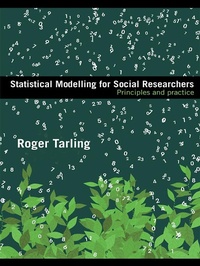
Statistical Modelling for Social Researchers
Principles and Practice
Published on 16. September 2008
224 pages
978-1-134-06108-2 (ISBN)
Description

This book explains the principles and theory of statistical modelling in an intelligible way for the non-mathematical social scientist looking to apply statistical modelling techniques in research. The book also serves as an introduction for those wishing to develop more detailed knowledge and skills in statistical modelling. Rather than present a limited number of statistical models in great depth, the aim is to provide a comprehensive overview of the statistical models currently adopted in social research, in order that the researcher can make appropriate choices and select the most suitable model for the research question to be addressed. To facilitate application, the book also offers practical guidance and instruction in fitting models using SPSS and Stata, the most popular statistical computer software which is available to most social researchers. Instruction in using MLwiN is also given.
Models covered in the book include; multiple regression, binary, multinomial and ordered logistic regression, log-linear models, multilevel models, latent variable models (factor analysis), path analysis and simultaneous equation models and models for longitudinal data and event histories. An accompanying website hosts the datasets and further exercises in order that the reader may practice developing statistical models.
An ideal tool for postgraduate social science students, research students and practicing social researchers in universities, market research, government social research and the voluntary sector.
Models covered in the book include; multiple regression, binary, multinomial and ordered logistic regression, log-linear models, multilevel models, latent variable models (factor analysis), path analysis and simultaneous equation models and models for longitudinal data and event histories. An accompanying website hosts the datasets and further exercises in order that the reader may practice developing statistical models.
An ideal tool for postgraduate social science students, research students and practicing social researchers in universities, market research, government social research and the voluntary sector.
Reviews / Votes
"Tarling has produced a no-nonsense, comprehensive and very accessible book that will be a constant companion for the social researcher who wants to move beyond simple analysis. Building and testing theories is at the heart of social research and models are the way in which these theories are formulated. Conceptually it is not difficult to develop theoretical models but many stumble when they try to test models against quantitative data. This remarkably comprehensive book guides the social researcher through the logic of model building and shows how to apply a wide range of statistical approaches to testing these models. It is always practical but never simplistic; thorough but not longwinded. Each chapter explains how to use a statistical method to evaluate a model but the book goes well beyond simply showing what the steps to take. It progressively builds an understanding of what lies behind the techniques so that the researcher can become an independent and creative thinker as they interact with their data. All social researchers from intermediate to advanced levels will learn a great deal from this outstanding book." - David de Vaus, La Trobe University, Australia"...Tarling provides a masterful overview of several of the key statistical techniques currently used by Sociologists and other social scientists. He provides practical advice on how to build statistical models without employing too much jargon." - Canadian Journal Of Sociology, Vol, 34, No. 1, 2009
"I congratulate the author for having written such a nice introduction to the application of statisticial tools helping to understand the (social) world. I highly recommend this book to everybody who can adopt (my interpretation of) the authors intended cycle..." - Thomas Hochkirchen, Royal Statistical Society Journal Tarling has produced a no-nonsense, comprehensive and very accessible book that will be a constant companion for the social researcher who wants to move beyond simple analysis. Building and testing theories is at the heart of social research and models are the way in which these theories are formulated. Conceptually it is not difficult to develop theoretical models but many stumble when they try to test models against quantitative data. This remarkably comprehensive book guides the social researcher through the logic of model building and shows how to apply a wide range of statistical approaches to testing these models. It is always practical but never simplistic; thorough but not longwinded. Each chapter explains how to use a statistical method to evaluate a model but the book goes well beyond simply showing what the steps to take. It progressively builds an understanding of what lies behind the techniques so that the researcher can become an independent and creative thinker as they interact with their data. All social researchers from intermediate to advanced levels will learn a great deal from this outstanding book.
David de Vaus, La Trobe University, Australia
More details
Series
Language
English
Place of publication
London
United Kingdom
Publishing group
Taylor & Francis Ltd
Target group
College/higher education
Illustrations
85 s/w Abbildungen, 23 s/w Tabellen, 85 s/w Zeichnungen
23 Tables, black and white; 85 Line drawings, black and white; 85 Illustrations, black and white
File size
2,61 MB
ISBN-13
978-1-134-06108-2 (9781134061082)
Copyright in bibliographic data and cover images is held by Nielsen Book Services Limited or by the publishers or by their respective licensors: all rights reserved.
Schweitzer Classification
Other editions
Additional editions
Book
09/2008
1st Edition
Routledge
€282.16
Shipment within 15-20 days
Book
09/2008
1st Edition
Routledge
€96.72
Shipment within 15-20 days
Person
Roger Tarling is Professor of Social Research at the University of Surrey, a post he has occupied since 1996. Before that he was for 23 years a member of the Home Office Research and Planning Unit, the last six as Head of RPU. Throughout his career he has used statistical modelling in research and has had to explain statistical models and the inferences from them to research assistants, policy makers and to the students he has taught. He is a Certified Statistician of the Royal Statistical Society.
Content
1. Statistical Modelling: An Overview 2. Research Designs and Data 3. Statistical Preliminaries 4. Multiple Regression for Continuous Response Variables 5. Logistic Regression for Binary Response Variables 6. Multinomial Logistic Regression for Multinomial Response Variables 7. Loglinear Modelling 8. Ordinal Logistic Regression for Ordered Categorical Response Variables 9. Multilevel Modelling 10. Latent Variables and Factor Analysis 11. Causal Modelling: Simultaneous Equation and Structural Equation Models 12. Longitudinal Data Analysis 13. Event History Models
