

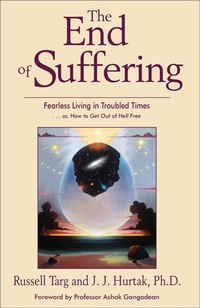
The End of Suffering
Fearless Living in Troubled Time . . . or, How to Get Out of Hell Free
Published on 23. June 2023
226 pages
978-1-61283-114-5 (ISBN)
Description

This spiritual inquiry into the nature of truth draws on Buddhism and quantum physics to liberate us from limited understandings of ourselves and others.
The hopeful teaching of this book is that while everybody suffers, most of this suffering is unnecessary-it can be overcome. The belief that things must be either true or untrue leads us to think in terms of polarities: good or evil, right or wrong. This friend-or-foe approach may seem to make life easier, but in The End of Suffering, Russell Targ and J. J. Hurtak assert that this worldview only increases our experience of suffering.
In an effort to overcome the polarity of opposites and the accompanying suffering, Targ and Hurtak combine the wisdom of the East with the findings of quantum physics, uncovering a middle ground that shows opposing sides are really the same.
Buddha taught us to live a helpful and compassionate life and to surrender our ego to the peace of spaciousness. The middle path of Buddhism also shows that things may be neither true nor not true, or both true and untrue. The End of Suffering puts the perceived opposites of Buddhism and physics together, showing step-by-step how we can learn to surrender the story of who we think we are and experience an end to our suffering.
The hopeful teaching of this book is that while everybody suffers, most of this suffering is unnecessary-it can be overcome. The belief that things must be either true or untrue leads us to think in terms of polarities: good or evil, right or wrong. This friend-or-foe approach may seem to make life easier, but in The End of Suffering, Russell Targ and J. J. Hurtak assert that this worldview only increases our experience of suffering.
In an effort to overcome the polarity of opposites and the accompanying suffering, Targ and Hurtak combine the wisdom of the East with the findings of quantum physics, uncovering a middle ground that shows opposing sides are really the same.
Buddha taught us to live a helpful and compassionate life and to surrender our ego to the peace of spaciousness. The middle path of Buddhism also shows that things may be neither true nor not true, or both true and untrue. The End of Suffering puts the perceived opposites of Buddhism and physics together, showing step-by-step how we can learn to surrender the story of who we think we are and experience an end to our suffering.
More details
Other editions
Additional editions
Book
03/2006
Hampton Roads Publishing Co
€19.00
Shipment within 3-4 weeks
Persons
Russell Targ is currently "retired" and enjoys motorcycling in the Silcon Valley (even though he is legally blind) and studying Dzogchen Buddhism.
Content
- Intro
- The End of Suffering
- Contents
- Cast of Characters and Their Concepts, in Order of Appearance
- Foreword
- Preface
- Acknowledgments
- PART ONE: The End of Suffering
- 1: Why Do We Suffer?
- 2: Our Limited View of Ourselves: Duality and Two-Valued Logic as a Cause of Suffering
- 3: Looking beyond Aristotle: Freedom and Nonduality in Language and Thought
- 4: Nagarjuna's Philosophy: Changing Your Mind and Choosing Peace
- 5: Nagarjuna and the Challenge of the Two Truths
- PART TWO: A Guide Naked Awareness
- 6: Introduction to Nonlocality and Nonduality
- 7: Life in the Nonlocal World: Experiencing Your Limitless Mind
- 8: Healing the World with Your Nonlocal Mind
- 9: The Nature of New Identity: The Universal Self
- 10: Release from Suffering: A Path to Integration
- Glossary
- Bibliography
- Index
- About the Authors
