

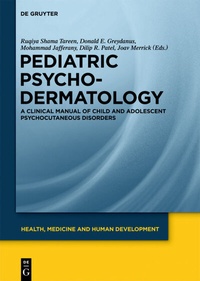
Pediatric Psychodermatology
Description

Psychodermatology is a relatively new field in evolution and thus, there is a comparative paucity of information in general. However, when it comes to children and adolescents there is a complete vacuum of information as no other book has aimed to specifically address the psychodermatological issues facing this particular population. For assessment, diagnosis, comprehensive treatment of children with psychodermatologic conditions and establishing a relationship between skin and psyche, there is a lack of clear and relevant clinical information about these complex disorders. The complexity of these disorders is related to lack of understanding in genetic, embryonic, physiologic, neuroimmunologic, neurocutaneous, stress-related neuromodulation, and psychosomatic interconnections.
This book presents a clinically relevant approach to the management of psychodermatologic issues encountered in normal practice. Various classifications and major categories that are discussed include psychophysiologic disorders, psychiatric conditions with dermatologic manifestations, dermatologic disorders predisposing to psychiatric disorders, systemic diseases with psychodermatological manifestations, and special issues in management of psychocutaneous disorders in children and adolescents.
More details
Other editions
Additional editions
Persons
Content
2 - Foreword II [Seite 27]
3 - Preface [Seite 29]
4 - Author index [Seite 37]
5 - Abbreviations [Seite 41]
6 - Part I: INTERFACE OF DERMATOLOGY AND PSYCHIATRY [Seite 47]
6.1 - 1 Perspectives on management of pediatric dermatologie disorders [Seite 49]
6.1.1 - 1.1 Introduction [Seite 49]
6.1.2 - 1.2 Skin infections and infestations [Seite 49]
6.1.2.1 - 1.2.1 Bacterial infections [Seite 49]
6.1.2.2 - 1.2.2 Viral infections [Seite 61]
6.1.3 - 1.3 HIV/AIDS [Seite 65]
6.1.3.1 - 1.3.1 Non-infectious skin lesions [Seite 65]
6.1.3.2 - 1.3.2 Bacterial infections in HIV [Seite 65]
6.1.3.3 - 1.3.3 Viral infections in HIV [Seite 66]
6.1.3.4 - 1.3.4 Fungal infections in HIV [Seite 66]
6.1.3.5 - 1.3.5 Fungal infections [Seite 67]
6.1.3.6 - 1.3.6 Topical antifungals [Seite 71]
6.1.3.7 - 1.3.7 Infestations [Seite 72]
6.1.4 - 1.4 Dermatitis [Seite 75]
6.1.4.1 - 1.4.1 Irritant dermatitis [Seite 75]
6.1.4.2 - 1.4.2 Dry-skin dermatitis [Seite 75]
6.1.4.3 - 1.4.3 Seborrheic dermatitis [Seite 75]
6.1.4.4 - 1.4.4 Allergic dermatitides [Seite 76]
6.1.4.5 - 1.4.5 Idiopathic dermatitides [Seite 79]
6.1.5 - 1.5 Hypersensitivity [Seite 79]
6.1.5.1 - 1.5.1 Urticaria [Seite 79]
6.1.5.2 - 1.5.2 Drug eruptions [Seite 81]
6.1.6 - 1.6 Miscellaneous skin conditions [Seite 83]
6.1.6.1 - 1.6.1 Acne vulgaris [Seite 83]
6.1.6.2 - 1.6.2 Nevi [Seite 87]
6.1.6.3 - 1.6.3 Papulosquamous disorders [Seite 90]
6.1.6.4 - 1.6.4 Lichens [Seite 92]
6.1.6.5 - 1.6.5 Psoriasis [Seite 95]
6.1.7 - 1.7 Dermatologic manifestations of systematic disorders [Seite 98]
6.1.7.1 - 1.7.1 Pruritus without rash [Seite 98]
6.1.7.2 - 1.7.2 Inflammatory bowel disease (IBD) [Seite 99]
6.1.7.3 - 1.7.3 Erythema nodosum [Seite 99]
6.1.7.4 - 1.7.4 Pyoderma gangrenosum [Seite 99]
6.1.7.5 - 1.7.5 Less common skin manifestations [Seite 99]
6.1.7.6 - 1.7.6 Management [Seite 99]
6.1.8 - 1.8 Collagen vascular disease [Seite 100]
6.1.8.1 - 1.8.1 Lupus erythematosus (SLE) [Seite 100]
6.1.8.2 - 1.8.2 Dermatomyositis [Seite 100]
6.1.8.3 - 1.8.3 Juvenile idiopathic arthritis [Seite 100]
6.1.8.4 - 1.8.4 Management [Seite 100]
6.1.9 - 1.9 Endocrinologic disorders [Seite 101]
6.1.9.1 - 1.9.1 Thyroid disorders [Seite 101]
6.1.9.2 - 1.9.2 Diabetes mellitus [Seite 101]
6.1.9.3 - 1.9.3 Adrenal disorders [Seite 101]
6.1.9.4 - 1.9.4 Management [Seite 102]
6.1.10 - 1.10 Hair and nails [Seite 102]
6.1.10.1 - 1.10.1 Alopecia areata [Seite 102]
6.1.10.2 - 1.10.2 Telogen effluvium [Seite 104]
6.1.10.3 - 1.10.3 Androgenic alopecia [Seite 104]
6.1.10.4 - 1.10.4 Trichotillomania [Seite 105]
6.1.10.5 - 1.10.5 Traction alopecia [Seite 105]
6.1.10.6 - 1.10.6 Hirsutism and hypertrichosis [Seite 105]
6.1.10.7 - 1.10.7 Hair changes with systemic disease [Seite 106]
6.1.10.8 - 1.10.8 Infection [Seite 106]
6.1.10.9 - 1.10.9 Bacterial [Seite 108]
6.1.10.10 - 1.10.10 Fungal [Seite 109]
6.1.10.11 - 1.10.11 Onychodystrophy [Seite 110]
6.1.10.12 - 1.10.12 Nail changes with systemic and nutritional disorders [Seite 111]
6.2 - 2 Psychoneuroimmunology and other interactions between skin and psyche [Seite 115]
6.2.1 - 2.1 Introduction [Seite 115]
6.2.1.1 - 2.1.1 History of psychodermatology [Seite 116]
6.2.1.2 - 2.1.2 Classification of psychodermatologic disorders [Seite 118]
6.2.1.3 - 2.1.3 Psychological perspective of skin [Seite 118]
6.2.1.4 - 2.1.4 Skin, mind, and the embryological embrace [Seite 120]
6.2.2 - 2.2 Psychoneuroimmunology [Seite 121]
6.2.2.1 - 2.2.1 Neuroendocrine response to stress [Seite 121]
6.2.2.2 - 2.2.2 Immune response and central nervous system [Seite 122]
6.2.2.3 - 2.2.3 Immune response and peripheral nervous system [Seite 123]
6.2.2.4 - 2.2.4 Immune response and skin disease [Seite 123]
6.2.2.5 - 2.2.5 Immune response and psychiatric disease [Seite 125]
6.2.3 - 2.3 Conclusion [Seite 126]
6.3 - 3 A clinician's approach to psychocutaneous diseases in adolescents: Untying the Gordian knot [Seite 129]
6.3.1 - 3.1 Introduction [Seite 129]
6.3.1.1 - 3.1.1 History taking skills in adolescent patients [Seite 129]
6.3.2 - 3.2 Interviewing the adolescent patient [Seite 131]
6.3.2.1 - 3.2.1 Confidentiality [Seite 133]
6.3.2.2 - 3.2.2 Parental confidentiality [Seite 133]
6.3.2.3 - 3.2.3 Health questionnaires [Seite 133]
6.3.2.4 - 3.2.4 Interview techniques [Seite 134]
6.3.2.5 - 3.2.5 Active listening skills [Seite 135]
6.3.3 - 3.3 Concepts of the physical examination [Seite 136]
6.3.4 - 3.4 Successful management of the adolescent patient [Seite 136]
6.3.4.1 - 3.4.1 Informed consent [Seite 136]
6.3.4.2 - 3.4.2 Shared decision makings [Seite 137]
6.3.4.3 - 3.4.3 Improving compliance [Seite 138]
6.3.5 - 3.5 Conclusion [Seite 138]
6.4 - 4 Quality of life issues in children and adolescents with dermatological conditions and their wider impact on the family and society [Seite 141]
6.4.1 - 4.1 Introduction [Seite 141]
6.4.2 - 4.2 Pediatric quality of life and its assessment [Seite 142]
6.4.3 - 4.3 Skin disease and quality of life [Seite 143]
6.4.3.1 - 4.3.1 Impact of skin diseases on children's quality of life [Seite 143]
6.4.3.2 - 4.3.2 Quality of life assessment in children with dermatological conditions [Seite 145]
6.4.3.3 - 4.3.3 Children's Dermatology Life Quality Index (CDLQI) [Seite 146]
6.4.3.4 - 4.3.4 Infant's Dermatitis Quality of Life Index (IDQoL) [Seite 146]
6.4.3.5 - 4.3.5 Impact of skin disease on the quality of life of adolescents [Seite 147]
6.4.4 - 4.4 Assessment of adolescents' quality of life in dermatology [Seite 148]
6.4.4.1 - 4.4.1 Teenager's QoL questionnaire (T-QoL) [Seite 148]
6.4.4.2 - 4.4.2 Skindex-Teen [Seite 149]
6.4.4.3 - 4.4.3 Impact of skin disease on family quality of life: The "greater patient" concept [Seite 150]
6.4.5 - 4.5 Assessment of family quality in dermatology [Seite 152]
6.4.5.1 - 4.5.1 Family Dermatology Life Quality Index (FDLQI) [Seite 152]
6.4.5.2 - 4.5.2 Dermatitis Family Impact questionnaire (DFI) [Seite 153]
6.4.5.3 - 4.5.3 Parents' Index of Quality of Life in Atopic Dermatitis (PIQoL-AD) [Seite 154]
6.4.5.4 - 4.5.4 Childhood Atopic Dermatitis Impact Scale (CADIS) [Seite 154]
6.4.5.5 - 4.5.5 Psoriasis Family Index (PFI) [Seite 155]
6.4.6 - 4.6 Societal impact of childhood dermatological conditions [Seite 155]
6.4.7 - 4.7 Conclusions [Seite 156]
7 - Part II: PSYCHOPHYSIOLOGIC DISORDERS [Seite 163]
7.1 - 5 Atopic dermatitis: a psychocutaneous review [Seite 165]
7.1.1 - 5.1 Introduction [Seite 165]
7.1.1.1 - 5.1.1 Epidemiology [Seite 165]
7.1.2 - 5.2 Pathophysiologic factors in atopic dermatitis [Seite 166]
7.1.2.1 - 5.2.1 Genetic predisposition [Seite 166]
7.1.2.2 - 5.2.2 Socio-economic status [Seite 166]
7.1.2.3 - 5.2.3 Family size [Seite 166]
7.1.2.4 - 5.2.4 Food allergens [Seite 166]
7.1.3 - 5.3 Psychoneuroimmunologic factors [Seite 167]
7.1.3.1 - 5.3.1 Breast feeding [Seite 167]
7.1.3.2 - 5.3.2 Environmental allergens [Seite 167]
7.1.4 - 5.4 Psychophysiological aspects of atopic dermatitis [Seite 168]
7.1.4.1 - 5.4.1 Impact of stress on the immunological system [Seite 168]
7.1.4.2 - 5.4.2 Psychoanalytic hypothesis [Seite 169]
7.1.4.3 - 5.4.3 Biopsychosocial model [Seite 170]
7.1.4.4 - 5.4.4 Psychological dysregulation due to atopic dermatitis [Seite 170]
7.1.5 - 5.5 Clinical features [Seite 171]
7.1.6 - 5.6 Diagnosis [Seite 171]
7.1.6.1 - 5.6.1 Allergy Testing [Seite 173]
7.1.6.2 - 5.6.2 Differential Diagnosis [Seite 174]
7.1.7 - 5.7 Management [Seite 174]
7.1.7.1 - 5.7.1 Prevention of relapse [Seite 174]
7.1.7.2 - 5.7.2 Food allergens [Seite 175]
7.1.7.3 - 5.7.3 Aeroallergens [Seite 175]
7.1.7.4 - 5.7.4 Optimizing the epidermal barrier (EB) [Seite 175]
7.1.7.5 - 5.7.5 Hydration therapy [Seite 176]
7.1.7.6 - 5.7.6 Management of pruritus [Seite 176]
7.1.7.7 - 5.7.7 Topical corticosteroids [Seite 177]
7.1.7.8 - 5.7.8 Topical immunomodulators [Seite 180]
7.1.8 - 5.8 Systematic treatment of atopic dermatits [Seite 180]
7.1.8.1 - 5.8.1 Antihistamines [Seite 180]
7.1.8.2 - 5.8.2 Phototherapy [Seite 181]
7.1.8.3 - 5.8.3 Antibiotics [Seite 181]
7.1.8.4 - 5.8.4 Systemic corticosteroids [Seite 182]
7.1.8.5 - 5.8.5 Immunomodulators [Seite 182]
7.1.8.6 - 5.8.6 Cyclosporine [Seite 183]
7.1.8.7 - 5.8.7 Azathioprine [Seite 183]
7.1.8.8 - 5.8.8 Infliximab [Seite 183]
7.1.8.9 - 5.8.9 Interferon-. [Seite 184]
7.1.8.10 - 5.8.10 Leukotriene inhibitors [Seite 184]
7.1.9 - 5.9 Psychiatric comorbidities [Seite 184]
7.1.9.1 - 5.9.1 Family dynamics [Seite 185]
7.1.9.2 - 5.9.2 Internalizing and externalizing behaviors [Seite 185]
7.1.9.3 - 5.9.3 Anxiety and depression [Seite 186]
7.1.9.4 - 5.9.4 Personality traits [Seite 186]
7.1.10 - 5.10 Management of psychiatric comorbidities [Seite 187]
7.1.10.1 - 5.10.1 Multidisciplinary approach [Seite 187]
7.1.10.2 - 5.10.2 Psychoeducation [Seite 187]
7.1.10.3 - 5.10.3 Psychosocial assessment [Seite 187]
7.1.10.4 - 5.10.4 Psychiatric symptoms review [Seite 188]
7.1.10.5 - 5.10.5 Quality of life assessment [Seite 188]
7.1.10.6 - 5.10.6 Psychodynamic therapy [Seite 188]
7.1.10.7 - 5.10.7 Cognitive behavioral therapy [Seite 189]
7.1.10.8 - 5.10.8 Behavioral modifications [Seite 189]
7.1.10.9 - 5.10.9 Psychotropic medications [Seite 189]
7.1.11 - 5.11 Conclusion [Seite 190]
7.2 - 6 Psoriasis and children: A psychological approach [Seite 193]
7.2.1 - 6.1 Introduction [Seite 193]
7.2.1.1 - 6.1.1 Epidemiology [Seite 194]
7.2.2 - 6.2 Dermatological clinical features [Seite 194]
7.2.2.1 - 6.2.1 Plaque psoriasis [Seite 195]
7.2.2.2 - 6.2.2 Guttate psoriasis [Seite 195]
7.2.2.3 - 6.2.3 Erythrodermic psoriasis [Seite 195]
7.2.2.4 - 6.2.4 Pustular psoriasis [Seite 196]
7.2.2.5 - 6.2.5 Psoriatic arthritis [Seite 197]
7.2.2.6 - 6.2.6 Inverse psoriasis [Seite 197]
7.2.3 - 6.3 Psychological clinical features [Seite 198]
7.2.3.1 - 6.3.1 Differential diagnosis [Seite 200]
7.2.3.2 - 6.3.2 Psychotherapeutic intervention [Seite 201]
7.2.3.3 - 6.3.3 Psychotherapy [Seite 202]
7.2.4 - 6.4 Conclusions [Seite 205]
7.3 - 7 The acnes: Acne vulgaris, acne rosacea, and acne excoriée [Seite 209]
7.3.1 - 7.1 Acne Vulgaris [Seite 209]
7.3.1.1 - 7.1.1 Introduction [Seite 209]
7.3.1.2 - 7.1.2 Epidemiology [Seite 209]
7.3.1.3 - 7.1.3 Pathogenesis [Seite 213]
7.3.1.4 - 7.1.4 Classification [Seite 214]
7.3.1.5 - 7.1.5 Management [Seite 214]
7.3.1.6 - 7.1.6 Teratogenicity and isotretinoin [Seite 225]
7.3.1.7 - 7.1.7 Depression, suicidality, and isotretinoin [Seite 226]
7.3.2 - 7.2 Acne Rosacea [Seite 230]
7.3.2.1 - 7.2.1 Pathophysiology [Seite 231]
7.3.2.2 - 7.2.2 Management of acne rosacea [Seite 232]
7.3.3 - 7.3 Acne Variants [Seite 233]
7.3.4 - 7.4 Conclusion [Seite 233]
7.4 - 8 Psychogenic purpura (Gardner-Diamond syndrome) [Seite 239]
7.4.1 - 8.1 Introduction [Seite 239]
7.4.2 - 8.2 History [Seite 239]
7.4.3 - 8.3 Etiology and pathogenesis [Seite 240]
7.4.4 - 8.4 Clinical features [Seite 241]
7.4.5 - 8.5 Differential diagnosis [Seite 241]
7.4.5.1 - 8.5.1 Disease course [Seite 241]
7.4.5.2 - 8.5.2 Histopathology [Seite 241]
7.4.5.3 - 8.5.3 Laboratory testings [Seite 242]
7.4.5.4 - 8.5.4 Psychological disturbances [Seite 242]
7.4.6 - 8.6 Treatment approaches and recommendations [Seite 242]
7.4.7 - 8.7 Conclusion [Seite 243]
8 - Part III: PSYCHIATRIC DISORDERS WITH DERMATOLOGIC MANIFESTATIONS [Seite 245]
8.1 - 9 Body dysmorphic disorder in adolescents [Seite 247]
8.1.1 - 9.1 Introduction [Seite 247]
8.1.2 - 9.2 Definition [Seite 248]
8.1.2.1 - 9.2.1 Epidemiology [Seite 249]
8.1.2.2 - 9.2.2 Clinical features [Seite 249]
8.1.2.3 - 9.2.3 Differential diagnosis [Seite 250]
8.1.3 - 9.3 Management [Seite 251]
8.1.3.1 - 9.3.1 Preliminary considerations [Seite 251]
8.1.3.2 - 9.3.2 The clinical interview [Seite 252]
8.1.3.3 - 9.3.3 Assessment [Seite 252]
8.1.3.4 - 9.3.4 Patient education [Seite 254]
8.1.3.5 - 9.3.5 Treatment [Seite 254]
8.1.4 - 9.4 Other treatment techniques [Seite 256]
8.1.4.1 - 9.4.1 Anxiety management training (AMT) [Seite 256]
8.1.4.2 - 9.4.2 Eye movement desensitization and reprocessing (EMDR) [Seite 257]
8.1.4.3 - 9.4.3 Family therapy [Seite 257]
8.1.4.4 - 9.4.4 Group therapy [Seite 257]
8.1.4.5 - 9.4.5 Metaphors [Seite 257]
8.1.4.6 - 9.4.6 Mindfulness [Seite 258]
8.1.4.7 - 9.4.7 Intervention [Seite 258]
8.1.4.8 - 9.4.8 Nonpsychiatric medical treatment [Seite 258]
8.1.4.9 - 9.4.9 Final management considerations [Seite 259]
8.1.5 - 9.5 Conclusions [Seite 259]
8.2 - 10 Delusional infestation in childhood, adolescence, and adulthood [Seite 263]
8.2.1 - 10.1 Introduction [Seite 263]
8.2.2 - 10.2 How to diagnose a delusion [Seite 264]
8.2.3 - 10.3 Primary and secondary delusional infestation [Seite 265]
8.2.4 - 10.4 The context of children and adolescence [Seite 266]
8.2.5 - 10.5 Clinical pictures [Seite 267]
8.2.5.1 - 10.5.1 Case one [Seite 267]
8.2.5.2 - 10.5.2 Case two [Seite 268]
8.2.5.3 - 10.5.3 Case Three [Seite 269]
8.2.5.4 - 10.5.4 Commentary on these three cases [Seite 270]
8.2.6 - 10.6 Delusional elaboration ("Wahnarbeit") [Seite 270]
8.2.7 - 10.7 Prevalence of delusional infestation [Seite 272]
8.2.7.1 - 10.7.1 Treatment [Seite 273]
8.2.7.2 - 10.7.2 Which antipsychotic in DI? [Seite 274]
8.2.8 - 10.8 Antipsychotics [Seite 276]
8.2.9 - 10.9 Conclusion [Seite 278]
8.3 - 11 Dermatitis artefacta, skin picking, and other self-injurious behaviors: A psychological perspective [Seite 283]
8.3.1 - 11.1 Introduction [Seite 283]
8.3.2 - 11.2 Epidemiology [Seite 285]
8.3.3 - 11.3 Etiology [Seite 287]
8.3.4 - 11.4 Clinical features [Seite 289]
8.3.4.1 - 11.4.1 Dermatitis Artefacta [Seite 291]
8.3.4.2 - 11.4.2 Skin picking [Seite 292]
8.3.4.3 - 11.4.3 Self-mutilation behavior [Seite 292]
8.3.5 - 11.5 Differential diagnosis [Seite 294]
8.3.6 - 11.6 Management [Seite 294]
8.3.6.1 - 11.6.1 Pharmacological Treatment [Seite 297]
8.3.6.2 - 11.6.2 Psychotherapy [Seite 297]
8.3.6.3 - 11.6.3 Issues with Treatment [Seite 301]
8.3.7 - 11.7 Conclusions [Seite 303]
8.4 - 12 Trichotillomania [Seite 307]
8.4.1 - 12.1 Introduction [Seite 307]
8.4.2 - 12.2 Definition [Seite 307]
8.4.3 - 12.3 Differential diagnosis [Seite 308]
8.4.4 - 12.4 Assessment [Seite 310]
8.4.5 - 12.5 Management [Seite 312]
8.4.5.1 - 12.5.1 Psychotherapy [Seite 313]
8.4.5.2 - 12.5.2 Medication [Seite 313]
8.4.6 - 12.6 Conclusions: Future directions [Seite 314]
8.5 - 13 Psychogenic pruritus with particular emphasis on children and adolescents [Seite 317]
8.5.1 - 13.1 Introduction [Seite 317]
8.5.2 - 13.2 Epidemiology [Seite 318]
8.5.3 - 13.3 Clinical features [Seite 319]
8.5.4 - 13.4 Differential diagnosis [Seite 320]
8.5.5 - 13.5 Management [Seite 321]
8.5.6 - 13.6 Conclusion [Seite 323]
9 - Part IV: DERMATOLOGIC DISORDERS PREDISPOSING TO PSYCHIATRIC DISORDERS [Seite 327]
9.1 - 14 Disorders of hair loss [Seite 329]
9.1.1 - 14.1 Introduction [Seite 329]
9.1.2 - 14.2 Causes of hair loss [Seite 329]
9.1.3 - 14.3 Diagnostic approach to hair loss [Seite 331]
9.1.3.1 - 14.3.1 History [Seite 331]
9.1.3.2 - 14.3.2 Examination [Seite 331]
9.1.3.3 - 14.3.3 Laboratory investigation [Seite 332]
9.1.4 - 14.4 Tinea capitis [Seite 332]
9.1.5 - 14.5 Telogen effluvium [Seite 333]
9.1.6 - 14.6 Alopecia areata [Seite 333]
9.1.7 - 14.7 Male pattern hair loss [Seite 334]
9.1.8 - 14.8 Hair Loss due to Chemotherapy [Seite 334]
9.1.9 - 14.9 Psychiatric aspects [Seite 334]
9.1.9.1 - 14.9.1 Psychological treatment approaches [Seite 336]
9.1.10 - 14.10 Conclusion [Seite 337]
9.2 - 15 Disorders of skin pigmentation [Seite 341]
9.2.1 - 15.1 Introduction [Seite 341]
9.2.2 - 15.2 Disorders of hypopigmentation [Seite 342]
9.2.2.1 - 15.2.1 Vitiligo [Seite 342]
9.2.2.2 - 15.2.2 Albinism [Seite 344]
9.2.2.3 - 15.2.3 Postinflammatory hypopigmentation [Seite 344]
9.2.2.4 - 15.2.4 Pityriasis alba [Seite 345]
9.2.2.5 - 15.2.5 Tinea versicolor [Seite 345]
9.2.3 - 15.3 Disorders of hyperpigmentation [Seite 346]
9.2.3.1 - 15.3.1 Postinflammatory hyperpigmentation [Seite 346]
9.2.3.2 - 15.3.2 Melasma [Seite 346]
9.2.3.3 - 15.3.3 Hyperpigmentation associated with medical disorders [Seite 346]
9.2.3.4 - 15.3.4 Café-au-lait spots [Seite 347]
9.2.3.5 - 15.3.5 Lentigines [Seite 347]
9.2.4 - 15.4 Psychological aspects of disorders of pigmentations [Seite 347]
9.2.4.1 - 15.4.1 Psychosocial management of disorders of pigmentation [Seite 349]
9.2.5 - 15.5 Conclusion [Seite 350]
9.3 - 16 Skin adnexal disorders [Seite 353]
9.3.1 - 16.1 Hidradenitis suppurativa (HS) [Seite 353]
9.3.1.1 - 16.1.1 Introduction [Seite 353]
9.3.1.2 - 16.1.2 Diagnosis [Seite 353]
9.3.1.3 - 16.1.3 Etiology [Seite 354]
9.3.1.4 - 16.1.4 Clinical features [Seite 355]
9.3.1.5 - 16.1.5 Differential Diagnosis [Seite 356]
9.3.2 - 16.2 Hyperhidrosis [Seite 357]
9.3.2.1 - 16.2.1 Definition [Seite 357]
9.3.2.2 - 16.2.2 Epidemiology [Seite 358]
9.3.2.3 - 16.2.3 Etiology [Seite 358]
9.3.2.4 - 16.2.4 Clinical features [Seite 359]
9.3.2.5 - 16.2.5 Differential diagnosis [Seite 359]
9.3.2.6 - 16.2.6 Management [Seite 360]
9.3.3 - 16.3 Anhidrotic ectodermal dysplasia [Seite 362]
9.3.3.1 - 16.3.1 Definition [Seite 362]
9.3.3.2 - 16.3.2 Epidemiology [Seite 362]
9.3.3.3 - 16.3.3 Clinical features [Seite 362]
9.3.3.4 - 16.3.4 Differential diagnosis [Seite 362]
9.3.3.5 - 16.3.5 Management [Seite 363]
9.3.4 - 16.4 Nevus sebaceous [Seite 363]
9.3.4.1 - 16.4.1 Definition [Seite 363]
9.3.4.2 - 16.4.2 Epidemiology [Seite 363]
9.3.4.3 - 16.4.3 Clinical features [Seite 363]
9.3.4.4 - 16.4.4 Differential diagnosis [Seite 364]
9.3.4.5 - 16.4.5 Management [Seite 364]
9.3.5 - 16.5 Conclusion [Seite 364]
10 - Part V: SYSTEMATIC DISEASES WITH PSYCHODERMATOLOGIC MANIFESTATIONS [Seite 367]
10.1 - 17 Neurocutaneous disorders [Seite 369]
10.1.1 - 17.1 Introduction [Seite 369]
10.1.2 - 17.2 Neurofibromatosis [Seite 369]
10.1.2.1 - 17.2.1 Clinical features [Seite 371]
10.1.2.2 - 17.2.2 Neuropsychiatric aspects of neurofibromatosis type 1 [Seite 371]
10.1.2.3 - 17.2.3 Management [Seite 372]
10.1.2.4 - 17.2.4 NF1 summary [Seite 374]
10.1.3 - 17.3 Tuberous Sclerosis Complex (TSC) [Seite 374]
10.1.3.1 - 17.3.1 Introduction [Seite 374]
10.1.3.2 - 17.3.2 Clinical features of TSC [Seite 375]
10.1.3.3 - 17.3.3 Neurologic lesions [Seite 375]
10.1.3.4 - 17.3.4 Psychiatric symptoms [Seite 375]
10.1.3.5 - 17.3.5 Management [Seite 376]
10.1.3.6 - 17.3.6 Treatment of neuropsychiatric problems [Seite 376]
10.1.4 - 17.4 Conclusion [Seite 378]
10.2 - 18 Collagen vascular disorders: Psychiatric and dermatologic manifestations [Seite 381]
10.2.1 - 18.1 Lupus erythematosus (LE) [Seite 381]
10.2.1.1 - 18.1.1 Epidemiology [Seite 381]
10.2.1.2 - 18.1.2 Clinical features [Seite 381]
10.2.1.3 - 18.1.3 Cutaneous manifestations [Seite 382]
10.2.1.4 - 18.1.4 Neuropsychiatric systemic lupus erythematosus (NPSLE) [Seite 383]
10.2.1.5 - 18.1.5 Differential diagnosis [Seite 386]
10.2.1.6 - 18.1.6 Clinical diagnosis [Seite 386]
10.2.1.7 - 18.1.7 Diagnostic workup [Seite 388]
10.2.1.8 - 18.1.8 Management [Seite 388]
10.2.1.9 - 18.1.9 Treatment of cutaneous lupus lesions [Seite 389]
10.2.1.10 - 18.1.10 Treatment of NPSLE [Seite 389]
10.2.2 - 18.2 Dermatomyositis [Seite 390]
10.2.2.1 - 18.2.1 Epidemiology [Seite 390]
10.2.2.2 - 18.2.2 Clinical features [Seite 391]
10.2.2.3 - 18.2.3 Cutaneous manifestations [Seite 391]
10.2.2.4 - 18.2.4 Psychiatric manifestations [Seite 392]
10.2.2.5 - 18.2.5 Management [Seite 393]
10.2.3 - 18.3 Rheumatoid Arthritis [Seite 394]
10.2.3.1 - 18.3.1 Epidemiology [Seite 394]
10.2.3.2 - 18.3.2 Etiopathogenesis [Seite 395]
10.2.3.3 - 18.3.3 Clinical features [Seite 395]
10.2.3.4 - 18.3.4 Cutaneous manifestations [Seite 395]
10.2.3.5 - 18.3.5 Psychiatric manifestations [Seite 397]
10.2.3.6 - 18.3.6 Laboratory findings [Seite 399]
10.2.3.7 - 18.3.7 Management [Seite 400]
10.2.3.8 - 18.3.8 Management of psychiatric issues [Seite 402]
10.3 - 19 Psychocutaneous manifestations of endocrine disorders [Seite 407]
10.3.1 - 19.1 Introduction [Seite 407]
10.3.2 - 19.2 Diabetes Mellitus [Seite 407]
10.3.2.1 - 19.2.1 Clinical features [Seite 408]
10.3.2.2 - 19.2.2 Dermatological manifestations [Seite 409]
10.3.2.3 - 19.2.3 Psychiatric manifestations [Seite 411]
10.3.2.4 - 19.2.4 Management of psychiatric conditions [Seite 412]
10.3.3 - 19.3 Disorders of growth hormone [Seite 413]
10.3.3.1 - 19.3.1 Acromegaly [Seite 413]
10.3.3.2 - 19.3.2 Dermatological manifestations [Seite 413]
10.3.3.3 - 19.3.3 Psychiatric manifestations [Seite 414]
10.3.3.4 - 19.3.4 Diagnostic workup [Seite 415]
10.3.3.5 - 19.3.5 Clinical management [Seite 415]
10.3.3.6 - 19.3.6 Management of dermatological manifestations [Seite 416]
10.3.3.7 - 19.3.7 Management of psychiatric manifestations [Seite 416]
10.3.4 - 19.4 Thyroid hormone disorders [Seite 416]
10.3.4.1 - 19.4.1 Hypothyroidism [Seite 416]
10.3.4.2 - 19.4.2 Hyperthyroidism [Seite 417]
10.3.4.3 - 19.4.3 Clinical features of thyroid disorders [Seite 417]
10.3.4.4 - 19.4.4 Dermatological manifestations of hypothyroidism [Seite 418]
10.3.4.5 - 19.4.5 Dermatological manifestations of hyperthyroidism [Seite 419]
10.3.4.6 - 19.4.6 Psychiatric manifestations [Seite 419]
10.3.4.7 - 19.4.7 Diagnostic workup [Seite 421]
10.3.4.8 - 19.4.8 Management of hypothyroidism [Seite 421]
10.3.4.9 - 19.4.9 Management of hyperthyroidism [Seite 421]
10.3.4.10 - 19.4.10 Management of psychiatric disorders [Seite 423]
10.3.5 - 19.5 Adrenal gland disorders [Seite 424]
10.3.5.1 - 19.5.1 Hypoadrenocorticism (adrenal insufficiency [AI] or Addison disease [AD]) [Seite 424]
10.3.5.2 - 19.5.2 Hyperadrenocorticism (Cushing syndrome) [Seite 426]
10.3.6 - 19.6 Disorders of parathyroid glands [Seite 430]
10.3.6.1 - 19.6.1 Hypoparathyroidism [Seite 430]
10.3.6.2 - 19.6.2 Hyperparathyroidism [Seite 434]
10.3.7 - 19.7 Disorders of hormones of the reproductive system [Seite 436]
10.3.8 - 19.8 Androgen disorders [Seite 436]
10.3.8.1 - 19.8.1 Hypogonadism in males [Seite 436]
10.3.8.2 - 19.8.2 Androgen disorders in Females [Seite 437]
10.3.9 - 19.9 Estrogen disorders [Seite 440]
10.3.9.1 - 19.9.1 Estrogen disorders in males [Seite 440]
10.3.9.2 - 19.9.2 Estrogen disorders in females [Seite 440]
10.3.9.3 - 19.9.3 Psychiatric manifestations of disorders of androgen and estrogens [Seite 441]
10.3.10 - 19.10 Conclusion [Seite 442]
10.4 - 20 Inborn errors of metabolism with psychiatric and dermatologic features [Seite 449]
10.4.1 - 20.1 Introduction [Seite 449]
10.4.2 - 20.2 Phenylketonuria [PKU] [Seite 449]
10.4.2.1 - 20.2.1 Genetics and pathophysiology [Seite 450]
10.4.2.2 - 20.2.2 Clinical features [Seite 451]
10.4.2.3 - 20.2.3 Cutaneous manifestations [Seite 452]
10.4.2.4 - 20.2.4 Psychiatric manifestations [Seite 452]
10.4.2.5 - 20.2.5 Laboratory diagnosis [Seite 453]
10.4.2.6 - 20.2.6 Management [Seite 453]
10.4.3 - 20.3 Hartnup disease [Seite 455]
10.4.3.1 - 20.3.1 Genetics and pathophysiology [Seite 455]
10.4.3.2 - 20.3.2 Cutaneous manifestations [Seite 455]
10.4.3.3 - 20.3.3 Psychiatric manifestations [Seite 455]
10.4.3.4 - 20.3.4 Laboratory findings [Seite 456]
10.4.3.5 - 20.3.5 Management [Seite 456]
10.4.4 - 20.4 Homocystinuria [Seite 456]
10.4.4.1 - 20.4.1 Genetics and pathophysiology [Seite 456]
10.4.4.2 - 20.4.2 Clinical features [Seite 456]
10.4.4.3 - 20.4.3 Cutaneous manifestations [Seite 457]
10.4.4.4 - 20.4.4 Psychiatric Manifestations [Seite 457]
10.4.4.5 - 20.4.5 Management [Seite 458]
10.4.5 - 20.5 Porphyrias [Seite 458]
10.4.5.1 - 20.5.1 Genetics and prevalence [Seite 458]
10.4.5.2 - 20.5.2 Clinical features [Seite 459]
10.4.5.3 - 20.5.3 Cutaneous manifestations [Seite 459]
10.4.5.4 - 20.5.4 Psychiatric manifestations [Seite 460]
10.4.5.5 - 20.5.5 Laboratory diagnosis [Seite 461]
10.4.5.6 - 20.5.6 Management [Seite 461]
10.4.6 - 20.6 Conclusion [Seite 462]
11 - Part VI: SPECIAL ISSUES IN MANAGEMENT OF PSYCHOCUTANEOUS DISORDERS [Seite 467]
11.1 - 21 Psychiatric complications of dermatological treatments [Seite 469]
11.1.1 - 21.1 Introduction [Seite 469]
11.1.2 - 21.2 Epidemiology [Seite 469]
11.1.3 - 21.3 Clinical features by medication category [Seite 470]
11.1.3.1 - 21.3.1 Antibacterial agents [Seite 470]
11.1.3.2 - 21.3.2 Antiviral agents [Seite 471]
11.1.3.3 - 21.3.3 Corticosteroids [Seite 472]
11.1.3.4 - 21.3.4 Dapsone [Seite 472]
11.1.3.5 - 21.3.5 Antimalarial agents [Seite 472]
11.1.3.6 - 21.3.6 Retinoids [Seite 473]
11.1.3.7 - 21.3.7 Interferons [Seite 474]
11.1.3.8 - 21.3.8 Other agents [Seite 474]
11.1.4 - 21.4 Differential diagnosis [Seite 474]
11.1.5 - 21.5 Management [Seite 474]
11.1.5.1 - 21.5.1 Drug-drug interactions [Seite 475]
11.1.5.2 - 21.5.2 Non-pharmacologic interventions [Seite 475]
11.1.6 - 21.6 Conclusion [Seite 476]
11.2 - 22 Dermatologic manifestations of psychotropic medications [Seite 479]
11.2.1 - 22.1 Introduction [Seite 479]
11.2.1.1 - 22.1.1 Epidemiology [Seite 479]
11.2.2 - 22.2 Diagnosis [Seite 480]
11.2.3 - 22.3 Pathogenesis [Seite 481]
11.2.4 - 22.4 Categories [Seite 482]
11.2.5 - 22.5 Common adverse cutaneous reactions [Seite 482]
11.2.5.1 - 22.5.1 Pruritus [Seite 482]
11.2.5.2 - 22.5.2 Exanthematous eruptions [Seite 482]
11.2.5.3 - 22.5.3 Urticaria and angioedema [Seite 496]
11.2.5.4 - 22.5.4 Fixed drug eruptions [Seite 497]
11.2.5.5 - 22.5.5 Photosensitivity [Seite 497]
11.2.5.6 - 22.5.6 Pigmentation [Seite 498]
11.2.5.7 - 22.5.7 Diaphoresis [Seite 498]
11.2.5.8 - 22.5.8 Alopecia [Seite 498]
11.2.6 - 22.6 Serious and life-threatening cutaneous reactions [Seite 499]
11.2.6.1 - 22.6.1 Erythema multiforme [Seite 499]
11.2.6.2 - 22.6.2 Stevens-Johnson Syndrome and Toxic Epidermolysis Necrolysis [Seite 499]
11.2.6.3 - 22.6.3 Drug hypersensitivity syndrome [Seite 500]
11.2.6.4 - 22.6.4 Vasculitis [Seite 501]
11.2.6.5 - 22.6.5 Exfoliative dermatitis [Seite 501]
11.2.6.6 - 22.6.6 Anaphylactoid reactions [Seite 502]
11.2.7 - 22.7 General dermatologic conditions [Seite 502]
11.2.7.1 - 22.7.1 Acneiform eruptions [Seite 502]
11.2.7.2 - 22.7.2 Psoriasiform eruption [Seite 503]
11.2.7.3 - 22.7.3 Seborrheic eruption [Seite 503]
11.2.7.4 - 22.7.4 Lichenoid eruption [Seite 503]
11.2.8 - 22.8 Conclusion [Seite 504]
11.3 - 23 Non-pharmacological approaches to treat psychocutaneous disorders [Seite 507]
11.3.1 - 23.1 Introduction [Seite 507]
11.3.2 - 23.2 Non-pharmacological modalities [Seite 508]
11.3.2.1 - 23.2.1 Acupuncture [Seite 508]
11.3.2.2 - 23.2.2 Aromatherapy [Seite 508]
11.3.2.3 - 23.2.3 Biofeedback [Seite 509]
11.3.2.4 - 23.2.4 Brief dynamic psychotherapy [Seite 510]
11.3.2.5 - 23.2.5 Cognitive behavioral therapy methods [Seite 510]
11.3.2.6 - 23.2.6 Emotional freedom techniques (EFT) [Seite 510]
11.3.2.7 - 23.2.7 Eye Movement Desensitizing and Reprocessing (EMDR) [Seite 511]
11.3.2.8 - 23.2.8 Hypnosis [Seite 511]
11.3.2.9 - 23.2.9 Music [Seite 512]
11.3.2.10 - 23.2.10 Placebo [Seite 513]
11.3.2.11 - 23.2.11 Suggestion [Seite 513]
11.3.3 - 23.3 Conclusion [Seite 513]
11.4 - 24 Psychiatric disorders frequently encountered in dermatology practices [Seite 517]
11.4.1 - 24.1 Introduction [Seite 517]
11.4.1.1 - 24.1.1 Epidemiology [Seite 518]
11.4.2 - 24.2 Mood disorders [Seite 518]
11.4.2.1 - 24.2.1 Epidemiology [Seite 518]
11.4.2.2 - 24.2.2 Diagnosis of depressive disorders [Seite 521]
11.4.2.3 - 24.2.3 Differential diagnosis of depressive disorders [Seite 522]
11.4.2.4 - 24.2.4 Management of depressive disorders [Seite 522]
11.4.3 - 24.3 Bipolar spectrum disorders [Seite 523]
11.4.3.1 - 24.3.1 Types of bipolar disorders [Seite 524]
11.4.3.2 - 24.3.2 Diagnosis of bipolar disorders [Seite 526]
11.4.3.3 - 24.3.3 Differential diagnosis of bipolar disorders [Seite 527]
11.4.4 - 24.4 Anxiety spectrum disorders [Seite 531]
11.4.4.1 - 24.4.1 Obsessive compulsive disorder [Seite 532]
11.4.4.2 - 24.4.2 Social anxiety disorder (SAD) [Seite 534]
11.4.4.3 - 24.4.3 Eating disorders [Seite 537]
11.4.5 - 24.5 Personality disorders (PDs) [Seite 540]
11.4.5.1 - 24.5.1 Introduction [Seite 540]
11.4.5.2 - 24.5.2 Clinical diagnosis [Seite 541]
11.4.6 - 24.6 Conclusion [Seite 544]
12 - APPENDIX [Seite 547]
12.1 - 25 About the editors [Seite 549]
12.2 - 26 FDA approved psychotropic medication indications for children and adolescents [Seite 553]
12.3 - 27 Common psychiatric terms [Seite 555]
12.4 - 28 Common dermatotologic lesions [Seite 559]
13 - Index [Seite 565]
14 - Plate section [Seite 573]
