

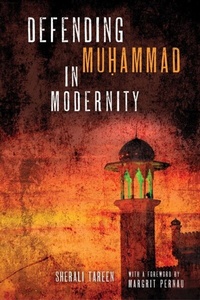
Defending Mu?ammad in Modernity
1st Edition
Published on 31. January 2020
506 pages
978-0-268-10672-0 (ISBN)
Description

In this groundbreaking study, SherAli Tareen presents the most comprehensive and theoretically engaged work to date on what is arguably the most long-running, complex, and contentious dispute in modern Islam: the Barelvi-Deobandi polemic. The Barelvi and Deobandi groups are two normative orientations/reform movements with beginnings in colonial South Asia. Almost two hundred years separate the beginnings of this polemic from the present. Its specter, however, continues to haunt the religious sensibilities of postcolonial South Asian Muslims in profound ways, both in the region and in diaspora communities around the world.
Defending Mu?ammad in Modernity challenges the commonplace tendency to view such moments of intra-Muslim contest through the prism of problematic yet powerful liberal secular binaries like legal/mystical, moderate/extremist, and reformist/traditionalist. Tareen argues that the Barelvi-Deobandi polemic was instead animated by what he calls "competing political theologies" that articulated-during a moment in Indian Muslim history marked by the loss and crisis of political sovereignty-contrasting visions of the normative relationship between divine sovereignty, prophetic charisma, and the practice of everyday life. Based on the close reading of previously unexplored print and manuscript sources in Arabic, Persian, and Urdu spanning the late eighteenth and the entirety of the nineteenth century, this book intervenes in and integrates the often-disparate fields of religious studies, Islamic studies, South Asian studies, critical secularism studies, and political theology.
Defending Mu?ammad in Modernity challenges the commonplace tendency to view such moments of intra-Muslim contest through the prism of problematic yet powerful liberal secular binaries like legal/mystical, moderate/extremist, and reformist/traditionalist. Tareen argues that the Barelvi-Deobandi polemic was instead animated by what he calls "competing political theologies" that articulated-during a moment in Indian Muslim history marked by the loss and crisis of political sovereignty-contrasting visions of the normative relationship between divine sovereignty, prophetic charisma, and the practice of everyday life. Based on the close reading of previously unexplored print and manuscript sources in Arabic, Persian, and Urdu spanning the late eighteenth and the entirety of the nineteenth century, this book intervenes in and integrates the often-disparate fields of religious studies, Islamic studies, South Asian studies, critical secularism studies, and political theology.
Reviews / Votes
"Tareen approaches his sources with rich theoretical tools, crafted by anthropologists, philosophers, and South Asianists, among others." -Bloomsbury PakistanProviding rich sources and a strong conceptual base, Defending Mu?ammad in Modernity is a must-read for researchers working on South Asian Islam, political theology and those interested in the Barelvi-Deobandi controversy. -Contemporary South Asia
"SherAli Tareen's Defending Mu?ammad in Modernity presents a rich and textured analysis of the Barelvi-Deobandi polemical battle in colonial South Asia.... [T]his is an important book that provides an original engagement with key theological aspects of modern Islamic thought." -Journal of Urdu Studies
"SherAli Tareen questions the very validity of the transformation-versus-continuity issue altogether in his learned book on the debates between two prominent orientations within Islam: the Barelvi and Deobandi schools." -Journal of the American Academy of Religion
"Defending Muhammad in Modernity is a groundbreaking study of the conceptual problem space of 'the Deobandi-Barelvi polemic,' a defining intra-Muslim dispute in modern South Asian Islam. . . . [T]his book is indispensable for scholars who want to engage seriously with the intellectual foundations of Muslim sectarianism in South Asia." -Reading Religion
"Tareen's Defending Muhammad in Modernity is a thoroughly researched, well-written, monumental contribution to the scholarly literature on religious construction during colonialism in South Asia." -American Journal of Islam and Society
"There is little denying the fact that through [Tareen's] account, one learns a huge amount, about theology, method, Islam, and much more. The thoroughness to detail and depth in his commentary and analysis and in the very wide reading that he has undertaken and conveyed to a reader is most welcome and useful and highly recommended. This is a superb book." -H-Asia, H-Net Reviews
"The book is a tremendous contribution to the fields of South Asia and Islamic studies, while its theorizing on the twin forces of religion and secularism also adds greatly to conversations in the study of religion and politics." -New Books Network
"Defending Muhammad in Modernity is dense, meticulously researched, and elegantly written and will set the standard for the study of the two most influential Sunni Muslim movements in the region today." -The Journal of Asian Studies
"A masterful study of the polemics over Mu?ammad's status that have been occurring for more than a century in India, Pakistan, and Bangladesh... it shows us that this polemical tradition is founded in a genuine argument, whose philosophical and juridical implications are meaningful even for those outside its purview." -Faisal Devji, University of Oxford, author of Muslim Zion: Pakistan as a Political Idea
"This book lands like an obelisk at the intersection of several fields. It joins the philological rigor of classical Islamic studies with the theoretical framing of religious studies and the contextual nous of South Asian studies. It will likely be a new point of departure for conversations around Islam in early modern and modern South Asia." -Jonathan Brown, Georgetown University, author of Misquoting Muhammad: The Challenges and Choices of Interpreting the Prophet's Legacy
"Defending Mu?ammad in Modernity offers a major contribution to the literature on the history of Muslims (and Islam) in South Asia. SherAli Tareen's detailed exploration of the form and logic of the polemical engagements that marked the development of competing Deobandi and Barelvi visions in the nineteenth century is exceptional and provides a critical backdrop for understanding the divisions that continue to shape the dynamics of South Asian Muslim thinking today. The book is also noteworthy for its deep engagement with Urdu, Persian, and Arabic sources." -David Gilmartin, North Carolina State University, author of Empire and Islam: Punjab and the Making of Pakistan
"No book offers a richer, more illuminating guide to the origins and complex theological relationship of the Barelvi and the Deobandi orientations, which have dominated Sunni Islam in modern South Asia, than Defending Mu?ammad in Modernity. SherAli Tareen's deeply researched, theoretically informed, yet remarkably accessible study will help make Islam in modern South Asia part of wider and much needed conversations among scholars of religion." -Muhammad Qasim Zaman, Princeton University, author of Islam in Pakistan: A History
"This book is beautifully written in a language accessible for students and colleagues who have not previously engaged with this topic. If you can only read three books on Islam in South Asia, Defending Mu?ammad in Modernity needs to be one of them." -Margrit Pernau, Max Planck Institute for Human Development
"A must-read text for both scholars and students concerned with South Asian Islam and reformation around the imagination of the Prophet Muhammad in the modern era." -Religion
"A groundbreaking work that greatly contributes to the study of modern South Asian Sunni Islam and the competing orientations among ulama in their intellectual traditions. It is a must-read text for both scholars and students concerned with South Asian Islam and reformation around the imagination of the Prophet Muhammad in the modern era."-Reading Religion
All prices
More details
Language
English
Place of publication
Notre Dame IN
United States
Target group
Professional and scholarly
Product notice
Reflowable
Illustrations
- 4 Halftones, black and white - 4 Maps
ISBN-13
978-0-268-10672-0 (9780268106720)
Copyright in bibliographic data and cover images is held by Nielsen Book Services Limited or by the publishers or by their respective licensors: all rights reserved.
Schweitzer Classification
Other editions
Additional editions
SherAli Tareen
Defending Mu?ammad in Modernity
Book
01/2020
University of Notre Dame Press
€145.20
Shipment within 10-20 days
SherAli Tareen
Defending Mu?ammad in Modernity
Book
01/2020
University of Notre Dame Press
€36.90
Shipment within 10-20 days
Persons
SherAli Tareen is associate professor of religious studies at Franklin and Marshall College. He is co-editor of Imagining the Public in Modern South Asia.
Margrit Pernau is a senior researcher at the Max Planck Institute for Human Development and author of Ashraf Into Middle Classes: Muslims in Nineteenth-Century Delhi.
Margrit Pernau is a senior researcher at the Max Planck Institute for Human Development and author of Ashraf Into Middle Classes: Muslims in Nineteenth-Century Delhi.
Content
Introduction
Part 1. Competing Political Theologies
1.Thinking the Question of Sovereignty in Early Colonial India
2. The Perils and Promise of Moral Reform
3. Reenergizing Sovereignty
4.Salvational Politics
5. Intercessory Wars
Part 2. Competing Normativities
6. Reforming Religion in the Shadow of Colonial Power.
7. Law, Sovereignty, and the Boundaries of Normative Practice
8. Forbidding Piety to Restore Sovereignty: The Mawlid and its Discontents
9. Retaining Goodness: Reform as the Preservation of Original Forms
10. Knowing the Unknown: Contesting the Sovereign Gift of Knowledge
Part 3
11. Internal Disagreements
Epilogue
Postscript: Listening to the Internal 'other'
Part 1. Competing Political Theologies
1.Thinking the Question of Sovereignty in Early Colonial India
2. The Perils and Promise of Moral Reform
3. Reenergizing Sovereignty
4.Salvational Politics
5. Intercessory Wars
Part 2. Competing Normativities
6. Reforming Religion in the Shadow of Colonial Power.
7. Law, Sovereignty, and the Boundaries of Normative Practice
8. Forbidding Piety to Restore Sovereignty: The Mawlid and its Discontents
9. Retaining Goodness: Reform as the Preservation of Original Forms
10. Knowing the Unknown: Contesting the Sovereign Gift of Knowledge
Part 3
11. Internal Disagreements
Epilogue
Postscript: Listening to the Internal 'other'
