

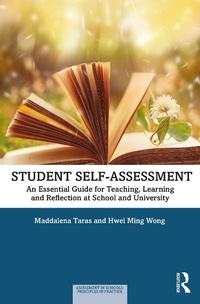
Student Self-Assessment
An Essential Guide for Teaching, Learning and Reflection at School and University
1st Edition
Published on 30. December 2022
198 pages
978-1-000-82574-9 (ISBN)
Description

This book provides the basics of student self-assessment and implementation challenges, and it offers practical solutions and examples for navigating the use of student self-assessment in various subject disciplines in primary schools, secondary schools and higher education. It provides an informed approach for educators to understand the complexities and subtleties involved in implementing self-assessment, and how this might include and impact on teachers and students.
Involving students in assessment is not a new idea nor is student self-assessment a new assessment tool in schools. Despite the advantages and the necessity for including it in our pedagogic processes explicitly, the use of student self-assessment has been far from commonplace and consistent in classrooms, schools and universities. This book makes clear the choices of what, how and why student self-assessment is important and usable in the classroom.
This book is designed for educators at different levels, and educational researchers. It will provide food for thought for pre- and in-service teachers and school leaders who are interested in nurturing independent and self-directed learners by involving students in the assessment process and maximising student learning through the use of student self-assessment.
Involving students in assessment is not a new idea nor is student self-assessment a new assessment tool in schools. Despite the advantages and the necessity for including it in our pedagogic processes explicitly, the use of student self-assessment has been far from commonplace and consistent in classrooms, schools and universities. This book makes clear the choices of what, how and why student self-assessment is important and usable in the classroom.
This book is designed for educators at different levels, and educational researchers. It will provide food for thought for pre- and in-service teachers and school leaders who are interested in nurturing independent and self-directed learners by involving students in the assessment process and maximising student learning through the use of student self-assessment.
Reviews / Votes
"Maddalena Taras provides is a highly personal reflection on the nature of self-assessment, but one which does not shy away from the necessity of students making judgments about their work and learning against disciplinary, vocational, or professional standards and norms. The book brings together her work with that of the co-author Hwei Ming Wong, and Singapore colleagues who describe self-assessment use from primary schooling to higher education contexts. The emphasis is on practical 'how to' applications of self-assessment. The introductory chapters give Taras' perspectives, from her long experience, on student self-assessment. Readers can dip into various chapters to find suggestions for implementing student self-assessment in their own context."Gavin T L Brown, Professor, The University of Auckland, New Zealand
"A thorough introduction to student self-assessment-a form of assessment rarely discussed and even more rarely used in the worlds' education systems. My thinking about assessing my students has been substantially changed by this book, and it certainly made me wonder why I was never exposed to such good ideas before!
I strongly recommend this book to educators around the world. Here, Taras and Wong convincingly argue that student self-assessment has worthwhile benefits that are different from and certainly as important as those associated with more traditional forms of assessment.
The authors make clear that student self assessment has distinct benefits for both students and teachers that are not found in contemporary assessment practices. Self assessment offers a much greater likelihood that closer and more respectful relationships between students and their teachers will be developed. Moreover, students learn skills that should help them in the world of work, after graduation.
The authors provide school administrators and teachers with novel and creative ideas to rethink classroom assessment. Their ideas can redefine contemporary assessment practices, and improve teacher student relationships at the same time!"
David C. Berliner, Regents' Professor Emeritus, Arizona State University and Past President of the American Educational Research Association
More details
Series
Edition
1. Auflage
Language
English
Place of publication
London
United Kingdom
Publishing group
Taylor & Francis Ltd
Target group
College/higher education
Professional and scholarly
Product notice
Reflowable
Illustrations
17 Tables, black and white; 2 Line drawings, black and white; 25 Halftones, black and white; 27 Illustrations, black and white
ISBN-13
978-1-000-82574-9 (9781000825749)
Copyright in bibliographic data and cover images is held by Nielsen Book Services Limited or by the publishers or by their respective licensors: all rights reserved.
Schweitzer Classification
Other editions
Additional editions
Maddalena Taras | Hwei Ming Wong
Student Self-Assessment
An Essential Guide for Teaching, Learning and Reflection at School and University
Book
12/2022
1st Edition
Routledge
€160.94
Shipment within 15-20 days
Maddalena Taras | Hwei Ming Wong
Student Self-Assessment
An Essential Guide for Teaching, Learning and Reflection at School and University
Book
12/2022
1st Edition
Routledge
€54.90
Shipment within 15-20 days
Persons
Maddalena Taras is Associate Professor at the University of Sunderland, UK. She was awarded a National Teaching Fellowship in 2013, and in REF 2014, a 4* world class research impact. www.ref.ac.uk
Hwei Ming Wong is a Senior Education Research Scientist and is the Programme Director of the Schools, Leadership and System Studies Research Programme at the Centre for Research in Pedagogy and Practice, National Institute of Education, Singapore. She was previously a primary school teacher and an educational psychologist with the Ministry of Education.
Hwei Ming Wong is a Senior Education Research Scientist and is the Programme Director of the Schools, Leadership and System Studies Research Programme at the Centre for Research in Pedagogy and Practice, National Institute of Education, Singapore. She was previously a primary school teacher and an educational psychologist with the Ministry of Education.
Content
Section 1: Exploring (Fundamentals of) Student Self-Assessment 1: Student Self-Assessment: what it is, why it is important and why educators should use it explicitly 2. Student Self-Assessment in Practice, what are the choices: models, strategies/techniques 3: Implementing Student Self-Assessment - conditions and climate 4. Student Self-Assessment and Feedback Section 2: Student Self-Assessment in Practice 5. Enhancing Student Self-Assessment Using Technology 6. Student Self-Assessment in Primary Schools 7: Student Self-Assessment in Secondary Schools 8. Student Self-assessment in Higher Education Section 3: Challenges and Future of Student Self-Assessment 9. Using Student self-assessment to best effect 10. Unresolved Dilemmas in Self-Assessment: Looking to the Future
