

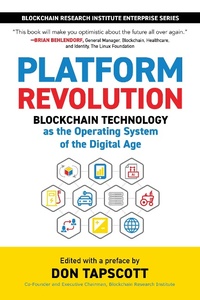
Platform Revolution
Blockchain Technology as the Operating System of the Digital Age
Published on 1. November 2021
244 pages
978-1-988025-77-3 (ISBN)
Description

The first era of the digital age spanned mainframes, minicomputers, the personal computer, the Internet, the World Wide Web, social media, mobility, the cloud, and big data. We''re now entering a second era where digital technologies permeate everything. Such inventions as machine learning, robotics, drones, software robots or "bots," process automation, and additive manufacturing are accelerating new types of platforms on which to build digital engines of the global economy. This second era has weighty implications for enterprise strategy and architecture. New business models will disrupt most industries and provide platforms for innovation for decades to come. This book looks at blockchain technologies as foundational to the governance and widespread adoption of these innovations-digital identities, data analytics, artificial intelligence, the Internet of Things, autonomous vehicles, distributed energy infrastructure, and quantum computing. Every organization can finally become a truly digital entity if its leaders are prepared. This book is designed to prepare them for the waves of creative destruction ahead.
More details
Other editions
Additional editions
Book
11/2021
Barlow Publishing
€24.00
Shipment within 3-4 weeks
Content
- Intro
- Copyright
- Contents
- List of Contributors
- Preface
- Chapter 1 | Saving the Web
- Securing the Web in brief
- Introduction
- The first ideal: Open access
- What is the open access ideal?
- How has the Web excluded potential users?
- Can blockchain technology improve access?
- Views of access from the decentralized future
- The second ideal: Fair participation
- What is the fair participation ideal?
- How has the Web permitted bias?
- Can blockchain technology promote fairness?
- Views of neutrality from the decentralized future
- The third ideal: Self-sovereignty
- What is the self-sovereignty ideal?
- How has the Web threatened self-sovereignty?
- Can blockchain technology ensure self-sovereignty?
- Views of sovereignty from the decentralized future
- Conclusions and recommendations
- Chapter 2 | The Convergence of Big Data and Blockchain
- Big data and blockchains in brief
- Introduction
- Challenges for organizations
- Challenges for consumers
- Blockchain and big data
- How Telstra applies blockchain to secure smart home systems
- Data sharing
- Data governance
- Data security
- Data privacy and identity
- Data ownership
- Shifting attitudes and policies
- Conclusions and recommendations
- What executives should keep in mind
- What organizations can do today
- Chapter 3 | Distributed Artificial Intelligence
- Distributed AI in brief
- What is artificial intelligence?
- Training data
- AI and centralization
- Blockchains and artificial intelligence
- Immutability
- Blockchain and democratization
- Smart contracts
- Blockchain governance
- Decentralized artificial intelligence
- Distributed AI versus decentralized AI
- DAI and blockchain's role
- Autonomous agents as AI representatives?
- Looking to the future: DAO
- Challenges with blockchain networks
- Scalability
- Governance
- Conclusion and recommendations
- Chapter 4 | The Ledger of Every Thing
- Blockchain and IoT in brief
- Introduction
- What is the Internet of Things?
- Typical architecture of an IoT deployment
- Blockchains and IoT
- Challenges of centralized IoT and what blockchains can do
- Limitations of blockchains for the IoT
- Implementing blockchains for IoT
- Present and future proof integration architecture
- Private blockchains
- Guidelines for durable IoT systems
- Conclusions and recommendations
- Editor's note
- Chapter 5 | Autonomous Vehicles and Blockchain
- Networked autonomous vehicles in brief
- State of our international highway network
- An industry-wide pivot
- The blessing and curse of autonomy
- Blockchain as a transportation platform
- Toll roads: Early blockchain-based vehicle value transfer system
- Mobile Open Blockchain Initiative
- Implementation considerations
- Blockchain latency and scalability
- Communications network latency
- Immutable records versus privacy
- Device security
- Legal and ethical implications
- Looking to the future
- A true sharing economy
- Flying cars
- Conclusions
- Chapter 6 | Slock.It
- Universal sharing network in brief
- The problem to be solved
- Slock.it's solution
- DAO: The hope, the hack, and the hard fork
- Culture reboot: Grounded in practical applications
- Radical transparency: The universal sharing network
- Postscript to the case
- Key takeaways
- Chapter 7 | Quantum-Proofing the Blockchain
- Quantum threat and defense in brief
- Introduction to the quantum threat
- A story from the year 2030
- The issue: Blockchain is not entirely quantum safe
- Analysis of our options
- An abstract model of the blockchain
- Ways of patching the blockchain
- Designing quantum-resistant blockchains from scratch
- Flavors of quantum adversaries
- Quantum-proofing existing blockchains
- Performance analysis
- What the experts say about blockchain security
- Conclusions and recommendations
- Chapter 8 | Standardized and Decentralized?
- Standardization imperative in brief
- An origin story
- Why standardize?
- Network effects
- Outsized economic gains
- How does the "standardization" model apply to blockchain?
- Semantic standardization: Defining the blockchain stack
- Beyond Bitcoin
- Subdivision of the blockchain layer
- Redefining overlay networks
- Connecting applications to protocols
- Adding end-to-end completeness
- The modern blockchain stack
- Technological standardization: Decentralized unanimity
- Core protocol layer: Ethereum Classic and Bitcoin Cash
- Consensus layer: Proof of work and proof of stake
- Economic layer: The ERC-20 token standard
- Recommendations for standardizing decentralized technology
- Relentlessly pursue semantic standardization
- Make better stuff than anyone else
- Reconsider waging a decentralized standards war
- Resist consensus for consensus' sake
- Conclusions
- Acronyms and Abbreviations
- About the Blockchain Research Institute
- About the Contributors
- Acknowledgments
- Notes
- Index
- Back Cover
