

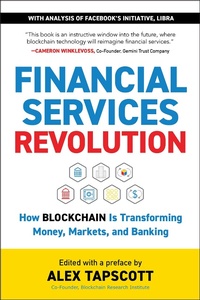
Financial Services Revolution
How Blockchain is Transforming Money, Markets, and Banking
Published on 23. January 2020
268 pages
978-1-988025-51-3 (ISBN)
Description

This book offers readers a startling view of how blockchain technology will transform the financial industry in profound ways. Some of the world''s top thinkers in blockchain have contributed chapters that survey the coming digital storm-how it will level the playing field, give individuals more financial power, and create greater transparency in operations. Written for the educated financial reader, it reveals how blockchain can create a token-based incentive system that aligns the interests of participants in large-scale initiatives, as well as the rewiring of global payment networks and innovative financing methods such as initial coin offerings to fund infrastructure development. The transition for the financial industry is bound to be complicated, but it presents enormous opportunity for those who understand the storm as it''s brewing.
More details
Other editions
Additional editions
Alex Tapscott
Financial Services Revolution
How Blockchain is Transforming Money, Markets, and Banking
Book
02/2020
Barlow Book Publishing inc.
€24.00
Shipment within 3-4 weeks
Content
- Intro
- Copyright
- Contents
- List of contributors
- Preface
- Chapter 1 | The coming cataclysm
- Financial services in brief
- Introduction
- The blockchain revolution in financial services
- Facebook joins the blockchain revolution-buckle up!
- Libra: The latest innovation
- Blockchain transformation for financial services
- Cryptoassets and open finance
- Financialization and digitization of everything
- Blockchains as state machines
- A new model for identity
- Decentralized finance: The golden nine
- Challenges and implications
- Threat and opportunity for incumbents
- Rethinking central banking
- Onboarding the unbanked
- Preventing crime while preserving rights
- Conclusion: Promise and peril
- The world in 2030
- What can we do?
- Chapter 2 | The token economy
- Token economy in brief
- A preface to this chapter
- Introduction to the token economy
- A solution to the Tragedy of the Commons?
- Initial coin offerings: A new breed of meta-asset
- The advent of digital scarcity
- Tokens as powerful incentives
- Balancing innovation and regulation
- A golden age of protocols?
- The BAT: A new paradigm for online advertising?
- The token landscape: Cryptocurrencies, cryptocommodities, and cryptotokens
- Cryptocurrencies
- Cryptocommodities
- Cryptotokens
- But is it legal? Is it safe?
- Conclusions and recommendations
- Chapter 3 | Financing open blockchain ecosystems
- Financing open blockchain ecosystems in brief
- Introduction to blockchain's impact on fundraising
- Inherent tension of privately funding a public good
- Ecosystem tokens
- Decentralized application (Dapp) tokens
- An evolving landscape of practices and regulatory approaches
- Historical analysis
- Evolving SEC standards
- Recontextualizing Howey in light of ecosystem tokens and app coins
- Legal fictions and creative structuring: A review of practical solutions
- The foundation model
- The SAFT model: Simple agreement for future tokens
- Securities registration exemptions
- Creative solutions moving forward
- Sell only to strategic partners or potential platform users
- Discourage the establishment of a secondary market
- Cap the token price or use token bounding mechanisms
- Separate fundraising from token ecosystem governance
- Conclusion
- Chapter 4 | Reinventing international clearing and settlement
- The global payment system in brief
- Introduction to global payments
- How the global payment system works
- Why the system sometimes doesn't work
- A history of payment systems
- The East India Trading Company and Ronald Coase
- The rise of the mercantile bank, letters of credit, and the associated pain
- The creation of SWIFT and its messaging service
- Payment systems to manage payment systems
- In search of a better system
- The strategies of existing players
- Canada
- US Federal Reserve
- European Central Bank
- Singapore
- Japan
- SWIFT
- Ripple
- Depository Trust and Clearing Corporation
- TransferWise
- Analysis: Creating a better system on the blockchain
- A new role for government?
- A new role for SWIFT?
- Conclusions and recommendations
- Chapter 5 | Consolidating multiple ledgers with blockchain
- Consolidating multiple ledgers in brief
- Overview of receiver general ledger system
- Central financial management reporting system
- Receiver general-general ledger
- Account balance concept
- Public sector applications of blockchain
- Identity management in Estonia
- US GSA and FASt Lane
- State of Delaware's blockchain initiative
- Sweden's land registry
- A single ledger for the accounts of Canada
- Solution approach
- Solution architecture
- Public versus private blockchain consensus mechanisms
- User experience
- Adaptation of the receiver general mandate and workflow
- Challenges and risk management
- Implementation costs
- Triple-entry accounting
- Conclusions and recommendations
- Chapter 6 | Managing blockchain transparency
- Blockchain transparency in brief
- Introduction to real-time information symmetry
- The benefits of shared knowledge
- How much is too much transparency?
- Native transparency in blockchain technology
- Ownership transfers: Central registries versus distributed ledgers
- Ownership transfers: Public versus private blockchains
- Transparency as a risk and an asset
- Transparency as a strategic risk
- Transparency as a strategic asset
- Solving the problem: Technological approaches to privacy in blockchains
- Procedural workarounds: Usage of multiple IDs
- High-tech solution: Zero-knowledge proofs
- Implementation in public versus private blockchains
- Conclusions and recommendations
- Appendix to chapter 6 | How to access the ethereum blockchain
- Acknowledgments
- About the blockchain research institute
- About the contributors
- Acronyms and abbreviations
- Notes
- Index
- Back Cover
