

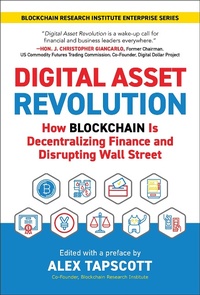
Digital Asset Revolution
How Blockchain Is Decentralizing Finance and Disrupting Wall Street
Published on 12. July 2022
280 pages
978-1-988025-92-6 (ISBN)
Description

From the coauthor of the bestseller Blockchain Revolution comes the foundational book on cryptoassets, decentralized finance, and the transformation of value.In tune with the crypto Zeitgeist, Alex Tapscott brings us a well-researched and highly accessible book on the peer-to-peer marketplaces and open economic systems that are supporting new digital assets like NFTs, CBDCs, stablecoins, crypto derivatives, and more. If bitcoin was the spark for the financial services revolution, Tapscott writes, then DeFi and digital assets are the accelerant. The fire will engulf firms that fail to innovate, adapt, and embrace this hot new industry. The conflagration will suck oxygen from centralized systems and blow it into a new decentralized web. The financial phoenix that rises will be virtually unrecognizable from the system we have today.This book explains how every aspect of the economy is changing, from how we move and store value to how we access credit, invest, trade, transact, and insure against risk. But this upheaval is about more than dislocating market intermediaries. It''s about Web 3''s unleashing new business models and organizational capabilities that will change existing industries and redefine the architecture of our institutions. Leaders ignore these signs at their own risk."Alex Tapscott takes us to the frontiers of finance, where digital assets are transforming money, reimagining financial markets, and disrupting leading institutions, including central banks. Digital Asset Revolution is a wake-up call for financial and business leaders everywhere."-Hon. J. Christopher Giancarlo, Senior Counsel, Willkie Farr & Gallagher LLP, Former Chairman, US Commodity Futures Trading Commission
More details
Other editions
Additional editions
Alex Tapscott
Digital Asset Revolution
How Blockchain Is Decentralizing Finance and Disrupting Wall Street
Book
07/2022
Barlow Book Publishing inc.
€24.00
Shipment within 3-4 weeks
Content
- Cover
- Copyright
- Contents
- List of Contributors
- Preface
- Chapter 1: Digital Asset Revolution
- Introduction: The building blocks of disruption
- The rise of digital assets and the future of financial services
- Web 3 and the new Internet of value
- The Golden Nine: Essential functions of the financial industry
- A taxonomy for digital assets
- Decentralized finance is eating Wall Street
- DeFi: A new architecture for the financial system
- The Golden Nine: How DeFi is reimagining Wall Street
- A taxonomy of digital assets
- Cryptocurrencies aka digital money
- Protocol tokens
- Central bank digital currencies
- Non-fungible tokens
- Stablecoins
- Securities tokens
- Governance tokens
- Exchange tokens
- Natural asset tokens
- Implementation challenges of DeFi
- The technology is not ready for prime time
- The energy use is unsustainable
- Governments will stifle or twist it
- Powerful incumbents of the old paradigm will usurp it
- The incentives are inadequate for adoption:
- Blockchain is a job killer
- Governance is like herding cats
- Criminals will use it
- Conclusion: The coming conflagration
- Chapter 2: Cosmos and Polkadot for the Enterprise
- Interoperability in brief
- The challenge of interoperability
- Introducing Cosmos
- Cosmos' origins and ethos
- The core technology components of Cosmos
- Metrics of Cosmos success
- Introducing Polkadot
- Polkadot's origins and ethos
- The core technology components of Polkadot
- How enterprise can use Polkadot
- The Polkadot ecosystem and its impact
- What do decision makers need to know?
- Key similarities
- Key differences
- Conclusions on interoperability
- Chapter 3: The Promise of Community-Owned Prediction Markets
- Prediction markets in brief
- The promise of prediction markets
- Classic use case: Sports and political betting
- The problems of sportsbooks
- The perils of centralized betting exchanges
- The centralized governance problem
- The future is clear: Community-owned betting markets
- Introducing the crypto network
- Problems with decentralized governance
- Introducing prediction market-based governance
- Governance design for a simple prediction market
- Conclusion: The inevitability of crypto networks
- Chapter 4: Going Cashless With CBDCS
- Introduction: A new paradigm for money
- Disruptive technology makes for new policy options
- Overview of the digital dollar
- How digital currencies differ from other financial assets
- Attributes of the digital dollar
- The need for infrastructure innovation
- Road map to a new banking system
- Attributes of a digital global reserve currency
- The goal of modernizing global economic architecture
- The need to modernize global financial regulation
- Conclusions: This is just the beginning
- Diversity makes for a healthy marketplace
- Blockchain will transform other financial assets
- Currency innovation will unleash economic innovation
- Chapter 5: Introduction to Stablecoins
- Stablecoins in brief
- The context for stablecoins
- The economics behind the protocols
- Governance of stablecoins
- Gold or bitcoin, a stable commodity?
- Types of stablecoins
- Asset-collateralized stablecoins
- Non-collateralized stablecoins
- Hybrid stablecoin models
- Top stablecoins
- Tether (USDT)
- USD Coin (USDC)
- Binance USD (BUSD)
- Dai (DAI)
- Frax (FRAX)
- TrueUSD (TUSD)
- Paxos Dollar (USDP)
- Gemini (GUSD)
- Using stablecoins: A few ideas
- Conclusion and review
- Chapter 6: Financial Derivatives With Blockchain and Smart Contracts
- Blockchain-based derivatives in brief
- Derivative contracts on blockchains
- Levels of applications
- Standardization, transparency, and interoperability
- Collateral, settlement, and automation
- Derivatives on public blockchains
- LuxDeco and the world's first cryptobond
- The control bond
- An experimental bond
- Key takeaways on crypto derivatives
- Chapter 7: Oil, Natural Gas, and Blockchain
- Energy use case in brief
- Introduction to the oil and gas market
- Investing in oil and gas
- The downside of conventional direct investments
- Streamlining direct investments through blockchain
- Digital securities and tokenization
- Trading oil and gas
- Poor integration, long-term contracts, and opacity
- Smart contracts
- The utility of natural resource tokens
- Consuming and conserving natural gas
- Waste and inefficiency
- Natural gas-powered data centers
- Implementation challenges
- Scalability of the platform
- Governance of an investment platform
- Interoperability with other platforms
- Regulation and regulatory uncertainty
- Implications and key takeaways
- Chapter 8: Non-Fungible Tokens
- NFTs in brief
- Introduction to NFTs
- The Salvator Metaversi
- Ease of use: The trade-offs
- Early adoption of use cases
- Christie's: A case study of incumbent innovation
- The realities of NFT ownership
- What exactly is ownership anyway?
- The bundle of rights for NFTs
- NFTs as assets
- How NFTs engage communities
- NFTs as self-fulfilling prophecies
- NFTs as models of engagement
- NFTs for commodities
- The myth of mass commodification
- From global supply chains to local makerspaces
- Implementation challenges of NFTs
- Legal and regulatory unknowns
- Tax and accounting unknowns
- Lack of digital technology expertise
- Conclusions and recommendations
- Acronyms and Abbreviations
- About the Blockchain Research Institute
- About the Contributors
- Mohamed El-Masri
- J. Christopher Giancarlo
- Alan Majer
- Massimo Morini
- Alyze Sam
- Alex Tapscott
- Don Tapscott
- Anthony D. Williams
- Andrew Fennell Young
- Acknowledgments
- Notes
- Index
- Back Cover
