

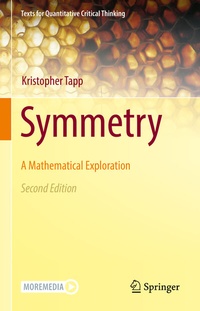
Symmetry
Description

This textbook invites readers to explore the properties of objects that we effortlessly recognize as symmetrical. From the human body, to elaborate artworks and abstract networks, symmetry is ubiquitous in the world around us; it is essential to function and beauty across the built and natural world. By developing mathematical language to describe symmetry, this textbook equips readers to explore symmetries with precision, illuminating commonalities across art and science.
Beginning with an exploration of intuitive notions of symmetry, the author introduces the algebraic structure of groups by examining rotations and reflections. Topics that follow include the classification of two-dimensional patterns, the Platonic solids, and a study of real and prime numbers. This second edition features numerous new examples and exercises, "Elements of Mathematics" sections that more closely examine mathematical tools, and optional content that offers opportunities for extension. Figures are woven into the presentation throughout, with many illustrations now offered in motion as integrated video content.
Symmetry
suits a wide audience, demanding no mathematical training past high school basics, yet stretching the imagination of math and non-math majors alike. Its engaging yet rigorous style offers a window into mathematicians' ways of thinking. By developing mathematical reasoning skills in a spatial context, this text is ideal for a course that meets quantitative requirements for non-STEM majors. Instructors will appreciate the author's comprehensive online resources, which include a full set of animated lecture slides; all readers will delight in watching the book's content come alive using the multimedia app.
Reviews / Votes
"This book has much to recommend it. The material is presented clearly and enthusiastically . . there are a lot of well-chosen exercises, ranging from very easy to more challenging. . this is a well-written book, covering interesting material, that can serve a number of possible audiences. . many math majors will never have seen many of the topics discussed in this book . technical details by the instructor, serve as a useful text for a capstone course for majors." (Mark Hunacek MAA Reviews, November 14, 2021)More details
Other editions
Additional editions
Person
Kristopher Tapp is Professor of Mathematics at Saint Joseph's University in Philadelphia. The recipient of numerous teaching awards, he is particularly interested in communicating ideas from mathematics to students in other fields. His research extends from differential geometry to the mathematical study of gerrymandering. Previous books include Differential Geometry of Curves and Surfaces , which appears in Undergraduate Texts in Mathematics .
