

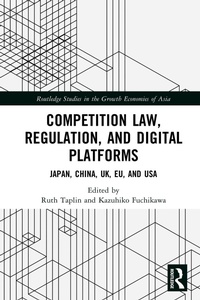
Competition Law, Regulation and Digital Platforms
Japan, China, UK, EU and USA
1st Edition
Published on 6. May 2025
120 pages
978-1-040-34966-3 (ISBN)
Description

This book confronts and analyses how competition law in its present form is unable to deal with the new advances in digital technology that have made tech giants not subject to national jurisdictions as they straddle the world, with a particular focus on Japan, China, UK, EU and USA.
Demonstrating how the gatekeeping role of digital platforms has broken through the boundaries of national regulation, this book highlights examples where companies have broken and infringed antitrust law with impunity, pursuing self-preferencing and unfair competition practices solely for their own profitability. It also identifies how tech giants can open their digital platforms for fair use by consumers, small and medium enterprises (SMEs), and creators ,while still allowing tech giants to maintain their important role as gatekeepers of digital security that protects users from cyberattacks. This is followed by an examination of the similarities between tech giants and big pharma within the competition law and intellectual property context, revealing how tech giants are beginning to target the healthcare sector.
Exploring how intellectual property rights are interwoven through new modernising regulations to curtail the dominance of Big Tech on digital platforms, this book will appeal to students, scholars and practitioners of Business Ethics, Intellectual Property, Law, and Regulation.
Demonstrating how the gatekeeping role of digital platforms has broken through the boundaries of national regulation, this book highlights examples where companies have broken and infringed antitrust law with impunity, pursuing self-preferencing and unfair competition practices solely for their own profitability. It also identifies how tech giants can open their digital platforms for fair use by consumers, small and medium enterprises (SMEs), and creators ,while still allowing tech giants to maintain their important role as gatekeepers of digital security that protects users from cyberattacks. This is followed by an examination of the similarities between tech giants and big pharma within the competition law and intellectual property context, revealing how tech giants are beginning to target the healthcare sector.
Exploring how intellectual property rights are interwoven through new modernising regulations to curtail the dominance of Big Tech on digital platforms, this book will appeal to students, scholars and practitioners of Business Ethics, Intellectual Property, Law, and Regulation.
Reviews / Votes
"One should appreciate the importance of this book. For the first time, we are faced with a technology that could dominate economies. Like other powerful tools, it has potential for both great good and great harm. Given the nature of digital platforms, market forces do not act as constraints. It is then critical for governments to minimize harm by imposing suitable regulations. [...] The very fluidity of the market may make this a most important time to focus interventions in ways that will lead to promising regulatory frameworks. This book provides the background to address this with clarity and wisdom."Kenneth S. Friedman, The Japan Society Review
"The central message emerging from the book is an urgent appeal for competition law globally and specifically in the territories analysed to modernise by learning from recent high-profile cases. The argument is bolstered with case studies of tech giants breaking anti-trust law with impunity. Students in this field, established business ethics advisors, legal advocates, regulators and creators concerned about the erosion of intellectual property rights will draw much insight from this compendium."
James Brewer, All About Shipping
"Very little has been written about this topic in relation to Japan, so the book is fortunate to have the voices of the country's practitioners in the field."
James Brewer, All About Shipping
"This book is about what is arguably one of the most challenging economic and social issues of our time - how to regulate Big Tech, the term used to describe the handful of tech giants that exercise monopoly ownership and control over the world's major digital platforms. [...] In sum, this book is a thoughful and stimulating overview of how competition law can and must adapt to a new era of rapid technological change and consequential growth of monopolistic practices, just as it did in an earlier era of industralisation with the emergence of the so-called railway barons."
Roy Green, Interdisciplinary Journal of Economics and Business Law
"Xiaofei Lu provides a fascinating history of competition law in China as it tries to keep up with the growth of tech giants like Alibaba and Tencent, without unduly compromising their ability to develop effective, long-term positioning in domestic and global markets."
Roy Green, Interdisciplinary Journal of Economics and Business Law
More details
Series
Edition
1. Auflage
Language
English
Place of publication
London
United Kingdom
Publishing group
Taylor & Francis Ltd
Target group
Professional and scholarly
Illustrations
2 Tables, black and white
File size
5,38 MB
ISBN-13
978-1-040-34966-3 (9781040349663)
Copyright in bibliographic data and cover images is held by Nielsen Book Services Limited or by the publishers or by their respective licensors: all rights reserved.
Schweitzer Classification
Other editions
Additional editions
Ruth Taplin | Kazuhiko Fuchikawa
Competition Law, Regulation and Digital Platforms
Japan, China, UK, EU and USA
Book
05/2025
1st Edition
Routledge
€206.80
Shipment within 10-20 days

Competition Law, Regulation, and Digital Platforms
Japan, China, Uk, EU and USA
Book
05/2025
Routledge
Unfortunately, price unknown
Available (delivery time upon request)
Persons
Ruth Taplin (PhD London School of Economics and Political Science [LSE] and Graduate Diploma in Law) is Director of the Centre for Japanese and East Asian Studies, London, Editor/Founder of the Interdisciplinary Journal of Economics and Business Law (IJEBL), Professor Taplin is the author/editor of 28 books and over 200 articles. Early on in her career she was chosen as a future leader in the Japanese field for the UK.
Kazuhiko Fuchikawa is an Associate Professor of Competition Law at Keio University, Japan. Professor Fuchikawa is a winner of the Masatoshi Yokota Memorial Award (New Face Award of the Japan Association of Economic Law), 2015.
Kazuhiko Fuchikawa is an Associate Professor of Competition Law at Keio University, Japan. Professor Fuchikawa is a winner of the Masatoshi Yokota Memorial Award (New Face Award of the Japan Association of Economic Law), 2015.
Content
1. Overview 2. Regulating Non-Price Exclusionary Conducts and Preferential Treatments in the Digital Economy 3. Fair Competition and Appropriate Use of Data and Algorithms in the Digital Platform Business-Case Studies and Policy Approaches in Japan 4. Cloud Computing and Competition Law 5. Regulation and Competition: A Study on Competition Regulation among Digital Platforms in China 6. Addendum- Excessive Patenting in Big Pharma: Should This Strategy be Regulated by Competition Law as Big Tech Targets Healthcare? 7. Conclusion
