

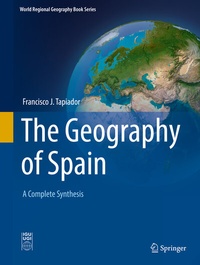
The Geography of Spain
Description

This book is the latest and most comprehensive reference to the regional geography of Spain, taking into account emergent issues such as biodiversity, climate change and nationalism. It appeals to scientists as well as to students and instructors and all fields of geography, regional, environmental and cultural studies, and business related disciplines.
It covers the whole range of topics from the physical to the human geography of Spain and provides detailed insights into all 17 autonomous communities. Dozens of GIS maps and hundreds of photographs and images including remote sensing imagery make this volume a must have for every geography department.
More details
Other editions
Additional editions
Person
Professor Francisco J. Tapiador lectures at the Department of Environmental Sciences and in the Architecture School of UCLM (Toledo, Spain). He graduated in Geography and History and holds a PhD in Physics. He has worked as professional geographer in large regional development projects, developing both guidelines and policies for regional and rural planning, and implementing geographical information and management systems. His research in rural issues spans from Climate Change to Historical GIS and Remote Sensing. His findings have been published in highly cited journals (Landscape and Urban Planning, Journal of Geography in Higher Education, Bulletin of the American Meteorological Society, Journal of Climate, Energy and Environmental Science, Political Geography, Geophysical Research Letters and International Journal of Remote Sensing, amongst others). He has been a visiting scholar at the universities of Barcelona (Spain), Cambridge (UK) The Sorbonne (Paris 7, France), Oklahoma University (USA), Caltech (USA) and Colorado State University (USA). He was the chief editor of the Journal of the Geographical Information System. He has also been the Dean of the Faculty of Environmental Sciences and Biochemistry at UCLM.
Content
Preface.- Chapter 1. The art and science of describing a country.- Chapter 2. Spain: a privileged land, strong in its diversity.- Chapter 3. General data about Spain.- Part I: Natural Factors.- Chapter 4. The relief: a mountainous country.- Chapter 5. Underwater Spain: the hidden country.- Chapter 6. The geological history: a unique event.- Chapter 7. Lithology: the fourfold scheme.- Chapter 8. Climates: a North-South gradient.- Chapter 9. The fresh waters: a precious but scarce resource.- Chapter 10. The tree cover: the remains of green Spain.- Chapter 11. Biodiversity: a lively country.- Chapter 12. Natural risks and hazards.- Part II: Anthropic Components.- Chapter 13. The history on the territory.- Chapter 14. The state and the institutions: solid ground.- Chapter 15. The state and the institutions: solid ground.- Chapter 16. Population: sudden ongoing changes.- Chapter 17. Society: inclusive and progressive.- Chapter 18. Infrastructures: an efficient network.- Chapter 19. Economy: a services-based specialization.- Chapter 20. Trade: foods, cars and machinery.- Chapter 21. Primary sector: a new countryside.- Chapter 22. Industry: the importance of food.- Chapter 23. Tourism: the key player.- Chapter 24. Heritage: a treasure chest.- Chapter 25. Education: a high-quality system.- Chapter 26. Science and technology: below potential.- Chapter 27. Domestic politics: new scenarios.- Chapter 28. Geopolitics: waning influence.- Part III: A comprehensive synthesis.- Chapter 29. Strategic analysis: a SWOT approach.- Chapter 30. Verifying the hypothesis: the uniqueness of Spain.- Chapter 31. Conclusion and outlook: a bright future for a great country.- Appendixes.- Index.
