

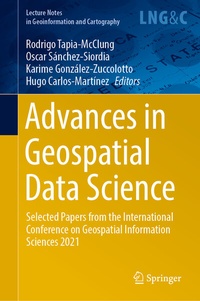
Advances in Geospatial Data Science
Description

This book presents a selection of manuscripts submitted to the 2nd International Conference on Geospatial Information Sciences 2021, a virtual conference held on November 3-5, 2021. These papers were selected by the Scientific Program Committee of the Conference after a rigorous peer-review process. They represent the vast scope of the interdisciplinary research areas that characterize the Geospatial Information Sciences that is done in the discipline. It especially represents a fabulous opportunity to showcase research carried out by young Mexican researchers and showcase it to the rest of the world and enhance the growth of the sciences in the country while, at the same time, enforces them to level up with other research at the international level.
More details
Other editions
Additional editions
Persons
Rodrigo Tapia McClung holds a Physics degree from the National Autonomous University in Mexico, a masters degree in Environmental Sciences from Wilfrid Laurier University, and a Ph.D. in Geospatial Information Sciences from the Research Center in Geospatial Information Sciences, Mexico.
His research has focused on geovisual analytics, geoweb, and participative cartography along with citizen science and participation and looking into ways to visualize spatial and temporal data and being able to properly and timely convey meaning to different types of users.
He has organized international workshops for the International Conference on Computational Science and its Applications (ICCSA) and reviewed several papers and years for their publication in Lecture Notes in Computer Science. He had also published in these proceedings. He has also published a couple of chapters in other books edited by Springer.
Currently, he serves as Graduate Program Coordinator for thespecialization graduate program at my home institution and Guest Editor for MDPIs remote sensing special issue "Advances in Remote Sensing and Geographic Information Science and Their Uses in Geointelligence."
Oscar S. Siordia has been a head researcher at the National Geointelligence Laboratory (GeoINT) of the Center for Research in Geospatial Information Sciences (CentroGeo) since 2014. He obtained his PhD in Information Technologies and Information Systems from the Universidad Rey Juan Carlos (URJC, Spain, 2013) and his Masters in Computer Science from Centro Nacional de Investigación y Desarrollo Tecnológico (CENIDET, Mexico, 2009). He has been a member of the National Researchers System since 2015 and his research is related to the application of novelty techniques for data analysis (data science) for the design and construction of expert systems.Karime González-Zuccolotto is a biologist with a Masters degree in GeospatialInformation Sciences from CentroGeo. She has worked as a technician in Geographic Information Systems at the Institute of Geophysics of the National Autonomous University of Mexico and for the International Atomic Energy Agency (IAEA) in the areas of risk management, hydrogeology, and volcanology where she collaborated in the development of monitoring systems of groundwater as well as the preparation of hazard maps for the Popocatépetl and Ceboruco volcanoes. She has worked as a data analyst in different areas of CentroGeo and GeoInt, and currently coordinates the Data Laboratory GeoInt-DataLab activities.
Hugo Carlos-Martínez obtained the degrees of Doctor of Science and Master of Science in Computer Science from the Center for Research in Mathematics A.C.
He has experience in researching and developing industrial applications in the public and private sectors. His research has focused on developing control algorithms,computer vision, and robotics. In particular, the lines of research have been oriented to optimal control algorithms for motion planning problems, computational vision algorithms for images with different dynamic ranges, image reconstruction algorithms, and visual inspection applications.
He currently works as a CONACyT Researcher at CentroGeo, developing remote sensing and 3D reconstruction applications.
