

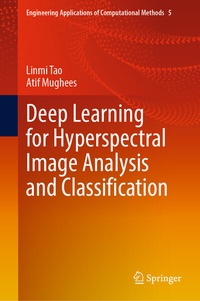
Deep Learning for Hyperspectral Image Analysis and Classification
Description

This book focuses on deep learning-based methods for hyperspectral image (HSI) analysis. Unsupervised spectral-spatial adaptive band-noise factor-based formulation is devised for HSI noise detection and band categorization. The method to characterize the bands along with the noise estimation of HSIs will benefit subsequent remote sensing techniques significantly.
This book develops on two fronts: On the one hand, it is aimed at domain professionals who want to have an updated overview of how hyperspectral acquisition techniques can combine with deep learning architectures to solve specific tasks in different application fields. On the other hand, the authors want to target the machine learning and computer vision experts by giving them a picture of how deep learning technologies are applied to hyperspectral data from a multidisciplinary perspective. The presence of these two viewpoints and the inclusion of application fields of remote sensing by deep learning are theoriginal contributions of this review, which also highlights some potentialities and critical issues related to the observed development trends.
More details
Other editions
Additional editions
Persons
Linmi Tao received the B.S. degree in Biology from Zhejiang University, Zhejiang, China, the M.S. degree in Cognitive Science from the Chinese Academy of Sciences, Beijing, China, and the Ph.D. degree in Computer Science from Tsinghua University, Beijing. He is currently an Associate Professor with the Department of Computer Science and Technology, Tsinghua University. He has studied and worked with the International Institute for Advanced Scientific Studies and the University of Verona, Italy, and Tsinghua University on computational visual perception, 3D visual information processing, and computer vision. His research work covers a broad spectrum of computer vision, computational cognitive vision, and human-centered computing based on his cross-disciplinary background. Currently, his research is mainly focused on vision and machine learning areas, including deep learning based hyperspectral image processing, medical image processing, and visual scene understanding.
Atif Mughees received his B.E. and M.S. degree in Computer Software from the National University of Science and Technology Islamabad, Pakistan, in 2005 and 2009, respectively, and Ph.D. degree in Computer Vision and Deep Learning from the Key Laboratory of Pervasive Computing, Department of Computer Science and Technology, Tsinghua University, Beijing, China, in 2018. His research interests include image processing, remote sensing applications, and machine learning with a special focus on spectral and spatial techniques for hyperspectral image classification.
