

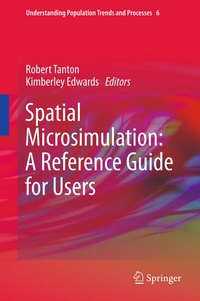
Spatial Microsimulation: A Reference Guide for Users
Description

Reviews / Votes
"This edited volume serves as a guide for those looking to learn more about spatial microsimulation modeling. . The book is well organized and topics appear sequentially. This text includes many useful topics and procedures for practitioners and researchers alike in the arena of spatial microsimulation. . Those intending to research further into the benefits of the use of microsimulation models should find this text very informative." (S. E. Ahmed, Technometrics, Vol. 57 (1), February, 2015)
More details
Other editions
Additional editions
Content
Part 1: Background: Chapter 1: Introduction to spatial microsimulation - History, Methods and Applications: Robert Tanton and Kimberley Edwards .- Chapter 2: Building a static spatial microsimulation model: data preparation: Rebecca Cassells, Riyana Miranti and Ann Harding.- Part 2: Static spatial microsimulation models.- Chapter 3: An Evaluation of Two Synthetic Small-Area Microdata simulation methodologies: Synthetic Reconstruction and Combinatorial Optimisation methodologies: Paul Williamson.- Chapter 4: Estimating Small Area Income Deprivation: An Iterative Proportional Fitting Approach: Ben Anderson.- Chapter 5: SimObesity: Combinatorial Optimisation (deterministic) model: Kimberley Edwards and Graham Clarke .- Chapter 6: Spatial Microsimulation using a generalised regression model: Robert Tanton, Ann Harding and Justine McNamara .- Chapter 7: Creating a Spatial Microsimulation model of the Irish Local Economy: Niall Farrell, Karyn Morrissey andCathal O'Donoghue .- Chapter 8: Linking static spatial microsimulation modelling to meso-scale models: The Relationship between Access to GP services & Long Term Illness: Karyn Morrissey, Graham Clarke and Cathal O'Donoghue .- Chapter 9: Projections using a static Spatial Microsimulation model: Yogi Vidyattama and Robert Tanton .- Chapter 10: Limits of static Spatial Microsimulation models: Robert Tanton and Kimberley Edwards .- Part 3: Dynamic spatial microsimulation models.- Chapter 11: Moses: A dynamic spatial microsimulation model for demographic planning: Belinda Wu and Mark Birkin .- Chapter 12: Design principles for micro models: Einar Holm and Kalle Mäkilä .- Chapter 13: SimEducation: a dynamic spatial microsimulation model for understanding educational inequalities: Dimitris Kavroudakis, Dimitris Ballas and Mark Birkin .- Chapter 14: Challenges for spatial dynamic microsimulation modelling: Mark Birkin .- Part 4: Validation of spatial microsimulation models and conclusion.- Chapter 15: Validation of spatial microsimulation models: Kimberley Edwards and Robert Tanton .- Chapter 16: Conclusions and the future of spatial microsimulation modelling: Graham Clarke and Ann Harding.
