

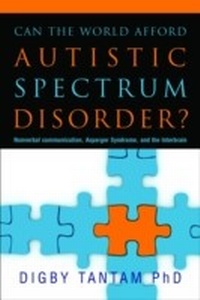
Can the World Afford Autistic Spectrum Disorder?
Nonverbal Communication, Asperger Syndrome and the Interbrain
Published on 15. April 2009
256 pages
978-1-84642-936-1 (ISBN)
Description

The world affords to most of us a web of subliminal nonverbal communication that regulates our minds, indicates whether our beliefs have, or have not, social approval, and generally guides us. People with autism do not seem to be influenced by these subliminal signals as much as others, and this results in the difficulties in social interaction that are so characteristic of all the autistic spectrum disorders. How is such nonverbal communication carried out, and why do people on the autism spectrum find it so difficult? What are the consequences of this for them, and how do these consequences affect their personality, self-awareness, and sense of place in the world?
Digby Tantam explores current theories on nonverbal communication and how it shapes social behaviour, and the evidence for it being impaired in people with autism spectrum disorder (ASD). He shows how knowledge of this difference can be used to overcome some of the impairments in nonverbal communication in people with ASD, but also how acknowledging them can result in more positive development elsewhere.
This groundbreaking book will be fascinating reading for anyone interested in communication, as well as people who have ASD themselves, their families, and all professionals working with people on the autism spectrum.
Digby Tantam explores current theories on nonverbal communication and how it shapes social behaviour, and the evidence for it being impaired in people with autism spectrum disorder (ASD). He shows how knowledge of this difference can be used to overcome some of the impairments in nonverbal communication in people with ASD, but also how acknowledging them can result in more positive development elsewhere.
This groundbreaking book will be fascinating reading for anyone interested in communication, as well as people who have ASD themselves, their families, and all professionals working with people on the autism spectrum.
Reviews / Votes
Can the World Afford Autistic Spectrum Disorder? is a fascinating existential volume, with numerous new concepts and terms that are most rewarding for both the curious reader, and the psychotherapist... The text is scholarly, most intelligible and interesting, very well referenced, and informs the existential practitioner in an admirably humane manner of all necessary dynamics. So, I can recommend this title to both the academic, and the interested public. This book is an authoritative, useful contribution to the study of ASD. -- Existential Analysis The book unfolds in a logical and sensible manner, beginning with a thorough introduction to non-verbal communication. In subsequent chapters, Tantam carefully builds his argument by drawing on evidence from research and clinical practice, also discussing the possible biological underpinnings of his ideas. Finally, he covers the extended consequences of non-verbal communication impairment and considers how the interbrain framework can be used to assist in understanding people with autism-spectrum disorder. The author's influences as a clinical psychotherapist and as a scientist are evident throughout the book and he is particularly impressive at fusing the biological and psychological aspects of autism-spectrum disorder. He makes extensive use of analogy and real-life vignettes to illustrate his ideas, making complex concepts easy to grasp and the book interesting and enjoyable to read. -- The British Journal of Psychiatry This thoughtful new book by Professor Digby Tantam is the result of a long career spanning more than two decades focused on understanding the puzzle of autism. As far back as the early 1980s Professor Tantam was studying the related condition of Asperger Syndrome, long before the rest of the English speaking medical community had realized that this subgroup even existed, let alone what its relationship was to classic autism. In this new book, Digby Tantam dissects one of the core 'symptoms' of autism and Asperger Syndrome, namely decoding non-verbal communication. He takes us from the level of behaviour to deep within the brain, to understand how emotional expressions and social signals can be the product of neural systems, and how these can function differently in autism spectrum conditions. And he asks the provocative question of whether such conditions really are disabilities, or whether they bring with them a combination of innocence and originality that are not just attractive but invaluable qualities. Written with the rare combination of scientific curiosity and compassion, this book will enrich both our understanding of and society's stance towards those on the autistic spectrum. -- Autism Research Centre, Cambridge University This book certainly had resonance with my experience as a father of two children with an ASD, and provides hope for the future. -- Communication Journeying through this book is akin to completing a memorable travel book written by an experienced explorer. I am glad of the journey and enlightened by the experience. -- Therapy Today In his highly readable and accessible book on the endlessly fascinating subject of autistic spectrum disorder (ASD), Professor Tantam draws on a wide range of respected and accepted research, which encapsulates much of what is known about specific dysfunctions in those affected. He illustrates his points with examples of people who have been diagnosed with Asperger's syndrome, including some whose diagnoses are questionable. But, most importantly for this book, he explores the theory he has developed for explaining the benefits in those affected by ASD through a useful contemporary metaphor based around computer technology...This book provides a thought-provoking read, both psychological and philosophically. -- Human Givens Journal Dr. Tantam's book takes us through a fascinating tour of a world where social experience is essentially the co-creation of people engaged in fast, broad, and essentially nonverbal "inter-action". Words are slow, linear, and often obfuscate rather than illuminate others' intentions. This vastly neglected area of research is also likely the single greatest challenge for individuals with autism. Thus in one stroke Dr. Tantam both compels us to uphold social intuition for investigation, and helps us to appreciate what social contact is in the absence of this invisible glue. -- Ami Klin, Ph.D., Director of Autism Program, Harris Professor of Child Psychology and Psychiatry Yale Child Study Center The book provides comprehensive text that attempts to dissect one of the core symptoms namely decoding non-verbal communication in ASD populations. However, the title maybe misleading as the main theme of the book relates to the sub title of non verbal communication and the interbrain. Based on the latest theories of how non-verbal communication shapes social behaviour, the book sharpens one's understanding of non-verbal communication. It also provides ample evidence of why people with ASD find non-verbal communication so difficult. -- Cotss PLD NewsletterAll prices
More details
Edition
Digital original
Language
English
Place of publication
London
United Kingdom
Target group
College/higher education
Professional and scholarly
Edition type
Digital original
File size
3,30 MB
ISBN-13
978-1-84642-936-1 (9781846429361)
Copyright in bibliographic data and cover images is held by Nielsen Book Services Limited or by the publishers or by their respective licensors: all rights reserved.
Schweitzer Classification
Other editions
Additional editions
Digby Tantam
Can the World Afford Autistic Spectrum Disorder?
Nonverbal Communication, Asperger Syndrome and the Interbrain
Book
04/2009
Jessica Kingsley Publishers
€47.27
Article exhausted; check different version
Person
Digby Tantam is Clinical Professor of Psychotherapy at the University of Sheffield, and Honorary Consultant Psychiatrist and Psychotherapist for Sheffield Care Trust. He founded an Asperger Syndrome clinic in 1980, and has written numerous articles and books on autism spectrum disorders.
Content
Acknowledgements. Introduction. 1: What is Nonverbal Communication, and How Does it Affect Us? 2: What is the Importance of Gaze and Shared Attention? 3: What do People Make of Nonverbal Communication? 4: What is the Evidence that Impaired Nonverbal Communication is the Fundamental Problem in Autistic Spectrum Disorder? 5: Is an Impairment of Nonverbal Communication a Brain Problem? 6: What are the Consequences of Lving with an Impairment in Nonverbal Communication? 7: Nonverbal Communication as a Tool to Understanding and Moving Forward. 8: Can Society Afford People with ASD? Revisited. References. Index.

