

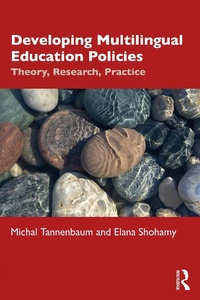
Developing Multilingual Education Policies
Theory, Research, Practice
1st Edition
Published on 23. February 2023
208 pages
978-1-000-82928-0 (ISBN)
Description

Multilingual policies are increasingly important and required in educational settings worldwide, yet a solid experimental body of theory, research, and practice providing guidance for the development of policies is lacking. The Israeli context presented in this book serves as a case study or a model that could be used by bodies or entities seeking to devise a multilingual policy.
The authors begin by addressing the general notion of a multilingual education policy with specific reference to the Israeli context. The book then focuses on specific challenges confronting the new policy that have been explored in empirical studies, and concludes with a proposed framework for a new multilingual education policy related to the core theoretical topics and empirical findings discussed in the previous chapters. This framework includes principles and strategies for implementing the process described in the book in other contexts, ensuring wide applicability and relevance.
Developing Multilingual Education Policies: Theory, Research, Practice is an essential read for all involved in language policy and planning within applied linguistics and education.
The authors begin by addressing the general notion of a multilingual education policy with specific reference to the Israeli context. The book then focuses on specific challenges confronting the new policy that have been explored in empirical studies, and concludes with a proposed framework for a new multilingual education policy related to the core theoretical topics and empirical findings discussed in the previous chapters. This framework includes principles and strategies for implementing the process described in the book in other contexts, ensuring wide applicability and relevance.
Developing Multilingual Education Policies: Theory, Research, Practice is an essential read for all involved in language policy and planning within applied linguistics and education.
Reviews / Votes
This is clear thinking and solid experience toward education for a truly democratic and just multilingual world. Beloved scholar-advocates Tannenbaum and Shohamy share wisdom, expertise and a way forward for multilingual education policy, drawing on their decades of lived experience and dedicated language policy research and practice in conflict-ridden Israel.Nancy H. Hornberger, University of Pennsylvania, USA
In this empirically rich and conceptually cogent book, Michal Tannenbaum and Elana Shohamy present a new multilingual education policy in Israel through Shared Education and an array of innovative pedagogical and assessment approaches. The implications of this work go well beyond language and education. It is in fact a new vision for the nation, with diversity and peace at the heart of it.
Li Wei, University College London, UK
More details
Edition
1. Auflage
Language
English
Place of publication
London
United Kingdom
Publishing group
Taylor & Francis Ltd
Target group
Professional and scholarly
Illustrations
10 Tables, black and white; 2 Line drawings, black and white; 15 Halftones, black and white; 17 Illustrations, black and white
ISBN-13
978-1-000-82928-0 (9781000829280)
Copyright in bibliographic data and cover images is held by Nielsen Book Services Limited or by the publishers or by their respective licensors: all rights reserved.
Schweitzer Classification
Other editions
Additional editions
Michal Tannenbaum | Elana Shohamy
Developing Multilingual Education Policies
Theory, Research, Practice
Book
02/2023
1st Edition
Routledge
€58.00
Shipment within 15-20 days
Michal Tannenbaum | Elana Shohamy
Developing Multilingual Education Policies
Theory, Research, Practice
Book
02/2023
1st Edition
Routledge
€185.90
Shipment within 15-20 days
Persons
Michal Tannenbaum is currently the chair of the Program for Multilingual Education at Tel Aviv University. She researches and writes about multiple perspectives of language policy, including family and education systems, emotional aspects of immigration and language sustainability, multilingualism, and art. She edited the book Challenges for Language Education and Policy: Making Space for People (with B. Spolsky & O. Inbar-Lourie; 2014, Routledge).
Elana Shohamy is a professor of multilingual education at Tel Aviv University where she researches and writes about multiple dimensions of language policy, language rights, immigration, language testing, and linguistic landscape. Her books include Language Policy: Hidden Agendas and New Approaches (2006, Routledge), and Linguistic Landscape: Expanding the Scenery (edited with D. Gorter; 2009, Routledge).
Elana Shohamy is a professor of multilingual education at Tel Aviv University where she researches and writes about multiple dimensions of language policy, language rights, immigration, language testing, and linguistic landscape. Her books include Language Policy: Hidden Agendas and New Approaches (2006, Routledge), and Linguistic Landscape: Expanding the Scenery (edited with D. Gorter; 2009, Routledge).
Content
Acknowledgements
Introduction
A journey towards a new multilingual policy
PART One - Language policy, multilingualism, and education
Chapter 1 A new approach to language education policy
Chapter 2 Languages and policy in Israel: History and the present
Chapter 3 Advocating for a new multilingual education policy in Israel
PART Two - From policy challenges to research: Major issues
Chapter 4 Stakeholder's attitudes and perceptions regarding multilingual education policies
Chapter 5 Testing and assessment of minority students: Language and content
Chapter 6 Incorporating L1 in the context of teaching English as an additional language
Chapter 7 Connecting Jewish and Arab students via Shared Education
Chapter 8 The role of heritage languages in multilingual education policies
Chapter 9 The linguistic landscape as multilingual awareness
PART Three - Conclusions, implementations, and challenges
Chapter 10 Principles of the new multilingual education policy
Chapter 11 Conclusions, challenges, and future directions
References
Appendices
Introduction
A journey towards a new multilingual policy
PART One - Language policy, multilingualism, and education
Chapter 1 A new approach to language education policy
Chapter 2 Languages and policy in Israel: History and the present
Chapter 3 Advocating for a new multilingual education policy in Israel
PART Two - From policy challenges to research: Major issues
Chapter 4 Stakeholder's attitudes and perceptions regarding multilingual education policies
Chapter 5 Testing and assessment of minority students: Language and content
Chapter 6 Incorporating L1 in the context of teaching English as an additional language
Chapter 7 Connecting Jewish and Arab students via Shared Education
Chapter 8 The role of heritage languages in multilingual education policies
Chapter 9 The linguistic landscape as multilingual awareness
PART Three - Conclusions, implementations, and challenges
Chapter 10 Principles of the new multilingual education policy
Chapter 11 Conclusions, challenges, and future directions
References
Appendices
