

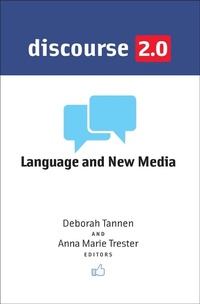
Discourse 2.0
Description

Our everyday lives are increasingly being lived through electronic media, which are changing our interactions and our communications in ways that we are only beginning to understand. In Discourse 2.0: Language and New Media, editors Deborah Tannen and Anna Marie Trester team up with top scholars in the field to shed light on the ways language is being used in, and shaped by, these new media contexts.
Topics explored include: how Web 2.0 can be conceptualized and theorized; the role of English on the worldwide web; how use of social media such as Facebook and texting shape communication with family and friends; electronic discourse and assessment in educational and other settings; multimodality and the "participatory spectacle" in Web 2.0; asynchronicity and turn-taking; ways that we engage with technology including reading on-screen and on paper; and how all of these processes interplay with meaning-making.
Students, professionals, and individuals will discover that Discourse 2.0 offers a rich source of insight into these new forms of discourse that are pervasive in our lives.
More details
Other editions
Additional editions
Persons
Deborah Tannen is university professor and professor of linguistics at Georgetown University and author of many books on discourse analysis.
Anna Marie Trester is a professorial lecturer and director of the master's program in language and communication in the Department of Linguistics at Georgetown University.
Content
Introduction
Deborah Tannen and Anna Marie Trester, Georgetown University
1. Discourse in Web 2.0: Familiar, Reconfigured, and Emergent
Susan C. Herring, Indiana University-Bloomington
2. Polities and Politics of Ongoing Assessments: Evidence from Video-Gaming and Blogging
Hervé Varenne, Gillian "Gus" Andrews, Aaron Chia-Yuan Hung, and Sarah Wessler, Teachers College, Columbia University
3. Participatory Culture and Metalinguistic Discourse: Performing and Negotiating German Dialects on YouTube
Jannis Androutsopoulos, University of Hamburg
4. "My English Is So PoorSo I Take Photos": Metalinguistic Discourses about English on Flickr
Carmen Lee, Chinese University of Hong Kong
5. "Their Lives Are So Much Better Than Ours!": The Ritual (Re)construction of Social Identity in Holiday Cards
Jenna Mahay, Concordia University Chicago
6. The Medium Is the Metamessage: Conversational Style in New Media Interaction
Deborah Tannen, Georgetown University
7. Bringing Mobiles into the Conversation: Applying a Conversation Analytic Approach to the Study of Mobiles in Co-present Interaction
Stephen M. DiDomenico, Rutgers University and Jeffrey Boase, Ryerson University
8. Facework on Facebook: Conversations on Social Media
Laura West and Anna Marie Trester, Georgetown University
9. Mock Performatives in Online Discussion Boards: Towards a Discourse-Pragmatic Model of Computer-Mediated Communication
Tuija Virtanen, Åbo Akademi University
10. Re- and Pre-authoring Experiences in Email Supervision: Creating and Revising Professional Meanings in an Asynchronous Medium
Cynthia Gordon and Melissa Luke, Syracuse University
11. Blogs: A Medium for Intellectual Engagement with Course Readings and Participants
Marianna Ryshina-Pankova and Jens Kugele, Georgetown University
12. Reading in Print or Onscreen: Better, Worse, or About the Same?
Naomi S. Baron, American University
13. Fakebook: Synthetic Media, Pseudo-sociality, and the Rhetorics of Web 2.0
Crispin Thurlow, University of Washington
Index
