

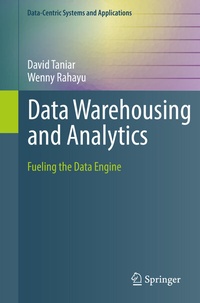
Data Warehousing and Analytics
Description

This textbook covers all central activities of data warehousing and analytics, including transformation, preparation, aggregation, integration, and analysis. It discusses the full spectrum of the journey of data from operational/transactional databases, to data warehouses and data analytics; as well as the role that data warehousing plays in the data processing lifecycle. It also explains in detail how data warehouses may be used by data engines, such as BI tools and analytics algorithms to produce reports, dashboards, patterns, and other useful information and knowledge.
The book is divided into six parts, ranging from the basics of data warehouse design (Part I - Star Schema, Part II - Snowflake and Bridge Tables, Part III - Advanced Dimensions, and Part IV - Multi-Fact and Multi-Input), to more advanced data warehousing concepts (Part V - Data Warehousing and Evolution) and data analytics (Part VI - OLAP, BI, and Analytics).
This textbook approaches data warehousing from the case study angle. Each chapter presents one or more case studies to thoroughly explain the concepts and has different levels of difficulty, hence learning is incremental. In addition, every chapter has also a section on further readings which give pointers and references to research papers related to the chapter. All these features make the book ideally suited for either introductory courses on data warehousing and data analytics, or even for self-studies by professionals. The book is accompanied by a web page that includes all the used datasets and codes as well as slides and solutions to exercises.
More details
Other editions
Additional editions
Persons
Wenny Rahayu is a Professor in Computer Science and currently the Dean of the School of Engineering and Mathematical Sciences, La Trobe University, Australia. She graduated with a PhD degree in Computer Science, specializing in Databases from La Trobe University in 2001. Her PhD thesis has been awarded the Best PhD Thesis Award by The Computing Research and Education Association of Australasia (CORE), an association of university departments of computer science in Australia and New Zealand. She has published more than 300 papers and successfully supervised 17 PhD students in databases.
Content
1. Introduction.- Part I: Star Schema.- 2. Simple Star Schemas.- 3. Creating Facts and Dimensions: More Complex Processes.- Part II: Snowflake and Bridge Tables.- 4. Hierarchies.- 5. Bridge Tables.- 6. Temporal Data Warehousing.- Part III: Advanced Dimension.- 7. Determinant Dimensions.- 8. Junk Dimensions.- 9. Dimension Keys.- 10. One-Attribute Dimensions.- Part IV: Multi-Fact and Multi-Input.- 11. Multi-Fact Star Schemas.- 12. Slicing a Fact.- 13. Multi-Input Operational Databases.- Part V: Data Warehousing Granularity and Evolution.- 14. Data Warehousing Granularity and Levels of Aggregation.- 15. Designing Lowest-Level Star Schemas.- 16. Levels of Aggregation: Adding and Removing Dimensions.- 17. Levels of Aggregation and Bridge Tables.- 18. Active Data Warehousing.- Part VI: OLAP, Business Intelligence, and Data Analytics.- 19. Online Analytical Processing (OLAP).- 20. Pre- and Post-Data Warehousing.- 21. Data Analytics for Data Warehousing.
