

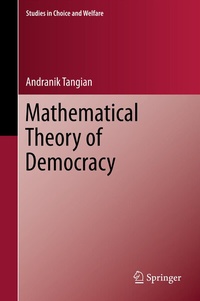
Mathematical Theory of Democracy
Description

The mathematical theory of democracy deals with selection of representatives who make decisions on behalf of the whole society. In this book, the notion of representativeness is operationalized with the index of popularity (the average percentage of the population whose opinion is represented on a number of issues) and the index of universality (the frequency of cases when the opinion of a majority is represented). These indices are applied to evaluate and study the properties of single representatives (e.g. president) and representative bodies (e.g. parliament, magistrate, cabinet, jury, coalition). To bridge representative and direct democracy, an election method is proposed that is based not on voting but on indexing candidates with respect to the electorate's political profile. In addition, societal and non-societal applications are considered.
Reviews / Votes
From the reviews:
"This book is much more technical and goes into more theoretical depth, and . it is worth seeking out if you are looking for this type of treatment. . Tangian has managed to write about an incredibly wide range of topics in great mathematical, historical, and philosophical depth, and yet the book is very readable. . reader who wishes to dedicate the required time and energy will learn quite a bit about Democracy, its history, its limitations, and its strengths." (Darren Glass, MAA Reviews, February, 2014)
"The book consists of three parts: history, theory and applications. . Andranik Tangian has written an impressive volume, not only in size, but particularly in terms of the fields covered. The author's erudition is remarkable. . The historical part of the book is suitable for independent study . . Parts two and three . are suitable for advanced doctoral courses in welfare economics, political science and applied mathematics." (Hannu Nurmi, Journal of Economics, Vol. 111, 2014)
"The author provides a novel viewpoint, engaging analyses in a stimulating historical context, and interesting new methods and suggestions which certainly have the strong merit of being oriented towards practical concerns. . overall, this is a well-written engaging book offering new ideas which are certainly worth considering when attempting practical reforms to modern-day democratic institutions and is well worth reading." (Swapan Das Gupta, zbMATH, Vol. 1283, 2014)
More details
Other editions
Additional editions
Person
Dr. Dr. Andranik Tangian is head of referat `Policy modeling' of the Institute for Economic and Social Research (WSI) in the Hans-Böckler-Foundation, Düsseldorf, and Professor of the Karlsruhe Institute of Technology
