

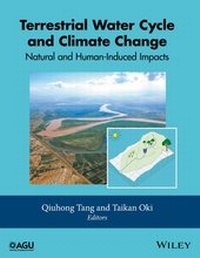
Terrestrial Water Cycle and Climate Change
Description

More details
Other editions
Additional editions
Persons
Qiuhong Tang is a Professor in the Institute of Geographic Sciences and Natural Resources Research at the Chinese Academy of Sciences in Beijing, China. His research focuses on Land surface hydrology, Global change, Remote sensing hydrology, Water resources. He has published extensively in many geological journals including the prestigious Nature Climate Change, Proceedings of the National Academy of Sciences, USA and AGU journal Geophysical Research Letters. He is a professional member of the American Geophysical Union (AGU), American Meteorological Society (AMS) and Geographical Society of China (GSC).
Content
1
Macroscale Hydrological Modeling and Global Water Balance
Taikan Oki and Hyungjun Kim
Institute of Industrial Science, The University of Tokyo, Tokyo, Japan
ABSTRACT
An overview of the global hydrological cycle, and recent achievements in macroscale modeling are given. Major components of fluxes and storages in the global hydrological cycle are described and quantitatively illustrated based on an off-line simulation framework. Methodologies for estimating fluxes and storage changes are presented from the simple water balance concept to the state-of-the-art numerical models that are capable of incorporating anthropogenic impacts. Efforts made by international research communities on global-scale hydrologic modeling are introduced. Current situations of modeling, research opportunities, and gaps in global hydrology are also identified.
1.1. INTRODUCTION
"Blue Planet" is a frequently used term to describe the Earth, as approximately 70% of its surface is covered by water. Although the water mass constitutes only 0.02% of the total mass of the planet (5.974 × 1024 kg), it is a critical matter for all organisms including humans in their survival [Oki et al., 2004]. Also, its availability has largely affected civilizations in both culture and economy in human history. Therefore, to ensure adequate fresh water supply is essential for human well-being.
The Earth's surface is dominated by various forms of water. The total volume of water on the Earth is estimated to be approximately 1.4 × 10¹⁸ m3, which corresponds to a mass of 1.4 × 10²¹ kg. The global hydrologic cycle always includes the oceanic circulation. The proportion of water in the ocean is large (96.5%). Oceanic circulations carry large amounts of energy and water. The surface ocean currents are driven by surface wind stresses, and the atmosphere itself is sensitive to the sea surface temperature. Temperature and salinity together determine the density of ocean water, and both factors contribute to the overturning and the ocean general circulation. Some terrestrial areas are covered by freshwater (lakes and rivers), solid water (ice and snow), and vegetations (which imply the existence of water). Even though the water content of the atmosphere is relatively small (approximately 0.3% by mass and 0.5% by volume), 0.68 (±0.03)% of the area above the Earth is always covered by clouds when considering clouds with optical depth > 0.1 [Stubenrauch et al., 2013].
Water on the Earth is stored in various reservoirs, and water flows from one to another. Water flow per unit time is also called water flux. To understand the global water cycle, the quantification of fluxes and storages with the associated processes is necessary. Figure 1.1 schematically illustrates various water storages and fluxes in the global hydrologic system [revised from Oki and Kanae, 2006].
Figure 1.1 Global hydrological fluxes (1000 km3 yr-1) and storages (1000 km3) with natural and anthropogenic cycles are synthesized from various sources. Vertical arrows show annual precipitation and evapotranspiration over ocean and land with major landscapes (1000 km3 yr-1). Parentheses indicate the area (million km2)
[from Oki and Kanae, 2006].
The objective of this chapter is to give a brief overview of research approaches for global water-balance estimation. To provide basic background of the water cycle, in Section 1.2, major components of terrestrial hydrologic processes are briefly explained with quantitative estimations using a global off-line simulation. From Section 1.3 to Section 1.5, the major methodologies for water-balance estimations are described. An early estimation that used reanalysis data set and a simple water-balance equation is introduced, and the development of the model-based macroscale land simulation framework and recent achievements to consider the human impact are covered. Section 1.6 introduces how the science communities have organized international collaborative frameworks. As the last part, prospects for macroscale hydrologic model development in the near future are given in Section 1.7.
1.2. COMPONENTS OF TERRESTRIAL HYDROLOGICAL CYCLES
Precipitation is the water flux from the atmosphere to the land or the ocean surface. It drives the hydrological cycle over the land surface and also changes the ocean surface physical properties (i.e., salinity and temperature), which affect its thermohaline circulation. It is intercepted by vegetation canopy, and the amount exceeding the interception storage reaches the land surface as throughfall. Compared to the other major hydrological fluxes, precipitation behaves in a more variable, intermittent, and concentrated way in time and space. Despite dense gauge station networks, such a highly inhomogeneous spatiotemporal variability makes the observation of precipitation and the aggregation of the process complicated and challenging. In a hybrid product, such as Global Precipitation Climatology Project (GPCP) [Huffman et al., 1997], satellite-based estimates are merged with in situ observational data to fill the observational gaps. Global distribution of precipitation is presented in Figure 1.2a.
Figure 1.2 Global distribution of long-term (1979-2013) annual mean of (a) precipitation (mm yr-1) from the GPCC [Schneider et al., 2014], (b) evapotranspiration (mm yr-1), (c) runoff (mm yr-1), (d) river discharge (m3 yr-1), (e) groundwater recharge (mm yr-1), and (f) soil wetness (-) from off-line hydrological simulations by Ensemble Land Surface Estimator (ELSE)
[Kim and Oki, 2014].
Snow has special characteristics compared to rain which refers to the liquid phase of precipitation. When snow accumulates, the surface temperature keeps 0 °C or below until the completion of snow melt. The albedo of new snow can be as high as cloud albedo, and it varies between 0.6 and 0.9 in the aging process (covered with dust). Consequently, the existence of snow significantly changes the surface budget of energy and water. A snow surface typically reduces the aerodynamic roughness, so that it may also have a dynamic effect on the atmospheric circulation and associated local and remote hydrologic cycles.
Evapotranspiration, consisting of evaporation and transpiration, is the flow of water and latent heat energy returning from the surface to the atmosphere. The amount of evaporation is determined by both atmospheric and hydrological conditions. Wetness at the surface influences the partition between latent and sensible heat significantly. The ratio of actual evaporation to potential evaporation is reduced due to drying stress near the surface. The stress is sometimes formulated as a resistance under which evaporation is classified as hydrology-driven (soil-controlled). If the land surface is wet enough compared to available energy for evaporation, the condition is classified as radiation driven (atmosphere controlled).
Transpiration is the release of water vapor from the stomata of leaves. It is distinguished from evaporation from soil surfaces in two aspects. One is that the resistance of stomata does not relate only to the soil dryness but also to the physiological conditions of vegetation through the opening and closing of stomata. The other is that roots can transfer water from deeper soil layers in contrast to evaporation over bare soil. Vegetation also modifies the balance of surface energy and water by altering surface albedo and by intercepting and evaporating a part of precipitation. The global distribution of total evapotranspiration is shown in Figure 1.2b.
Runoff (Fig. 1.2c) carries water back to the ocean from the land. Without rivers, global hydrologic cycles on the Earth are not closed. Runoff into the ocean also plays a role in the freshwater balance and the salinity of the ocean. Rivers carry not only water but also sediments, chemicals, and various nutrient materials from continents to seas. Runoff at the hillslope scale is a nonlinear and complex process. Surface runoff can be generated when the intensity of rainfall or snowmelt exceeds the infiltration capacity of the soil (Hortonian runoff), or when rain falls on the saturated land surface (Dunne runoff).
Saturation at the land surface mostly occurs along the hill slopes according to the topographic concentration mechanism. Infiltrated water in the upper part of the hill slope flows down the slope and discharges at the bottom of the hill. Because of the high heterogeneity of topography, soil properties (such as hydraulic conductivity and porosity), and precipitation, basic equations such as Richard's equation, which can be valid fairly well at a point scale or hillslope scale, cannot be directly applied in the macroscale using the mean quantities because of the nonlinearity involved. The river discharge accumulates total runoff generated in upstream watershed. The global distributions of runoff and river discharge are illustrated in Figure 1.2c and d.
Groundwater is the subsurface water in the saturated zone. It contributes to the runoff in the low-flow regime between storm events, that is, during a dry spell. Deep groundwater may also reflect the long-term climatological condition. The groundwater quantity in Figure 1.1 considers...
