

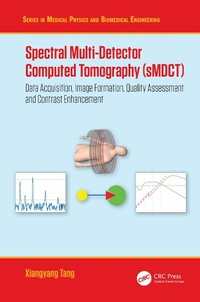
Spectral Multi-Detector Computed Tomography (sMDCT)
Data Acquisition, Image Formation, Quality Assessment and Contrast Enhancement
1st Edition
Published on 7. December 2023
292 pages
978-0-429-64769-7 (ISBN)
Description

X-ray computed tomography (CT) has been one of the most popular diagnostic imaging modalities for decades in the clinic for saving patients' lives or improving their quality of life. This book is an introductory one-stop shop for technological and clinical topics in multi-detector computed tomography (MDCT).
Starting with MDCT's fundamentals in physics and mathematics, the book provides an in-depth introduction to its system architecture and imaging chain, signal detection via energy-integration and photon-counting mechanisms, clinical application-driven scan modes and protocols, analytic and iterative image reconstruction solutions, and spectral imaging - the latest technological advancement in MDCT. The book extends its coverage on image quality assessment under the theory of signal detection and statistical decision. In recognition of its clinical relevance for conspicuity enhancement in angiographic and parenchymal imaging applications, the book features a chapter dedicated to the fundamental (chemical, physical and physicochemical) properties and clinical administration of iodinated contrast agent. The book ends with an outlook of the contrast agents that are novel in material and delivery, and their synergy with spectral MDCT to elevate CT's contrast resolution in cardiovascular, neurovascular and oncologic applications. This book will be an invaluable reference for researchers, engineers, radiological physicians and technologists, and graduate and senior undergraduate students.
Features
Provides an accessible introduction to the subject
Up to date with the latest advances in emerging technologies and procedures
Provides a historical overview of CT technology
Starting with MDCT's fundamentals in physics and mathematics, the book provides an in-depth introduction to its system architecture and imaging chain, signal detection via energy-integration and photon-counting mechanisms, clinical application-driven scan modes and protocols, analytic and iterative image reconstruction solutions, and spectral imaging - the latest technological advancement in MDCT. The book extends its coverage on image quality assessment under the theory of signal detection and statistical decision. In recognition of its clinical relevance for conspicuity enhancement in angiographic and parenchymal imaging applications, the book features a chapter dedicated to the fundamental (chemical, physical and physicochemical) properties and clinical administration of iodinated contrast agent. The book ends with an outlook of the contrast agents that are novel in material and delivery, and their synergy with spectral MDCT to elevate CT's contrast resolution in cardiovascular, neurovascular and oncologic applications. This book will be an invaluable reference for researchers, engineers, radiological physicians and technologists, and graduate and senior undergraduate students.
Features
Provides an accessible introduction to the subject
Up to date with the latest advances in emerging technologies and procedures
Provides a historical overview of CT technology
More details
Series
Edition
1. Auflage
Language
English
Place of publication
London
United Kingdom
Publishing group
Taylor & Francis Ltd
Target group
College/higher education
Product notice
Reflowable
Illustrations
10 Tables, black and white; 38 Line drawings, color; 20 Line drawings, black and white; 18 Halftones, color; 32 Halftones, black and white; 56 Illustrations, color; 52 Illustrations, black and white
ISBN-13
978-0-429-64769-7 (9780429647697)
Copyright in bibliographic data and cover images is held by Nielsen Book Services Limited or by the publishers or by their respective licensors: all rights reserved.
Schweitzer Classification
Other editions
Additional editions
Xiangyang Tang
Spectral Multi-Detector Computed Tomography (sMDCT)
Data Acquisition, Image Formation, Quality Assessment and Contrast Enhancement
Book
06/2025
1st Edition
CRC Press
€98.50
Shipment within 10-20 days
Xiangyang Tang
Spectral Multi-Detector Computed Tomography (sMDCT)
Data Acquisition, Image Formation, Quality Assessment and Contrast Enhancement
Book
12/2023
1st Edition
CRC Press
€188.00
Shipment within 15-20 days
Person
Xiangyang Tang is an imaging scientist with extensive R&D experience in industry (GE Healthcare), academia (Emory University School of Medicine) and the clinic (Emory Healthcare).
With a focus on computed tomography, Dr. Tang has been working in the field of medical imaging for more than 20 years. He is Professor of Radiology and Imaging Sciences at Emory University School of Medicine, Fellow of SPIE (International Society for Optics and Photonics) and Fellow of AAPM (American Association of Physicists in Medicine). Along with the publication of more than 200 papers in leading scientific journals and conferences, his contributions to the scientific community include serving as Associate Editor for a number of prestigious journals, in addition to working on the scientific committees of leading conferences and panels for numerous federal and foundational study sections.
With a focus on computed tomography, Dr. Tang has been working in the field of medical imaging for more than 20 years. He is Professor of Radiology and Imaging Sciences at Emory University School of Medicine, Fellow of SPIE (International Society for Optics and Photonics) and Fellow of AAPM (American Association of Physicists in Medicine). Along with the publication of more than 200 papers in leading scientific journals and conferences, his contributions to the scientific community include serving as Associate Editor for a number of prestigious journals, in addition to working on the scientific committees of leading conferences and panels for numerous federal and foundational study sections.
Content
Chapter 1: Introduction. Chapter 2: Fundamentals in Mathematics for MDCT. Chapter 3: Fundamentals in Physics for MDCT. Chapter 4: Image Formation via Analytic Reconstruction Algorithms. Chapter 5: Image Formation via Iterative Reconstruction Algorithms. Chapter 6: Assessment of Image Quality in MDCT under Theory of Signal Detection and Statistical Decision. Chapter 7: Spectral MDCT (I): Physics, Data Acquisition and Image Formation. Chapter 8: Spectral MDCT (II): Optimization of Image Quality for Clinical Applications. Chapter 9: Contrast Agents for MDCT: Fundamentals, State-of-the-art and Outlook. Chapter 10: Challenges and Opportunities in Photon-counting Spectral MDCT.
