

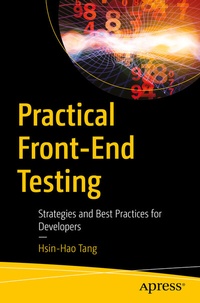
Practical Front-End Testing
Description

In the fast-paced and ever-evolving field of front-end development, one of the biggest challenges is maintaining high-quality code while producing work rapidly. This is why testing has become crucial. Deciding on the right testing approach and how to write and execute tests is a key issue every developer must consider. Code without tests is difficult to guarantee in terms of quality, and the solution lies in developing a solid testing strategy. This book provides practical guidance in front-end testing that will help you master a variety of techniques and understand how to apply them in real-world applications.
This book dives deep into the types and implementation of front-end testing to teach you best practices for building flexible, maintainable test code. By guiding you through various strategies, the book will help you produce test code efficiently. Its pragmatic approach promises to be useful if you encounter challenges when writing tests and are searching for solutions.
The book provides detailed explanations supported by visuals and code examples, helping you learn, practice, and apply various front-end tests. It presents clear principles and approaches to guide you in evaluating testing strategies and costs, so you can make the best choices. Additionally, the book contains thorough explanations of various challenges through easy-to-understand examples, enabling you to tackle testing obstacles with ease.
It begins with the fundamentals of testing, discussing basics like types of tests and naming conventions. The subsequent chapters cover how to write and use unit testing, integration testing, end-to-end testing, and visual testing. Additionally, the book includes a chapter on how to perform these tests. The final chapters focus on frequently asked questions about front-end testing, serving as a quick reference for developers. The book concludes with material on how to use AI in testing to boost productivity.
You Will Learn:
- How to write and employ a wide variety of tests, including unit testing, integration testing, end-to-end testing, and visual testing
- Effectively using AI tools to generate test code and enhance productivity
- Make informed decisions in testing, based on both cost and effectiveness
Who Is This Book For:
Front-end developers, full-stack developers, software testers, and QA automation developers.
More details
Other editions
Additional editions
Person
Hsin-Hao 'Summer' Tang is passionate about front-end development, with a strong focus on creating products that deliver excellent user experiences and high performance. She is a skilled SEO expert and an active blogger and writer. Her technical books in Chinese have been very well-received by developers.
Content
Chapter 1 - Getting Started with Testing.- Chapter 2 - Unit Testing.- Chapter 3 - Integration Testing.- Chapter 4 - End-to-end Testing.- Chapter 5 - Visual Testing.- Chapter 6 - After Writing the Test: What's Next? When and How to Perform Testing.- Chapter 7 - FAQ.- Chapter 8 - Leveraging AI for Writing Tests.- Chapter 9 - Summary.
