

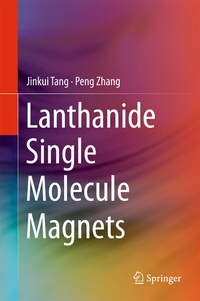
Lanthanide Single Molecule Magnets
Description

This book begins by providing basic information on single-molecule magnets (SMMs), covering the magnetism of lanthanide, the characterization and relaxation dynamics of SMMs and advanced means of studying lanthanide SMMs. It then systematically introduces lanthanide SMMs ranging from mononuclear and dinuclear to polynuclear complexes, classifying them and highlighting those SMMs with high barrier and blocking temperatures - an approach that provides some very valuable indicators for the structural features needed to optimize the contribution of an Ising type spin to a molecular magnet. The final chapter presents some of the newest developments in the lanthanide SMM field, such as the design of multifunctional and stimuli-responsive magnetic materials as well as the anchoring and organization of the SMMs on surfaces. In addition, the crystal structure and magnetic data are clearly presented with a wealth of illustrations in each chapter, helping newcomers and experts alike to better grasp ongoing trends and explore new directions.
Jinkui Tang is a professor at Changchun Institute of Applied Chemistry, Chinese Academy of Sciences.
Peng Zhang is currently pursuing his PhD at Changchun Institute of Applied Chemistry, Chinese Academy of Sciences, with a specific focus on the molecular magnetism of lanthanide compounds under the supervision of Prof. Jinkui Tang.
More details
Other editions
Additional editions
Persons
Jinkui Tang received his PhD degree in 2001 from Nankai University under the supervision of Prof. Dai-Zheng Liao and then worked as a postdoctoral fellow at Universität Karlsruhe (TH) in the research group of Prof. Annie K. Powell and Universiteit Leiden with Prof. Jan Reedijk, before initiating his independent career at Changchun Institute of Applied Chemistry, Chinese Academy of Sciences in 2007. His current research focuses on the synthesis and characterization of new molecular magnetic materials (including single molecule-magnets and single-molecule toroics) based on highly anisotropic lanthanide ions. His work has resulted in about 150 peer-reviewed publications.
Peng Zhang obtained his BSc in chemistry from Inner Mongolia University, China, in 2010. Now he is a PhD student supervised by Prof. Jinkui Tang at Changchun Institute of Applied Chemistry, Chinese Academy of Sciences (CAS). His current work focuses on lanthanide-based molecular magnetism.
Content
A Basis for Lanthanide Single Molecule Magnets.- Lanthanide Single Ion Molecule Magnets.- Dinuclear Lanthanide Single Molecule Magnets.- Single-molecule Toroics and Multinuclear Lanthanide Single Molecule Magnets.- Hydrazone-based Lanthanide Single Molecule Magnets.- Conclusion and Perspective.
