

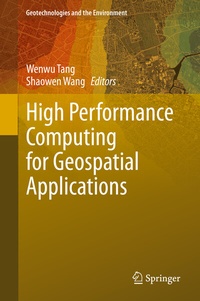
High Performance Computing for Geospatial Applications
Description

This volume fills a research gap between the rapid development of High Performance Computing (HPC) approaches and their geospatial applications. With a focus on geospatial applications, the book discusses in detail how researchers apply HPC to tackle their geospatial problems. Based on this focus, the book identifies the opportunities and challenges revolving around geospatial applications of HPC. Readers are introduced to the fundamentals of HPC, and will learn how HPC methods are applied in various specific areas of geospatial study.
The book begins by discussing theoretical aspects and methodological uses of HPC within a geospatial context, including parallel algorithms, geospatial data handling, spatial analysis and modeling, and cartography and geovisualization. Then, specific domain applications of HPC are addressed in the contexts of earth science, land use and land cover change, urban studies, transportation studies, and social science. The bookwill be of interest to scientists and engineers who are interested in applying cutting-edge HPC technologies in their respective fields, as well as students and faculty engaged in geography, environmental science, social science, and computer science.
More details
Other editions
Additional editions
Persons
Dr. Shaowen Wang is a Professor and Head of the Department of Geography and Geographic Information Science; Richard and Margaret Romano Professorial Scholar; and an Affiliate Professor of the Department of Computer Science, Department of Urban and Regional Planning, and School of Information Sciences at the University of Illinois at Urbana-Champaign (UIUC). He has served as Founding Director of CyberGIS Center for Advanced Digital and Spatial Studies at UIUC since 2013. He served as Associate Director of the National Center for Supercomputing Applications (NCSA) for CyberGIS from 2010 to 2017, and Lead of NCSA's Earth and Environment Theme from 2014 to 2017. He received a BS in computer engineering from Tianjin University, an MS in geography from Peking University, and an MS of computer science and a PhD in geography from the University of Iowa. His research interests include geographic information science and systems (GIS), advanced cyberinfrastructure and cyberGIS, complex environmental and geospatial problems, computational and data sciences, high-performance and distributed computing, and spatial analysis and modeling.
