

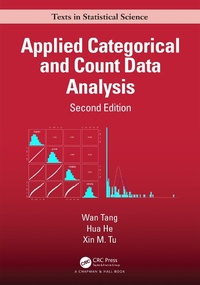
Applied Categorical and Count Data Analysis
2nd Edition
Published on 6. April 2023
400 pages
978-1-000-86397-0 (ISBN)
Description

Developed from the authors' graduate-level biostatistics course, Applied Categorical and Count Data Analysis, Second Edition explains how to perform the statistical analysis of discrete data, including categorical and count outcomes. The authors have been teaching categorical data analysis courses at the University of Rochester and Tulane University for more than a decade. This book embodies their decade-long experience and insight in teaching and applying statistical models for categorical and count data. The authors describe the basic ideas underlying each concept, model, and approach to give readers a good grasp of the fundamentals of the methodology without relying on rigorous mathematical arguments.
The second edition is a major revision of the first, adding much new material. It covers classic concepts and popular topics, such as contingency tables, logistic regression models, and Poisson regression models, along with modern areas that include models for zero-modified count outcomes, parametric and semiparametric longitudinal data analysis, reliability analysis, and methods for dealing with missing values. As in the first edition, R, SAS, SPSS, and Stata programming codes are provided for all the examples, enabling readers to immediately experiment with the data in the examples and even adapt or extend the codes to fit data from their own studies.
Designed for a one-semester course for graduate and senior undergraduate students in biostatistics, this self-contained text is also suitable as a self-learning guide for biomedical and psychosocial researchers. It will help readers analyze data with discrete variables in a wide range of biomedical and psychosocial research fields.
Features:
Describes the basic ideas underlying each concept and model
Includes R, SAS, SPSS and Stata programming codes for all the examples
Features significantly expanded Chapters 4, 5, and 8 (Chapters 4-6, and 9 in the second edition
Expands discussion for subtle issues in longitudinal and clustered data analysis such as time varying covariates and comparison of generalized linear mixed-effect models with GEE
The second edition is a major revision of the first, adding much new material. It covers classic concepts and popular topics, such as contingency tables, logistic regression models, and Poisson regression models, along with modern areas that include models for zero-modified count outcomes, parametric and semiparametric longitudinal data analysis, reliability analysis, and methods for dealing with missing values. As in the first edition, R, SAS, SPSS, and Stata programming codes are provided for all the examples, enabling readers to immediately experiment with the data in the examples and even adapt or extend the codes to fit data from their own studies.
Designed for a one-semester course for graduate and senior undergraduate students in biostatistics, this self-contained text is also suitable as a self-learning guide for biomedical and psychosocial researchers. It will help readers analyze data with discrete variables in a wide range of biomedical and psychosocial research fields.
Features:
Describes the basic ideas underlying each concept and model
Includes R, SAS, SPSS and Stata programming codes for all the examples
Features significantly expanded Chapters 4, 5, and 8 (Chapters 4-6, and 9 in the second edition
Expands discussion for subtle issues in longitudinal and clustered data analysis such as time varying covariates and comparison of generalized linear mixed-effect models with GEE
More details
Series
Edition
2nd edition
Language
English
Place of publication
London
United Kingdom
Publishing group
Taylor & Francis Ltd
Target group
Professional and scholarly
Illustrations
28 Tables, black and white; 3 Line drawings, color; 7 Line drawings, black and white; 3 Illustrations, color; 7 Illustrations, black and white
ISBN-13
978-1-000-86397-0 (9781000863970)
Copyright in bibliographic data and cover images is held by Nielsen Book Services Limited or by the publishers or by their respective licensors: all rights reserved.
Schweitzer Classification
Other editions
Additional editions
Wan Tang | Hua He | Xin M. Tu
Applied Categorical and Count Data Analysis
Book
04/2023
2nd Edition
Chapman & Hall/CRC
€115.00
Shipment within 15-20 days
Persons
Wan Tang (Ph.D.) is a Clinical Professor in the Department of Biostatistics and Data Science, Tulane University School of Public Health and Tropical Medicine. Dr. Tang's research interests include longitudinal data analysis, missing data modeling, structural equation models, causal inference, and nonparametric smoothing methods. He has co-edited a book on modern clinical trials.
Hua He (Ph.D.) is an Associate Professor in Biostatistics in the Department of Epidemiology at Tulane University School of Public Health and Tropical Medicine. Dr. He is a highly experienced biostatistician with expertise in longitudinal data analysis, structural equation models, potential outcome based causal inference, semiparametric models, ROC analysis and their applications to observational studies, and randomized controlled trials across a range of disciplines, especially in the behavioral and social sciences. She has co-authored a series of publications in peer-reviewed journals, one textbook on categorical data analysis and co-edited a book on statistical causal inference and their applications in public health research.
Xin Tu (Ph.D.) is a Professor in the Division of Biostatistics and Bioinformatics, Department of Family Medicine and Public Health, UCSD. Dr. Tu is well versed in statistical methods and their applications to a range of disciplines, particularly within the fields of biomedical, behavioral and social sciences. He has co-authored over 300 peer-reviewed publications, two textbooks on categorical data and applied U-statistics, and co-edited books on modern clinical trials and social network data analysis. He has done important work in the areas of longitudinal data analysis, causal inference, U-statistics, survival analysis with interval censoring and truncation, pooled testing, semiparametric efficiency, and has successfully applied his novel development to addressing important methodological problems in biomedical and psychosocial research.
Hua He (Ph.D.) is an Associate Professor in Biostatistics in the Department of Epidemiology at Tulane University School of Public Health and Tropical Medicine. Dr. He is a highly experienced biostatistician with expertise in longitudinal data analysis, structural equation models, potential outcome based causal inference, semiparametric models, ROC analysis and their applications to observational studies, and randomized controlled trials across a range of disciplines, especially in the behavioral and social sciences. She has co-authored a series of publications in peer-reviewed journals, one textbook on categorical data analysis and co-edited a book on statistical causal inference and their applications in public health research.
Xin Tu (Ph.D.) is a Professor in the Division of Biostatistics and Bioinformatics, Department of Family Medicine and Public Health, UCSD. Dr. Tu is well versed in statistical methods and their applications to a range of disciplines, particularly within the fields of biomedical, behavioral and social sciences. He has co-authored over 300 peer-reviewed publications, two textbooks on categorical data and applied U-statistics, and co-edited books on modern clinical trials and social network data analysis. He has done important work in the areas of longitudinal data analysis, causal inference, U-statistics, survival analysis with interval censoring and truncation, pooled testing, semiparametric efficiency, and has successfully applied his novel development to addressing important methodological problems in biomedical and psychosocial research.
Content
1. Introduction 2. Contingency Tables 3. Sets of Contingency Tables 4. Regression Models for Binary Response 5. Regression Models for Polytomous Responses 6. Regression Models for Count Response 7. Log-Linear Models for Contingency Tables 8. Analyses of Discrete Survival Time 9. Longitudinal and Clustered Data Analysis 10. Evaluation of Instruments 11. Analysis of Incomplete Data
