

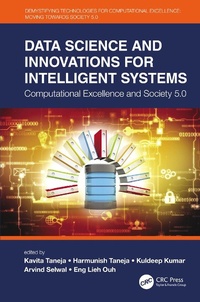
Data Science and Innovations for Intelligent Systems
Computational Excellence and Society 5.0
1st Edition
Published on 30. September 2021
382 pages
978-1-000-45616-5 (ISBN)
Description

Data science is an emerging field and innovations in it need to be explored for the success of society 5.0. This book not only focuses on the practical applications of data science to achieve computational excellence, but also digs deep into the issues and implications of intelligent systems.
This book highlights innovations in data science to achieve computational excellence that can optimize performance of smart applications. The book focuses on methodologies, framework, design issues, tools, architectures, and technologies necessary to develop and understand data science and its emerging applications in the present era.
Data Science and Innovations for Intelligent Systems: Computational Excellence and Society 5.0 is useful for the research community, start-up entrepreneurs, academicians, data-centered industries, and professeurs who are interested in exploring innovations in varied applications and the areas of data science.
This book highlights innovations in data science to achieve computational excellence that can optimize performance of smart applications. The book focuses on methodologies, framework, design issues, tools, architectures, and technologies necessary to develop and understand data science and its emerging applications in the present era.
Data Science and Innovations for Intelligent Systems: Computational Excellence and Society 5.0 is useful for the research community, start-up entrepreneurs, academicians, data-centered industries, and professeurs who are interested in exploring innovations in varied applications and the areas of data science.
More details
Series
Edition
1. Auflage
Language
English
Place of publication
London
United Kingdom
Publishing group
Taylor & Francis Ltd
Target group
College/higher education
Professional and scholarly
Product notice
Reflowable
Illustrations
49 Tables, black and white; 85 Line drawings, black and white; 41 Halftones, black and white; 126 Illustrations, black and white
ISBN-13
978-1-000-45616-5 (9781000456165)
Copyright in bibliographic data and cover images is held by Nielsen Book Services Limited or by the publishers or by their respective licensors: all rights reserved.
Schweitzer Classification
Other editions
Additional editions
Kavita Taneja | Harmunish Taneja | Kuldeep Kumar
Data Science and Innovations for Intelligent Systems
Computational Excellence and Society 5.0
Book
10/2024
1st Edition
CRC Press
€75.20
Shipment within 15-20 days
Kavita Taneja | Harmunish Taneja | Kuldeep Kumar
Data Science and Innovations for Intelligent Systems
Computational Excellence and Society 5.0
Book
12/2021
CRC Press
Unfortunately, price unknown
Available (delivery time upon request)
Kavita Taneja | Harmunish Taneja | Kuldeep Kumar
Data Science and Innovations for Intelligent Systems
Computational Excellence and Society 5.0
Book
10/2021
1st Edition
CRC Press
€207.40
Shipment within 15-20 days
Persons
Kavita Taneja is an Assistant Professor at Panjab University, Chandigarh. She obtained her Ph.D. in Computer Science and Applications from Kurukshetra University, Kurukshetra, India. She has published and presented over 60 papers in National/International Journals / Conferences and has bagged best paper awards in many Conferences including IEEE, Springer, Elsevier, ACM and many more. She is reviewer of many reputed Journals and has been Technical Program Committee member of many conferences. She has also authored and edited computer books. She has more than 18 years of teaching experience in various Technical institutions and Universities. She is also member of BoM, Academic Council and Board of Studies of many Universities and Institutions. She has guided scholars of Ph.D. / M.Phils., more than 100 PG students of various universities and currently 04 students are pursuing Ph.D. under her guidance at Panjab University. Her teaching and research activities include Mobile Ad hoc Networks, Simulation and Modelling and Wireless Communications.
Harmunish Taneja is an Assistant Professor at DAV College, Sector 10, Panjab University, Chandigarh. He obtained his Ph.D. in Computer Science and Applications from Kurukshetra University, Kurukshetra. He is having more than 21 years of teaching and research experience. He has guided 05 M.Phil. students and more than 90 PG students of various universities. 04 students are pursuing Ph.D. under his guidance. He is reviewer of many reputed Journals and has been Review Committee member of many conferences. His research interests are Information Computing, Mobile Adhoc Networks, Image processing, Data Science, Recommender systems and System Simulation. He has published and presented over 55 papers in International Journals / Conferences of repute. He has also authored books of Computer Science and Applications.
Kuldeep Kumar works at the Department of Computer Science and Engineering, National Institute of Technology Jalandhar, India. He received his PhD degree in Computer Science from the National University of Singapore in 2016. Prior to joining the institute, he worked for 2 years in the Birla Institute of Technology and Science, Pilani, India. He received his PhD in Computer Science from the School of Computing, National University of Singapore (NUS SoC), Singapore in 2016. He has several publications in reputed international journals/conferences.
Arvind Selwal works as Assistant Professor in the Department of Computer Science and Information Technology, Central University of Jammu, India. His research interest includes machine learning, biometric security, digital image processing and soft computing. He has contributed more 25 research articles in reputed International Journals He has authored a book titled "Fundamentals of Automata Theory and Computation". He is an active member of Computer Society of India (CSI). He is undertaking two research projects from DRDO, New Delhi, India.
Eng Lieh Ouh obtained his PhD in Computer Science (Software Engineering) from the National University of Singapore. He is involved in several large-scale information technology industry projects for a decade at IBM Singapore and Sun Microsystems before joining academia as an educator. His research areas are software reuse, software architecture design, design thinking and software analytics. He has experiences delivering courses for the postgraduate students, undergraduate students and industry participants in the software engineering areas including design thinking, practical software architecture design, security engineering and mobile development. He received multiple teaching excellence awards and industry projects recognition awards throughout his career.
Harmunish Taneja is an Assistant Professor at DAV College, Sector 10, Panjab University, Chandigarh. He obtained his Ph.D. in Computer Science and Applications from Kurukshetra University, Kurukshetra. He is having more than 21 years of teaching and research experience. He has guided 05 M.Phil. students and more than 90 PG students of various universities. 04 students are pursuing Ph.D. under his guidance. He is reviewer of many reputed Journals and has been Review Committee member of many conferences. His research interests are Information Computing, Mobile Adhoc Networks, Image processing, Data Science, Recommender systems and System Simulation. He has published and presented over 55 papers in International Journals / Conferences of repute. He has also authored books of Computer Science and Applications.
Kuldeep Kumar works at the Department of Computer Science and Engineering, National Institute of Technology Jalandhar, India. He received his PhD degree in Computer Science from the National University of Singapore in 2016. Prior to joining the institute, he worked for 2 years in the Birla Institute of Technology and Science, Pilani, India. He received his PhD in Computer Science from the School of Computing, National University of Singapore (NUS SoC), Singapore in 2016. He has several publications in reputed international journals/conferences.
Arvind Selwal works as Assistant Professor in the Department of Computer Science and Information Technology, Central University of Jammu, India. His research interest includes machine learning, biometric security, digital image processing and soft computing. He has contributed more 25 research articles in reputed International Journals He has authored a book titled "Fundamentals of Automata Theory and Computation". He is an active member of Computer Society of India (CSI). He is undertaking two research projects from DRDO, New Delhi, India.
Eng Lieh Ouh obtained his PhD in Computer Science (Software Engineering) from the National University of Singapore. He is involved in several large-scale information technology industry projects for a decade at IBM Singapore and Sun Microsystems before joining academia as an educator. His research areas are software reuse, software architecture design, design thinking and software analytics. He has experiences delivering courses for the postgraduate students, undergraduate students and industry participants in the software engineering areas including design thinking, practical software architecture design, security engineering and mobile development. He received multiple teaching excellence awards and industry projects recognition awards throughout his career.
Content
1. Quantum Computing: Computational Excellence for Society 5.0 2. Prediction Models for Accurate Data Analysis: Innovations in Data Science 3. Software Engineering Paradigm for Real-Time Accurate Decision Making for Code Smell Prioritization 4. Evaluating Machine Learning Capabilities for Predicting Joining Behavior of Freshmen Students Enrolled at Institutes of Higher Education: Case Study from a Novel Problem Domain 5. Image Processing for Knowledge Management and Effective Information Extraction for Improved Cervical Cancer Diagnosis 6. Recreating Efficient Framework for Resource Constrained Environment: HR Analytics and its Trends for Society 5.0 7. Integration of Internet of Things (IoT) in Health Care Industry: An Overview of Benefits, Challenges and Applications 8. Cloud, Edge and Fog Computing: Trends and Case Studies 9. A Paradigm Shift for Computational Excellence from Traditional Machine Learning to Modern Deep Learning-Based Image Steganalysis 10. Feature Engineering for Presentation Attack Detection in Face Recognition: A Paradigm Shift from Conventional to Contemporary Data-Driven Approaches 11. Reconfigurable Binary Neural Networks Hardware Accelerator for Accurate Data Analysis in Intelligent Systems 12. Recommender System: Techniques for Better Decision Making for Society 5.0 13. Implementation of Smart Irrigation System Using Intelligent Systems and Machine Learning Approaches 14. Light-Weight Cryptography using Trust Based System for Internet of Things (IoT) 15. Innovation in Healthcare for Improved Pneumonia Diagnosis with Gradient-Weighted Class Activation Map Visualization
