

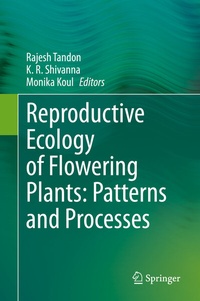
Reproductive Ecology of Flowering Plants: Patterns and Processes
1st Edition
Published on 7. August 2020
XVII, 413 pages
978-981-15-4210-7 (ISBN)
Description

Sexual reproduction is the predominant mode of perpetuation for flowering plant species. Investigating the reproductive strategies of plants has grown to become a vast area of research and, in crop plants, covers events from flowering to fruit and seed development; in wild species, it extends up to seed dispersal and seedling recruitment. Thus, reproduction determines the extent of yield in crop plants and, in wild plants, also determines the efficacy of recruiting new adults to the population, making this field important both from fundamental and applied plant biology perspectives. Moreover, in light of the growing concerns regarding food and nutritional security for the growing population and preserving biological diversity, reproductive biology of flowering plants has acquired special significance. Extensive studies on various facets of reproduction are being carried out around the world. However, these studies are scattered across research journals and reviews from diverse areas of biology.
The present volume covers the whole spectrum of reproductive ecology, from phenology and floral biology, to sexuality and pollination biology/ecology including floral rewards, breeding systems, apomixis and seed dispersal. In turn, transgene flow, its biosafety and mitigation approaches, and the 'global pollinator crisis', which has become a major international concern in light of the urgent need to sustain crop yield and biodiversity, are discussed in detail. Given its scope, the book offers a valuable resource for students, teachers and researchers of botany, zoology, ecology, agriculture and forestry, as well as conservation biologists.
The present volume covers the whole spectrum of reproductive ecology, from phenology and floral biology, to sexuality and pollination biology/ecology including floral rewards, breeding systems, apomixis and seed dispersal. In turn, transgene flow, its biosafety and mitigation approaches, and the 'global pollinator crisis', which has become a major international concern in light of the urgent need to sustain crop yield and biodiversity, are discussed in detail. Given its scope, the book offers a valuable resource for students, teachers and researchers of botany, zoology, ecology, agriculture and forestry, as well as conservation biologists.
More details
Series
Language
English
Place of publication
Singapore
Singapore
Publishing group
Springer Singapore
Target group
Professional and scholarly
Product notice
Reflowable
Illustrations
XVII, 413 p. 38 illus., 24 illus. in color.
File size
7,10 MB
ISBN-13
978-981-15-4210-7 (9789811542107)
DOI
10.1007/978-981-15-4210-7
Schweitzer Classification
Other editions
Additional editions
Rajesh Tandon | K. R. Shivanna | Monika Koul
Reproductive Ecology of Flowering Plants: Patterns and Processes
Book
08/2020
Springer
€299.59
Shipment within 3-4 weeks
Persons
Rajesh Tandon is presently working as Professor at the Department of Botany, University of Delhi. He obtained his Ph.D. in 1998 from the University of Delhi. He has been teaching and conducting research at the Institute for over 15 years, and so far has supervised 13 Ph.D. scholars for the doctoral degree and five for the M.Phil. His research interests have been plant reproduction, developmental biology and conservation biology. He has investigated reproductive ecology of many plant species including the threatened trees. He has published over 55 manuscripts in reputed International and National journals, and contributed chapters to several books. He has participated, delivered invited lectures in numerous National and International conferences, and served as resource person for workshops on plant reproductive biology. He is a co-author of a practical manual on the same topic as this edited volume. He was awarded Dr. Y. S. Murthy Young Scientist Medal (2008) by the Indian Botanical Society.
K. R. Shivanna, former Professor and Head, Department of Botany, University of Delhi is presently associated with Ashoka Trust for Research in Ecology and the Environment as INSA Honorary Fellow. A Ph.D. from the University of Delhi, Shivanna taught M.Sc. and M.Phil. students for over 30 years and is engaged in research on reproductive biology of flowering plants for the last 55 years. He has mentored 23 Ph.D. and 9 M.Phil. students. He has authored four books, edited three volumes and published 150 original research papers in refereed international journals. Shivanna has carried out collaborative research as Visiting Professor/Scientist at the Royal Botanical Gardens, Kew, UK, Welsh Plant Breeding Station, Wales, UK, University of Melbourne, Australia, University of Siena, Italy and University of Saskatchewan, Saskatoon, Canada under various Fellowship Awards. He is the Fellow of the Indian National Science Academy, Indian Academy of Sciences, National Academyof Agricultural Sciences and National Academy of Sciences, India. He is the recipient of many awards such as Maheshwari Medal and Dr. V. Puri Memorial Award.
Monika Koul is presently working as an Assistant Professor in the Department of Botany, Hansraj College, University of Delhi. She did her Ph. D. in Botany from the University of Delhi in 2004. She is involved in teaching of Reproductive Biology of Plants and Ecology to the undergraduate students of Botany, Zoology and Life Sciences for last 14 years. Monika has published 12 research papers, written a number of popular science articles in magazines and contributed chapters in various books. She has also co-edited one book and written articles for national newspapers on topics related to environment and conservation. Monika has also been a resource person for teacher training workshops and participated in developing e-content in NCERT and CBSE. She is the recipient of Ramaseshan Fellowship and SRF from Current Science Academy, IASC Bangaluru, India.
K. R. Shivanna, former Professor and Head, Department of Botany, University of Delhi is presently associated with Ashoka Trust for Research in Ecology and the Environment as INSA Honorary Fellow. A Ph.D. from the University of Delhi, Shivanna taught M.Sc. and M.Phil. students for over 30 years and is engaged in research on reproductive biology of flowering plants for the last 55 years. He has mentored 23 Ph.D. and 9 M.Phil. students. He has authored four books, edited three volumes and published 150 original research papers in refereed international journals. Shivanna has carried out collaborative research as Visiting Professor/Scientist at the Royal Botanical Gardens, Kew, UK, Welsh Plant Breeding Station, Wales, UK, University of Melbourne, Australia, University of Siena, Italy and University of Saskatchewan, Saskatoon, Canada under various Fellowship Awards. He is the Fellow of the Indian National Science Academy, Indian Academy of Sciences, National Academyof Agricultural Sciences and National Academy of Sciences, India. He is the recipient of many awards such as Maheshwari Medal and Dr. V. Puri Memorial Award.
Monika Koul is presently working as an Assistant Professor in the Department of Botany, Hansraj College, University of Delhi. She did her Ph. D. in Botany from the University of Delhi in 2004. She is involved in teaching of Reproductive Biology of Plants and Ecology to the undergraduate students of Botany, Zoology and Life Sciences for last 14 years. Monika has published 12 research papers, written a number of popular science articles in magazines and contributed chapters in various books. She has also co-edited one book and written articles for national newspapers on topics related to environment and conservation. Monika has also been a resource person for teacher training workshops and participated in developing e-content in NCERT and CBSE. She is the recipient of Ramaseshan Fellowship and SRF from Current Science Academy, IASC Bangaluru, India.
Content
Chapter 1: Reproductive Ecology of Flowering Plants: An Introduction.- Chapter 2: Climate Change and Vegetation Phenology.- Chapter 3: The Pistil: Structure in Relation to its Function.- Chapter 4: Pollen-Pistil Interaction and Fertilization.- Chapter 5: Olfactory Cues as Functional Traits in Plant Reproduction.- Chapter 6: A Snapshot of Evolutionary History of Floral Nectaries across Angiosperm Lineages.- Chapter 7: Floral Symmetry - What it is, How it Forms, and Why it Varies.- Chapter 8: Resource Allocation in Flowering Plants: Concept and Implications.- Chapter 9: Dynamics of Eco-evolutionary Forces in Shaping Dioecy.- Chapter 10: Secondary Pollen Presentation in Flowering Plants.- Chapter 11: Outbreeding in Angiosperms: Floral Architecture and Sexuality.- Chapter 12: Sexual Selection in Angiosperms: Paradox Re-visited.- Chapter 13: Role of Apomixis in Perpetuation of Flowering Plants: Ecological Perspective .- Chapter 14: Biotic Seed Dispersal Mechanisms Of Tropical Rain Forests - Bats, Fishes And Migratory Birds.- Chapter 15: (Trans)gene Flow: Mechanisms, Biosafety Concerns and Mitigation for Containment.- Chapter 16: 'Global Pollinator Crisis' and its Impact on Crop Productivity and Sustenance of Plant Diversity.
