

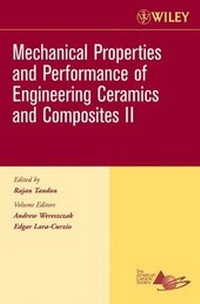
Mechanical Properties and Performance of Engineering Ceramics II, Volume 27, Issue 2
Published on 15. October 2009
808 pages
978-0-470-29172-6 (ISBN)
Description

This volume contains over 70 papers on advanced research and development of processing, mechanical properties and mechanics of ceramics and composites from the proceedings of the 30th International Conference on Advanced Ceramics and Composites, January 22-27, 2006, in Cocoa Beach, Florida. The conference was organized and sponsored by The American Ceramic Society and The American Ceramic Society's Engineering Ceramics Division in conjunction with the Nuclear and Environmental Technology Division. It covers underlying fundamental links between microstructure and properties, and the ability to achieve desired multifunctional properties through innovative processing techniques.
More details
Other editions
Additional editions
R. Wereszczak
Mechanical Properties and Performance of ng Ceramics II: Ceramic Engineering and Science Pr oceedings, Volume 27, Issue 2
Software
03/2008
Wiley
€74.27
No shipping information available
Andrew Wereszczak | Edgar Lara-Curzio | Rajan Tandon
Mechanical Properties and Performance of Engineering Ceramics II
Volume 27, Issue 2
Book
11/2006
1st Edition
Wiley
€62.90
Article exhausted; check for reprint
Persons
Andrew A. Wereszczak received his Ph.D. in Materials Science & Engineering from theUniversity ofDelaware in 1992, and while his research is varied, the study and interpretation of the relationship between mechanical properties and microstructure (of monolithic ceramics, structural materials, and electronic materials) are common denominators. Micromechanical characterization of structural and armor ceramics using instrumented static and dynamic indentation (e.g., Hertzian) with acoustic emission analysis, and adapting those measured performances and damage mechanism analyses to strength, rolling contact fatigue, wear, machining, and ballistic performances is a primary objective.
Additionally, ceramic strength and fatigue testing, ceramic fractographical and flaw population analyses, Weibull analysis strength-size-scaling, and probabilistic life prediction and design of structural ceramic components constitutive another primary research objective. In support of all these efforts, both conventional and microstructural-level finite element stress analyses and microstructure characterization are performed. He is the author or co-author of over 100 technical publications and has given over 80 presentations, and is the co-developer of µ-FEA software.
Additionally, ceramic strength and fatigue testing, ceramic fractographical and flaw population analyses, Weibull analysis strength-size-scaling, and probabilistic life prediction and design of structural ceramic components constitutive another primary research objective. In support of all these efforts, both conventional and microstructural-level finite element stress analyses and microstructure characterization are performed. He is the author or co-author of over 100 technical publications and has given over 80 presentations, and is the co-developer of µ-FEA software.
Content
- Mechanical Properties and Performance of Engineering Ceramics and Composites II
- Contents
- Preface
- Introduction
- Fracture and Deformation
- High-Velocity Impact Resistance of ZrB2-Sic
- High Temperature Fatigue Behavior of Mullite/SiC Multi-Composite Crack-Healed
- Multiple Cracking of Ceramic Hollow Cylinders Subjected to Thermal Loading: Experiments and Analysis
- Hertzian Indentation Stress Statistics in Microstructurally Tailored Sialons
- Fracture Toughness of Ceramics by the Vickers Indentation Crack Length Method: A Critical Review
- Fracture Toughness of Thin Plates by the Double-Torsion Test Method
- Fracture Toughness of Porous Cordierite
- The Mechanical Properties and Hydrothermal Stability of Porous, Partially (Biscuit-) Sintered Y-TZP Ceramics
- Improvement in Working Limit for Ceramic Components by Using Crack-Heal
- High Temperature Creep Deformation of Al,O,-Based Eutectic Ceramics Grown by the Laser Heated Float Zone Method
- Joining and Brazing
- Finite Element Analysis of Mechanical Test Methods for Evaluating Shear Strength of Ceramic Composite Joints Using Interface Element
- Adhesive Bonding of Titanium to Carbon-Carbon Composites for Heat Rejection Systems
- Diffusion Bonding of Silicon Carbide Ceramics Using Titanium lnterlayers
- The Effects of 304L Stainless Steel Pre-Oxidation on Bonding to Alkali Barium Silicate Glass
- Brazing of Ceramic-Matrix Composites to Titanium Using Metallic Glass lnterlayers
- Structure and Properties of Grain Boundaries, Interfaces and Composites
- Grain-Boundary Atomic Structures in Zirconia Ceramics
- The Effect of the Fiber/Matrix Interface on the Mechanical Properties of Ceramic-Reinforced Zirconia Phosphate-Based Matrix Composites
- Fiber Push-Out Nanoindentation Study of BN Interface in SIC/SIC Composites Exposed to High Temperatures
- Determination of Interface Opening Strength
- Measurement of the Matrix/Fiber Interfacial Strength of Carbon/Carbon Composites
- Oxidation of 3D-C/C Composites in Presence (or not) of Catalytic Impurities: Kinetics and Effect on Mechanical Properties
- Microstructure and Thermal Properties of 2 Directional and 3 Directional C/C Composites
- Influence of R-ratio on the Fatigue Behavior of a Woven SiC/SiC Composite
- Microstructure and Mechanical Properties of Non-Oxide Laminated Composites
- NDE and Novel Characterization Techniques
- Scanning Acoustic Microscopy for Characterization of Coatings and Near-Surface Features of Ceramics
- Nondestructive Evaluation of Machining Damage in Silicon-Nitride Ceramic Valves
- Strength of a C-Sphere Flexure Specimen
- The Segmented Cylinder Flexural Strength Test
- Non-Contact Non-Destructive Evaluation Using Microwave Radiation: Model Experiment and Application to Ceramic Fiber-Ceramic Matrix Composites
- Rapid, In-Situ, Ultra-High Temperature Investigations of Ceramics Using Synchrotron X-Ray Diffraction
- MAX-Phases Investigated by Soft X-Ray Emission Spectroscopy
- Through Thickness Modulus (E33) of Ceramic Matrix Composites: Mechanical Test Method Development
- Processing of Ceramics and Composites
- Forming by Extrusion of Annular Multichannel Monolithic Ceramics
- Microstructural Anisotropy During Varying Forming Conditions
- Oxynitride Glasses: Preparation and Properties-Implications for High Temperature Behaviour of Silicon Nitride Ceramics
- CAD/CAM Fabrication of 3D Photonic Fractals with Ceramic/ Polyester Composites and Their Electromagnetic Properties
- The CVI-Process: State of the Art and Perspective
- Pore Structure and Texture of Organic/lnorganic Hybrid Materials
- Carbodcarbon Composites Produced by Chemical Vapor Deposition
- Ceramic Foam Processing by the Chemical Vapor Infiltration of a Graphite Felt With SIC for Ceramic Composite Applications
- Mechanical and Physical Properties of Cu,O-xCu Cermet
- Microwave Assisted (MASS) Processing of Metal-Ceramic and Reaction-Bonded Composites
- Melt-Infiltration and Wetting Transitions of Ni,AI Alloy Infiltrated into TiC-AI,O3 Preforms
- Composition Control in Aluminum Boron Carbide Composites
- Three-Dimensional Printing of Ti-AI-O-C Composites
- Development of a High-Temperature Ceramic Braze: Analysis of Phase Equilibria in the Pd-Ag-CuO, System
- Microstructure and Nanoporosity of As-Set Geopolymers
- Heating Rates of Silicon Carbide in a Microwave Field
- Temperature and Frequency Characterization of PLZT Based Transparent Electrostrictive Ceramics Prepared by Electrophoretic Deposition
- Reliability and Analysis of Ceramics and Structures
- Strength Size Effects in Cellular Ceramic Structures
- Reliability of High Temperature Lightweight Valve Train Components in a Total Probabilistic Design Environment
- Static Fatigue (SCG) Models and Test Methods for Dense Ceramics
- Strength and Weibull Characterization of Polysilicon Membranes for MEMS Applications
- Characterization of Mechanical Performance of NT154 Silicon Nitride Microtrubine Rotors
- Life Limiting Behavior of Two Gas-Turbine Grade Silicon Nitrides at Intermediate Temperature for Stirling Convertor Applications
- Exclusivity of Strength-Limiting Extrinsic and Hybrid Flaws
- Sub-critical Crack Growth Parameters for Low Temperature Co-Fired Ceramic (LTCC)
- Synthesis, Characterization and Properties of Nitrides, Carbides, and Borides
- Hafnium Reactivity Below 1500°C in Search of Better Processing of HfB2/SiC UHTC Composites
- The Stability of Porous Silicon Carbide Under Water Vapor Below and at 1000 "C
- Processing, Microstructure and Mechanical Behavior of SiC-Based Ceramics via Naturally Derived Scaffolds
- Tribological Behavior, Wear and Erosion
- The Frictional Performance of Carbon-Carbon Composite Materials in the Presence of Hydraulic Fluid, Runway Deicer Agent, Aircraft Deicer Agent and Sea-Salt Water
- Effect of Heat Treatment on Crystal Structure and Wear Performance of Carbon-Carbon Composites
- Ceramic-Based Coatings on Metals Bonded by High Intensity Infrared Heating
- Effect of Microstructure on Sliding Contact Damage and Wear of Ceramic Coatings
- Processing and Friction Properties of Intermetallic-Bonded Diamond Ceramic Composites
- High-Thermal-Conductivity Densified Graphitic Foams as Novel Bearing Materials
- Solid-Particle Erosion of MgO and a Hardened Mg Alloy
- Tribological Properties of SI-AL-O-N Ceramic Under Reciprocating Sliding and Fretting Conditions
- Frictional Response of Ceramics in Scuffing
- Grindability of TiC-Ni,AI Metal Matrix Composites
- Microscopic Observations of Sliding Wear Surface of Alumina by TEM
- Effect of Grain Size on Dynamic Scratch Response in Alumina
- Author Index
