

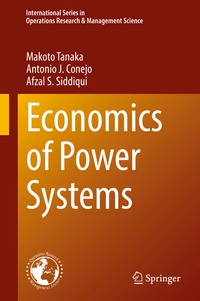
Economics of Power Systems
Description

This book describes the latest microeconomic concepts and operations research (OR) techniques needed to comprehend the design and operation of power markets, as well as the actions of their agents: producers, consumers, operators, and regulators. This is critical when it comes to addressing a constantly evolving power system environment that incorporates an increasing number of no-marginal-cost renewable sources, increasingly competitive storage facilities, increasingly responsive demands, and widespread communication channels that allow distributed decision-making. Such evolving environments call for a re-examination of the microeconomic concepts and OR techniques required by graduate students and practitioners in the electric energy field.
This accessible, tutorial-style book features numerous illustrative examples to help readers grasp the economic concepts and OR procedures used by power market professionals. The authors explian these concepts and procedures and presenta vision of a renewable-dominated marketplace. Each chapter also includes exercises.
More details
Other editions
Additional editions
Persons
Makoto Tanaka is a professor at the National Graduate Institute for Policy Studies (GRIPS) in Japan, which is an interdisciplinary institute of economics, operations research, and other fields. He gained industrial experience working in the power sector before entering academia. He focuses on the interdisciplinary fields of economic analysis and operations research, with special interests in energy and environmental policy issues. He has worked on several government committees on the power industry in Japan.
Antonio J. Conejo is a professor at The Ohio State University, OH. He holds an M.S. from MIT, and a Ph.D. from the Royal Institute of Technology, Sweden. He has published over 200 papers in refereed journals, and is the author or coauthor of various books published by Springer, John Wiley, McGraw-Hill and CRC. He is an INFORMS fellow, an IEEE fellow and a former editor-in-chief of the IEEE Transactions on Power Systems.
Afzal S. Siddiqui
is a professor in the Department of Computer and Systems Sciences at Stockholm University and an adjunct professor in the Department of Mathematics and Systems Analysis at Aalto University. Previously, he was Professor of Energy Economics in the Department of Statistical Science at University College London and a visiting professor in the Department of Decision Sciences at HEC Montréal. His research interests are in decision making under uncertainty and competition in the energy sector. He has also served as a consultant to the Ernest Orlando Lawrence Berkeley National Laboratory and the Directorate General for Communications Networks, Content and Technology of the European Commission.
