

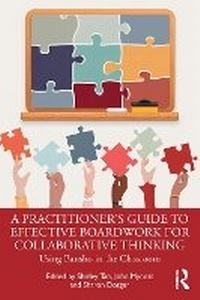
A Practitioner's Guide to Effective Boardwork for Collaborative Thinking
Using Bansho in the Classroom
Will be published approx. on 13. October 2026
224 pages
E-Book
978-1-040-58660-0 (ISBN)
Description

This is a book for any teacher and teacher educators looking for tools and collaborative teaching methods that can provide an effective method of collaborative sensemaking with students. Bansho is a traditional Japanese board writing practice that has spread beyond Japan, and boardwork is now widespread throughout the world.
Within this volume, readers will grow their understanding of what bansho and boardwork is and they can use it effectively in their teaching. Examples included are from multiple countries, grade levels, and subject areas. It explores how bansho intersects with modern technology, including interactive whiteboards, its potential for broader adoption across educational systems globally, and the development of teacher education programs designed to integrate bansho into pedagogical training. The contributors present case studies and practical examples to shed light on how teachers innovate with bansho in their classrooms and adapt bansho to cater to the local needs of students and educational contexts. The contributors also include practical examples, takeaways and guidance on using bansho in the classroom. Throughout the book, readers are encouraged to sketch boards for their own lessons as they read and to look forward to bringing those ideas to life with their students.
In-service teachers undertaking professional development, as well as pre-service teachers, will find this book helpful for their effective practice.
Within this volume, readers will grow their understanding of what bansho and boardwork is and they can use it effectively in their teaching. Examples included are from multiple countries, grade levels, and subject areas. It explores how bansho intersects with modern technology, including interactive whiteboards, its potential for broader adoption across educational systems globally, and the development of teacher education programs designed to integrate bansho into pedagogical training. The contributors present case studies and practical examples to shed light on how teachers innovate with bansho in their classrooms and adapt bansho to cater to the local needs of students and educational contexts. The contributors also include practical examples, takeaways and guidance on using bansho in the classroom. Throughout the book, readers are encouraged to sketch boards for their own lessons as they read and to look forward to bringing those ideas to life with their students.
In-service teachers undertaking professional development, as well as pre-service teachers, will find this book helpful for their effective practice.
Reviews / Votes
"Bansho-organized board-writing-is a powerful, yet little-known, secret of Japanese education. Bansho makes student thinking visible by creating a shared record of learning during a lesson, enabling students to revisit classmates' ideas and models and build powerful new insights. Learn about bansho in mathematics, science, language arts, and beyond. Leading practitioners from around the world bring bansho to life through examples, diagrams and their personal stories of change in practice."Catherine Lewis, Past President of World Association of Lesson Studies
"This publication reaffirms the significance of board writing as a fundamental teaching skill. In today's digital age, effective board writing enhances student engagement, showcases their thinking processes, and provides positive reinforcement. Through diverse examples from around the world, this book demonstrates how effective board writing enriches teaching practices and fosters an interactive classroom environment. A must-read for educators! "
Veronica Yau, Principal of Fanling Kau Yan College, China Hong Kong
More details
Series
Language
English
Place of publication
London
United Kingdom
Publishing group
Taylor & Francis Ltd
Target group
College/higher education
Professional and scholarly
Illustrations
3 Tables, color; 42 Halftones, color; 42 Illustrations, color
ISBN-13
978-1-040-58660-0 (9781040586600)
Copyright in bibliographic data and cover images is held by Nielsen Book Services Limited or by the publishers or by their respective licensors: all rights reserved.
Schweitzer Classification
Other editions
Additional editions
Shirley Tan | John Mynott | Sharon Dotger
A Practitioner's Guide to Effective Boardwork for Collaborative Thinking
Using Bansho in the Classroom
Book
approx. 10/2026
1st Edition
Routledge
€191.50
Not yet published
Shirley Tan | John Mynott | Sharon Dotger
A Practitioner's Guide to Effective Boardwork for Collaborative Thinking
Using Bansho in the Classroom
Book
approx. 10/2026
1st Edition
Routledge
€37.50
Not yet published
Persons
Shirley Tan is a Research Fellow at Windesheim University of Applied Sciences, the Netherlands. She is also an adjunct professor at EHL Lausanne, Switzerland.
John Paul Mynott is a Senior Lecturer in teacher education and Dean for Portfolio and Programme Development at the University of Aberdeen, UK.
Sharon Dotger is a Professor in Science Education at Syracuse University, USA. She is also the Faculty Director for Teacher Education and Undergraduate Studies.
John Paul Mynott is a Senior Lecturer in teacher education and Dean for Portfolio and Programme Development at the University of Aberdeen, UK.
Sharon Dotger is a Professor in Science Education at Syracuse University, USA. She is also the Faculty Director for Teacher Education and Undergraduate Studies.
Content
Introduction 1. Bansho, an introduction 2. Leveraging Bansho for Collaborative Knowledge Construction: Practical Applications and Insights from Hong Kong Secondary Education 3. Developing the board while planning science research lessons 4. What if we start planning the lesson by planning the board for the whole class discussion? 5. Using boards to organize students' "messy" thinking about learning science 6. Giving Feedback using Boards 7. Exploring Interconnected Thinking Bansho and its Integration with ICT in Japanese Classrooms 8. Where to next with the board? Where next with boardwork?
