

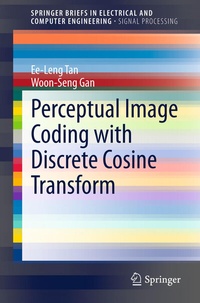
Perceptual Image Coding with Discrete Cosine Transform
Description

This book first introduces classic as well as recent computational models for just-noticeable-difference (JND) applications. Since the discrete cosine transform (DCT) is applied in many image and video standards (JPEG, MPEG-1/2/4, H.261/3), the book also includes a comprehensive survey of computational models for JND that are based on DCT. The visual factors used in these computational models are reviewed in detail. Further, an extensive comparative analysis of these models using quantitative and qualitative performance criteria is presented, which compares the noise shaping performance of these models with subjective evaluation and the accuracy between the estimated JND thresholds and subjective evaluation.
There are many surveys available on computational models for JND; however, these surveys seldom compare the performance of computational models that are based on DCT. The authors' survey of the computational models and their in-depth review of the visual factors used in them will help readers understand perceptual image coding based on DCT. The book also provides a comparative analysis of several perceptual image coders that are based on DCT, which are compatible with the highly popular and widely adopted JPEG standard.
More details
Other editions
Additional editions
Persons
Ee-Leng Tan received his BEng (1st Class Hons) and PhD degrees in Electrical and Electronic Engineering from Nanyang Technological University in 2003 and 2012, respectively. Dr. Tan joined the School of Electrical and Electronic Engineering, Nanyang Technological University, Singapore, as a Project Officer, Research Associate and Research Fellow in 2003, 2008, and 2012, respectively. His research interests include real-time signal processing, as well as audio and image processing. He is also involved with research and development work that is primarily related to real-time audio and image processing on digital signal processor (DSP) and PC platforms. To date, his work has translated to 4 patents. He had presented a talk on perceptual image coding at the Texas Instruments Developer Conference in 2006. His biographical profile is included in the Marquis Who's Who in the World since 2010.
Woon-Seng Gan received his BEng (1st Class Hons) and PhD degrees, both in Electrical and Electronic Engineering from the University of Strathclyde, UK in 1989 and 1993 respectively. He joined the School of Electrical and Electronic Engineering, Nanyang Technological University, Singapore, as a Lecturer and Senior Lecturer in 1993 and 1998 respectively. In 1999, he was promoted to Associate Professor. From 2008-2011, he was the Deputy Director of the Center for Signal Processing. He is currently the Head of Information Engineering Division, School of Electrical and Electronic Engineering in Nanyang Technological University. His research interests include adaptive signal processing, active noise control, directional sound system, psycho-acoustical signal processing and real-time embedded systems. Dr. Gan has published more than 200 international refereed journals and conferences and has been granted four Singapore and US patents. He has co-authored a book on Digital Signal Processors: Architectures, Implementations, and Applications (Prentice Hall, 2005). This book hassince been translated to chinese for adoption by universities in China. He is also the leading author of a new book on Embedded Signal Processing with the Micro Signal Architecture, (Wiley-IEEE, 2007). A book on Subband Adaptive Filtering: Theory and Implementation was also published by John Wiley in August 2009. His has also authored a book chapter in Rick Lyon's latest book on Streamlining Digital Signal Processing: A Trick of the Trade Guidebook, 2nd Edition, published by Wiley-IEEE press, 2012.
