

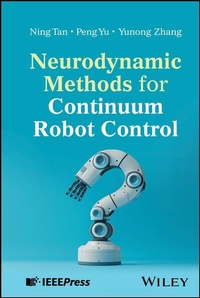
Neurodynamic Methods for Continuum Robot Control
Description

Exploration on how neurodynamic methods can be effectively applied to control complex, flexible robotic systems in research, and real-world settings
Neurodynamic Methods for Continuum Robot Control presents a comprehensive exploration of neurodynamic control methods for continuum robots-a new generation of soft, flexible robotic systems inspired by nature. The book is organized into seven thematic parts and eleven chapters, progressing from fundamental analytical techniques to advanced hybrid and adaptive control systems. After the introduction chapter, each chapter includes detailed theoretical derivations, algorithm design, and extensive validation through simulations and physical experiments.
This book explores how continuum robots are controlled effectively and robustly in real time, without requiring complex modeling or extensive data training. The solution explored throughout this book is a suite of neurodynamic control algorithms, which offer a powerful alternative to traditional model-based and learning-based approaches. These neurodynamic methods-particularly gradient neurodynamics (GND) and zeroing neurodynamics (ZND)-allow for fast, adaptive, and model-free solutions to inverse kinematics and trajectory tracking problems.
Written by a team of highly qualified authors with extensive experience in the field, this book includes information on:
- Inherent challenges in modeling and controlling continuum robots, including model uncertainty, high dimensionality, and elastic deformation
- Mathematical foundations of GND and ZND and the derivation and application of Jacobian-based and model-free kinematic control methods
- Advanced neurodynamic models including predefined-time convergent, time-synchronized, and varying-parameter schemes
- Hybrid intelligent methods such as fuzzy logic-enhanced neurodynamics and cerebellum-inspired architectures
- Benefits of neurodynamic control, including real-time performance, robustness, adaptability, and simplicity in deployment
Discussing theory, design, and applications to deliver state-of-the-art research, Neurodynamic Methods for Continuum Robot Control is an essential resource on the subject for researchers, graduate students, and advanced practitioners-not only a technical reference, but also a visionary guide to the future of intelligent robotics.
More details
Other editions
Additional editions
Persons
Ning Tan is an Associate Professor at Sun Yat-sen University, China. He is a Senior Member of IEEE. His research interests include continuum robotics, bioinspired design, and intelligent control.
Peng Yu is a PhD Candidate at Sun Yat-sen University, China. He is a graduate student member of IEEE.
Yunong Zhang is a Professor at Sun Yat-sen University, China. He is a Senior Member of IEEE, and his research interests lie in automation, robotics, neurodynamics, computation, and optimization.
Content
Foreword xi
About the Authors xiii
Preface xv
Acknowledgments xxi
Acronyms xxii
Part I Introduction 1
1 Introduction to Continuum Robots and Theoretical Foundations 3
1.1 Introduction 3
1.2 Modeling Continuum Robots Using PCC 4
1.3 Neurodynamic Models 6
1.4 Chapter Summary 7
Part II Model-based Neurodynamic Methods 9
2 Analytical-Jacobian-based Neurodynamic Control Methods 11
2.1 Introduction 11
2.2 Model-based Kinematic Control 12
2.3 Simulative Verification 21
2.4 Chapter Summary 26
Part III Model-free Neurodynamic Methods 27
3 Continuous-time Hybrid Neurodynamic Control Methods 29
3.1 Introduction 29
3.2 Model-free Kinematic Control 31
3.3 Simulative Verification 34
3.4 Chapter Summary 41
4 Discrete-time Neurodynamic Control Methods 43
4.1 Introduction 43
4.2 Method 44
4.3 Verification 48
4.4 Chapter Summary 54
Part IV Model- and Inverse-free Zeroing Neurodynamics Methods 57
5 Quad Neurodynamic Control Methods 59
5.1 Introduction 59
5.2 Preliminary 62
5.3 Velocity-level Quad Neurodynamics 63
5.4 Acceleration-level Quad Neurodynamics 67
5.5 Verification of DQND4 73
5.6 Verification of ADQN 75
5.7 Chapter Summary 80
Part V Variants of Zeroing Neurodynamics Methods 81
6 Nonlinearly Activated Zeroing Neurodynamic Control Methods 83
6.1 Introduction 83
6.2 Variants of ZND Models 84
6.3 Method 89
6.4 Verification 91
6.5 Chapter Summary 99
7 Varying-parameter Zeroing Neurodynamic Control Methods 101
7.1 Introduction 101
7.2 Preliminary 103
7.3 Varying-parameter ZND Methods 104
7.4 Recursive Least Square-aided Varying-parameter ZND Method 107
7.5 Verification of VP-ZND-1 and VP-ZND-2 111
7.6 Verification of ADVPEZND 114
7.7 Chapter Summary 117
8 Prescribed-performance Convergent Zeroing Neurodynamic Control Methods 119
8.1 Introduction 119
8.2 Predefined-time Convergent Method 121
8.3 PTS Method 126
8.4 Prescribed-performance Control Method 134
8.5 Verification of PTC-ZND 143
8.6 Verification of PTS-ZND 148
8.7 Verification of BPAC 149
8.8 Chapter Summary 161
Part VI Enhancing Zeroing Neurodynamics Methods with Intelligent Algorithms 163
9 Fuzzy-enhanced Zeroing Neurodynamic Control Method 165
9.1 Introduction 165
9.2 Method 167
9.3 Verification 170
9.4 Chapter Summary 174
10 Spiking Neural Network-enhanced Zeroing Neurodynamic Control Method 175
10.1 Introduction 175
10.2 Preliminary 176
10.3 LSM-based Control Scheme 179
10.4 Verification 185
10.5 Chapter Summary 186
Part VII Neurodynamics-based Model-free Teleoperation Method 187
11 Neurodynamics-based Teleoperation 189
11.1 Introduction 189
11.2 Preliminary 190
11.3 Method 191
11.4 Verification 196
11.5 Chapter Summary 198
References 199
Index 215
Preface
During the course of robotics research, biology has often provided researchers with inspiration to create novel robotic systems, and continuum robots are a prime example of this. In nature, organisms and structures such as elephant trunks, earthworms, and octopus tentacles exhibit exceptional mobility, manipulation capabilities, and flexibility in complex environments. These biological systems have inspired numerous researchers to replicate such abilities using electromechanical devices. This line of work has significantly contributed to the advancement of continuum robots, making them a focal point of research in recent years. Moreover, continuum robots hold the potential for applications in domains and environments where traditional robotic systems have yet to be effectively deployed. Continuum robots are characterized by their ability to bend continuously, possessing an infinite number of degrees of freedom and elastic structures. Although similar to hyper-redundant robots, continuum robots have distinct differences. Due to their novel structural design, continuum robots have garnered increasing attention within the field of robotics. Their high flexibility and adaptability enable them to serve as both safe and versatile tools in various applications. For instance, in earthquake rescue missions, continuum robots can be deployed to explore unknown, complex environments and search for trapped individuals in tight spaces where it is difficult to determine the presence of survivors. In industrial settings where both robots and human workers operate in the same space, continuum robots can be used for tasks such as grasping and sorting objects. Their soft structure minimizes the risk of injury to human workers, thus significantly enhancing safety. In the medical field, traditional surgical procedures often require large incisions, while continuum robots enable minimally invasive surgery, reducing patient trauma and shortening recovery time. Clearly, continuum robots offer broad potential for application across a wide range of fields.
Motion control of continuum robots involves calculating appropriate actuation signals to ensure the robot follows the desired path and posture. However, several challenges remain in solving this problem. First, the flexible and continuously bending body of a continuum robot presents greater modeling complexity compared to traditional rigid-link robots. This complexity leads to high computational costs during control processes, making it crucial to reduce the computational burden in order to achieve real-time control and broader practical applications. Addressing this challenge is an important yet difficult task. Second, due to the elastic properties of their materials and structures, continuum robots are more susceptible to unpredictable deformations caused by both internal compression and external forces, which can undermine the accuracy of the model. Overcoming the uncertainties in the modeling process is therefore a key issue for continuum robots. Additionally, different types of continuum robots have varied structures and models. If model-based algorithms are used for control, the modeling process must be repeated for each platform, significantly increasing the workload and difficulty of deployment. Therefore, designing a model-independent control algorithm for continuum robots is a vital and challenging task. Finally, the implementation of control systems is often affected by noise or faults, which can compromise the accuracy and reliability of the control system. Designing a control system with high precision and robustness is thus equally important and challenging for continuum robots.
Recurrent neural networks (RNNs) and related neurodynamic approaches have been widely regarded as effective tools for online computation. Among typical neurodynamic models, gradient neurodynamics (GND) has been extensively studied and employed to address various problems, such as solving Lyapunov matrix equations. However, GND does not fully exploit the time derivative information of coefficients, limiting its potential in certain time-invariant tasks. To overcome this limitation, a novel type of neurodynamics known as zeroing neurodynamics (ZND) was proposed. ZND was specifically designed to solve time-varying problems by making full use of time derivative information, leading to enhanced performance and higher accuracy. Due to its adaptability to dynamic environments, ZND has been successfully applied across a range of domains, including time-dependent matrix inversion, time-varying zero-finding problems, and robotic control. Unlike feed-forward neural networks and other learning-based methods, which require large-scale data collection and extensive pretraining, both GND and ZND models can be applied to solve various problems adaptively without the need for pretraining. The design of GND models is based on eliminating scalar-valued norm-based energy functions and is typically formulated in explicit dynamics. In contrast, ZND models aim to eliminate all entries of vector-valued indefinite error functions and are often described by implicit dynamics. Due to their advantages in computational efficiency, precision, and robustness, neurodynamic methods have been widely utilized for motion control in conventional rigid robots, establishing a robust framework in this area. However, the application of neurodynamic methods to the motion control of continuum robots has been relatively limited. A comprehensive and well-established framework for employing neurodynamics in continuum robot control remains underdeveloped, presenting a significant opportunity for further exploration and advancement in this field.
This book provides an in-depth exploration of various neurodynamic approaches for controlling continuum robots. It begins with analytical methods to derive the Jacobian matrix and use neurodynamic approaches for precise kinematic tracking control. Then, we introduce model-free and inverse-free schemes that rely on sensory feedback, including continuous-time and discrete-time algorithms based on GND and ZND. Next, this book advances into sophisticated control frameworks such as quad neurodynamics, varying-parameter ZND (VP-ZND), and predefined-time convergent models, designed to improve tracking performance under uncertain conditions like noise or disturbances. It introduces several hybrid methods, such as the dual fuzzy-enhanced neurodynamics (DFEN), which dynamically adapts control parameters to enhance convergence accuracy and stability. In addition, this book addresses more specialized applications, including cerebellum-inspired network models for visual servoing in surgical robots, and an adaptive teleoperation system that allows human operators to control continuum robots remotely. Overall, the book presents a blend of theoretical innovation and practical applications, offering a comprehensive guide for both researchers and practitioners in continuum robot control.
This book contains 11 chapters that are classified into the following seven parts:
- Part I: Introduction (Chapter 1);
- Part II: Model-based Neurodynamic Methods (Chapter 2);
- Part III: Model-free Neurodynamic Methods (Chapters 3 and 4);
- Part IV: Model- and Inverse-free Zeroing Neurodynamics Methods (Chapter 5);
- Part V: Variants of Zeroing Neurodynamics Methods (Chapters 6-8);
- Part VI: Enhancing Zeroing Neurodynamics Methods with Intelligent Algorithms (Chapters 9 and 10);
- Part VII: Neurodynamics-based Model-free Teleoperation Method (Chapter 11).
Chapter 1 - This chapter begins with foundational modeling techniques of continuum robots, followed by a theoretical introduction to neurodynamics.
Chapter 2 - In this chapter, two types of neurodynamic approaches, namely GND and ZND, are utilized to solve the real-time Jacobian matrix pseudo-inverse problem, thus achieving analytical-Jacobian-based kinematic tracking control of multi-segment continuum robots. Various neurodynamic models are examined, and their performances in terms of tracking accuracy are evaluated under conditions with and without noise disturbances. Simulative validations using a two-segment continuum robot show the feasibility and robustness of these neurodynamic models.
Chapter 3 - This chapter introduces different kinematic controllers and Jacobian estimators for continuum robots, employing ZND and GND, and then presents continuous-time hybrid neurodynamic approaches for continuum robot control. These methods address the trajectory tracking problem for continuum robots, relying solely on user-defined inputs and sensory feedback, allowing for tracking control without the need for model knowledge or internal structure details. Simulations are conducted to validate the effectiveness of the methods.
Chapter 4 - This chapter seeks to develop discrete-time neurodynamic algorithms for the control of continuum robots. To begin with, several discretization methods are introduced, including one-step forward and backward finite difference rules, three-step forward and backward finite difference rules, and a unified -step forward discretization formula. Subsequently, these methods are utilized to develop discrete GND and discrete ZND algorithms for the control of continuum robots. Finally, simulations and physical experiments are conducted to verify the effectiveness of these algorithms.
Chapter 5 - This chapter introduces a model-free and inverse-free continuous-time quad neurodynamics (CQND) scheme based on ZND. In view of the inherent discrete data processing of computers, the CQND scheme...
