

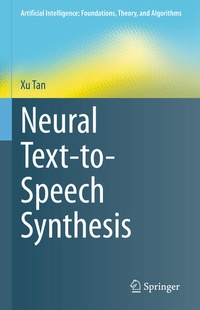
Neural Text-to-Speech Synthesis
Description

Text-to-speech (TTS) aims to synthesize intelligible and natural speech based on the given text. It is a hot topic in language, speech, and machine learning research and has broad applications in industry. This book introduces neural network-based TTS in the era of deep learning, aiming to provide a good understanding of neural TTS, current research and applications, and the future research trend.
This book first introduces the history of TTS technologies and overviews neural TTS, and provides preliminary knowledge on language and speech processing, neural networks and deep learning, and deep generative models. It then introduces neural TTS from the perspective of key components (text analyses, acoustic models, vocoders, and end-to-end models) and advanced topics (expressive and controllable, robust, model-efficient, and data-efficient TTS). It also points some future research directions and collects some resources related to TTS.
This book is the first to introduceneural TTS in a comprehensive and easy-to-understand way and can serve both academic researchers and industry practitioners working on TTS.
More details
Other editions
Additional editions
Person
Xu Tan is a Principal Researcher and Research Manager at Microsoft Research Asia. His research interests cover deep learning and its applications in language/speech/music processing and digital human creation. He has rich research experience in text-to-speech synthesis. He has developed high-quality TTS systems such as FastSpeech 1/2 (widely used in the TTS community), DelightfulTTS (winning the champion of the Blizzard TTS Challenge), and NaturalSpeech (achieving human-level quality on the TTS benchmark dataset), and transferred many research works to improve the experience of Microsoft Azure TTS services. He has given a series of tutorials on TTS at top conferences such as IJCAI, ICASSP, and INTERSPEECH, and written a comprehensive survey paper on TTS.
Besides speech synthesis, he has designed several popular language models (e.g., MASS) and AI music systems (e.g., Muzic), developed machine translation systems that achieved human parity in Chinese-English translation and won several champions in WMT machine translation competitions. He has published over 100 papers at prestigious conferences such as ICML, NeurIPS, ICLR, AAAI, IJCAI, ACL, EMNLP, NAACL, ICASSP, INTERSPEECH, KDD, and IEEE/ACM Transactions, and served as the area chair or action editor of some AI conferences and journals (e.g., NeurIPS, AAAI, ICASSP, TMLR).
