

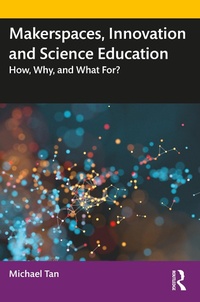
Makerspaces, Innovation and Science Education
How, Why, and What For?
1st Edition
Published on 27. February 2022
176 pages
978-1-351-11621-3 (ISBN)
Description

This book provides an overview to a range of theories in science and technology that inform the different ways in which makerspaces can be educative. Makerspaces are an indispensable site for science, technology, engineering, and mathematics (STEM) instruction and pose novel risks and opportunities for STEM instruction. Educators are likely to reach towards activities that have a high degree of engagement, but this might result in observations like 'it looks like fun, but what are they learning?'.
Beginning from the question of how we know what we know in science, the author asserts that understanding scientific knowledge requires us to know more than the abstract concepts typically presented in schools. The social and material aspects of knowledge are also important-these take the form of questions such as: What is the interplay between knowledge and power? How do we understand that we can have a 'feel' for materials and artefacts that we cannot completely describe in words? How do we know what ideas ought to be made real though technology and engineering? Significantly, this book also discusses the ethical dimensions of STEM education, in thinking about the kinds of STEM education that could be useful for open futures.
This book will be useful to graduate students and educators seeking an expansive view of STEM education. More generally, these ideas outline a possible new strategy for a vision of school that is not merely training or preparing students for work. Education needs to also prepare students for sociopolitical participation, and with STEM being central to our contemporary lives, this book provides insights for how this can happen in makerspaces.
Beginning from the question of how we know what we know in science, the author asserts that understanding scientific knowledge requires us to know more than the abstract concepts typically presented in schools. The social and material aspects of knowledge are also important-these take the form of questions such as: What is the interplay between knowledge and power? How do we understand that we can have a 'feel' for materials and artefacts that we cannot completely describe in words? How do we know what ideas ought to be made real though technology and engineering? Significantly, this book also discusses the ethical dimensions of STEM education, in thinking about the kinds of STEM education that could be useful for open futures.
This book will be useful to graduate students and educators seeking an expansive view of STEM education. More generally, these ideas outline a possible new strategy for a vision of school that is not merely training or preparing students for work. Education needs to also prepare students for sociopolitical participation, and with STEM being central to our contemporary lives, this book provides insights for how this can happen in makerspaces.
Reviews / Votes
'For a number of years Michael Tan's writings about contemporary arguments and developments in science and technology education have, through his breadth and depth of thinking across a very wide range of relevant fields, challenged and informed me in very helpful ways. Rather than me write about why this has been so, I suggest you turn to the final paragraph of Chapter 1 for a hint of the spectrum of fundamental ideas Michael will present to the reader as they work through this important volume.'Richard Gunstone, Emeritus Professor of Science and Technology Education, Monash University
'Michael Tan challenges us to rethink science and STEM education - indeed education more generally - to address the needs of a new century. Focusing on moving beyond schooling as reproduction to advocate innovation, creativity and forms of knowledge that serve the new millennium, in this book Michael has offered productive lines of attack for a reenvisaged curriculum. Pulling together a wide array of scholars to challenge our thinking and seek ways forward, he has crafted a narrative that is both educative and stimulating.'
Russell Tytler, Alfred Deakin Professor and Chair of Science Education, Deakin University
More details
Edition
1. Auflage
Language
English
Place of publication
London
United Kingdom
Publishing group
Taylor & Francis Ltd
Target group
College/higher education
Illustrations
1 Line drawings, black and white; 1 Halftones, black and white; 2 Illustrations, black and white
ISBN-13
978-1-351-11621-3 (9781351116213)
Copyright in bibliographic data and cover images is held by Nielsen Book Services Limited or by the publishers or by their respective licensors: all rights reserved.
Schweitzer Classification
Other editions
Additional editions
Book
03/2022
Routledge
Unfortunately, price unknown
Available (delivery time upon request)
Book
02/2022
1st Edition
Routledge
€57.70
Shipment within 15-20 days
Book
02/2022
1st Edition
Routledge
€207.20
Shipment within 15-20 days
Person
Michael Tan is a Lecturer (Research Scientist) at the National Institute of Education, Nanyang Technological University, Singapore. He researches the nature of scientific and technological knowledge, and the social consequences of the differential distribution of this knowledge through schools.
Content
1. Introduction 2. What is knowledge anyway? Obtaining clarity on knowledge and its role in society 3. An anti-intellectual approach to knowledge and learning 4. Design as a problem for school that reveals the problem of school 5. The uses and abuses of science and technology 6. The interaction of human and non-human agency 7. Rethinking education for social change
