

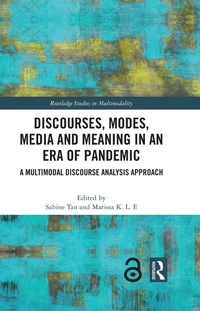
Discourses, Modes, Media and Meaning in an Era of Pandemic
A Multimodal Discourse Analysis Approach
1st Edition
Published on 30. September 2022
292 pages
978-1-000-77244-9 (ISBN)
Description

The COVID-19 pandemic has affected all aspects of our everyday lives - from the political to the economic to the social. Using a multimodal discourse analysis approach, this dynamic collection examines various discourses, modes and media in circulation during the early stages of the pandemic, and how these have impacted our daily lives in terms of the various meanings they express.
Examples include how national and international news organisations communicate important information about the virus and the crisis, the public's reactions to such communications, the resultant (counter-)discourses as manifested in social media posts and memes, as well as the impact social distancing policies and mobility restrictions have had on people's communication and interaction practices. The book offers a synoptic view of how the pandemic was communicated, represented and (re-)contextualised across different spheres, and ultimately hopes to help account for the significant changes we are continuing to witness in our everyday lives as the pandemic unfolds.
This volume will appeal primarily to scholars in the field of (multimodal) discourse analysis. It will also be of interest to researchers and graduate students in other fields whose work focuses on the use of multimodal artefacts for communication and meaning making.
The Open Access version of this book, available at http://www.taylorfrancis.com, has been made available under a Creative Commons Attribution-Non Commercial-No Derivatives 4.0 license.
Examples include how national and international news organisations communicate important information about the virus and the crisis, the public's reactions to such communications, the resultant (counter-)discourses as manifested in social media posts and memes, as well as the impact social distancing policies and mobility restrictions have had on people's communication and interaction practices. The book offers a synoptic view of how the pandemic was communicated, represented and (re-)contextualised across different spheres, and ultimately hopes to help account for the significant changes we are continuing to witness in our everyday lives as the pandemic unfolds.
This volume will appeal primarily to scholars in the field of (multimodal) discourse analysis. It will also be of interest to researchers and graduate students in other fields whose work focuses on the use of multimodal artefacts for communication and meaning making.
The Open Access version of this book, available at http://www.taylorfrancis.com, has been made available under a Creative Commons Attribution-Non Commercial-No Derivatives 4.0 license.
More details
Series
Edition
1. Auflage
Language
English
Place of publication
London
United Kingdom
Publishing group
Taylor & Francis Ltd
Target group
College/higher education
Professional and scholarly
Product notice
Reflowable
Illustrations
16 Tables, black and white; 2 Line drawings, black and white; 36 Halftones, black and white; 38 Illustrations, black and white
File size
8,69 MB
ISBN-13
978-1-000-77244-9 (9781000772449)
Copyright in bibliographic data and cover images is held by Nielsen Book Services Limited or by the publishers or by their respective licensors: all rights reserved.
Schweitzer Classification
Other editions
Additional editions
Sabine Tan | Marissa K. L. E
Discourses, Modes, Media and Meaning in an Era of Pandemic
A Multimodal Discourse Analysis Approach
Book
08/2024
1st Edition
Routledge
€63.60
Shipment within 15-20 days
Sabine Tan | Marissa K. L. E
Discourses, Modes, Media and Meaning in an Era of Pandemic
A Multimodal Discourse Analysis Approach
Book
09/2022
1st Edition
Routledge
€208.00
Shipment within 15-20 days
Persons
Sabine Tan was until recently a Senior Research Fellow at Curtin University, Australia. She has a background in critical multimodal discourse analysis, social semiotics, and visual communication. She has applied multidisciplinary perspectives for the analysis of institutional discourses involving traditional and new media, and worked on interdisciplinary projects involving the development of interactive software for the multimodal analysis of images, videos and 360-degree videos for research and educational purposes.
Marissa K. L. E is currently a Lecturer at the Centre for English Language Communication (CELC) at the National University of Singapore (NUS), Singapore. Her research interests include systemic functional linguistics, critical multimodal discourse analysis and conceptual metaphor theory. She has published and presented in the areas of social semiotics, multimodal discourse analysis, multiliteracies and the use of multimodality for educational purposes.
Marissa K. L. E is currently a Lecturer at the Centre for English Language Communication (CELC) at the National University of Singapore (NUS), Singapore. Her research interests include systemic functional linguistics, critical multimodal discourse analysis and conceptual metaphor theory. She has published and presented in the areas of social semiotics, multimodal discourse analysis, multiliteracies and the use of multimodality for educational purposes.
Content
Table of contents
List of figures
List of tables
List of contributors
Introduction
1. Discourses, modes, media and meaning in an era of pandemic: A multimodal discourse analysis approach
Sabine Tan and Marissa K. L. E
Part I. Use of semiotic modes/resources in COVID-19 discourses
2. 'Stay at home': Speech acts in Arab political cartoons on COVID-19 pandemic
Ahmed Abdel-Raheem
3. Communication as 'Graphic Medicine': A multimodal social semiotic approach
Marissa K. L. E and Sabine Tan
Part II. Use of media/media technologies in COVID-19 discourses
4. Design considerations for digital learning during the COVID-19 pandemic: Losses and gains
Fei Victor Lim and Weimin Toh
5. Phraseology and imagery in UK public health agency COVID-19 tweets
David Oakey, Christian Jones and Kay L. O'Halloran
Part III. Communicative functions/strategies of COVID-19 discourses
6. Australian universities engaging international students during the COVID-19 pandemic: A study of multimodal public communications with students
Zuocheng Zhang, Toni Dobinson and Wei Wang
7. "We are in this together": Cultural branding and affective activations in a pandemic context
Carl Jon Way Ng
8. Defamiliarise to engage the public: A multimodal study of a science video about COVID-19 on Chinese social media
Zhang Yiqiong, Tan Rongle, Marissa K. L. E and Sabine Tan
9. Beyond Reporting: The communicative functions of social media news during the COVID-19 Pandemic
Yuanzheng Wu and Dezheng (William) Feng
10. Exploring strategies of multimodal crisis and risk communication in the business and economic discourses of global pandemic news
Carmen Daniela Maier and Silvia Ravazzani
Part IV. Wider communicative meanings/purposes of COVID-19 discourses
11. "Stay Alert, Control the Virus, Make Memes": A multimodal discourse analysis of UK internet memes during the COVID-19 pandemic
Avery Anapol
12. Everyday acts of social-semiotic inquiry: Insights into emerging practices from the research collective PanMeMic
Elisabetta Adami and Emilia Djonov
Index
List of figures
List of tables
List of contributors
Introduction
1. Discourses, modes, media and meaning in an era of pandemic: A multimodal discourse analysis approach
Sabine Tan and Marissa K. L. E
Part I. Use of semiotic modes/resources in COVID-19 discourses
2. 'Stay at home': Speech acts in Arab political cartoons on COVID-19 pandemic
Ahmed Abdel-Raheem
3. Communication as 'Graphic Medicine': A multimodal social semiotic approach
Marissa K. L. E and Sabine Tan
Part II. Use of media/media technologies in COVID-19 discourses
4. Design considerations for digital learning during the COVID-19 pandemic: Losses and gains
Fei Victor Lim and Weimin Toh
5. Phraseology and imagery in UK public health agency COVID-19 tweets
David Oakey, Christian Jones and Kay L. O'Halloran
Part III. Communicative functions/strategies of COVID-19 discourses
6. Australian universities engaging international students during the COVID-19 pandemic: A study of multimodal public communications with students
Zuocheng Zhang, Toni Dobinson and Wei Wang
7. "We are in this together": Cultural branding and affective activations in a pandemic context
Carl Jon Way Ng
8. Defamiliarise to engage the public: A multimodal study of a science video about COVID-19 on Chinese social media
Zhang Yiqiong, Tan Rongle, Marissa K. L. E and Sabine Tan
9. Beyond Reporting: The communicative functions of social media news during the COVID-19 Pandemic
Yuanzheng Wu and Dezheng (William) Feng
10. Exploring strategies of multimodal crisis and risk communication in the business and economic discourses of global pandemic news
Carmen Daniela Maier and Silvia Ravazzani
Part IV. Wider communicative meanings/purposes of COVID-19 discourses
11. "Stay Alert, Control the Virus, Make Memes": A multimodal discourse analysis of UK internet memes during the COVID-19 pandemic
Avery Anapol
12. Everyday acts of social-semiotic inquiry: Insights into emerging practices from the research collective PanMeMic
Elisabetta Adami and Emilia Djonov
Index
