

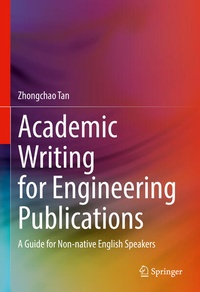
Academic Writing for Engineering Publications
Description

This textbook is designed for non-native English speakers who need to write scientific and engineering research articles, technical reports, engineering thesis, academic books, and other technical documents in English. The author focuses on formal academic writing in a professional language and frame. The book is written in standard English and provides useful guidelines on development of thoughts, organization of ideas, construction of paragraphs and sentences, and choices of precise words. It also pays attention to details such as visual creation, punctuation, and format. Informal writing is excluded from the scope of this practical guideline.
More details
Other editions
Additional editions
Person
Zhongchao Tan is a professor of Mechanical Engineering at the University of Waterloo. He received his BSc and MSc degrees from Tsinghua University, Beijing, and PhD Degree from the University of Illinois, Urbana-Champaign, USA. He was the former Associate Dean (International) of Waterloo Engineering and the founding Executive Director of Tsinghua-Waterloo Joint Research Centre for Energy and Environmental Technologies. In addition, Tan has provided dedicated services to several international professional societies including Canadian Society of Chemical Engineering and Canadian Society of Mechanical Engineering.
Dr. Tan's contribution to scholarship has been recognized by international peers, as evidenced by the popularity of his technical books in his fields of research. His single-authored textbook, Air Pollution and Greenhouse Gases, was downloaded 1.7+ million times globally, and another co-authored textbook was recognized as "the pop-used publications on SpringerLinkthat concern one or more of the UN Sustainable Development Goals". His impact on his peer groups and the wider society is also evidenced by numerous domestic and international awards, including PhD Thesis Award from the professional society in his field, Early Research Excellence Award, Outstanding Performance Award, and Highly Cited Researcher (top 1%) from Clarivate Analytics. Meanwhile, Tan mentored 100+ HQPs; many of them have taken leadership roles in their chosen fields, winning various awards including chair professorship, Best Journal Articles, Best Conference Papers, and Featured Articles.Content
Part I. Introduction.- Introduction.- Academic Integrity.- Part II. Organization of Ideas.- Preparing for Writing.- Outlining.- Drafting Introduction.- Drafting Methodology.- Drafting Results and Discussion.- Drafting Conclusions.- Drafting Other Sections.- Part III. Engineering Language Skills.- Engineering Language.- Paragraphs.- Sentences.- Phrases and Words.- Visuals.- Punctuation.- Finalization.- Part IV. Correspondence.- Correspondence.
