

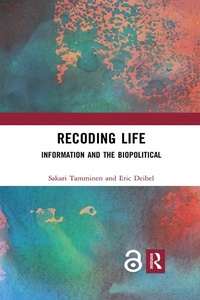
Recoding Life
Information and the Biopolitical
1st Edition
Published on 11. July 2018
172 pages
978-1-315-39920-1 (ISBN)
Description

This book addresses the unprecedented convergence between the digital and the corporeal in the life sciences and turns to Foucault's biopolitics in order to understand how life is being turned into a technological object. It examines a wide range of bioscientific knowledge practices that allow life to be known through codes that can be shared (copied), owned (claimed, and managed) and optimised (remade through codes based on standard language and biotech engineering visions).
The book's approach is captured in the title, which refers to 'the biopolitical'. The authors argue that through discussions of political theories of sovereignty and related geopolitical conceptions of nature and society, we can understand how crucially important it is that life is constantly unsettling and disrupting the established and familiar ordering of the material world and the related ways of thinking and acting politically. The biopolitical dynamics involved are conceptualised as the 'metacode of life', which refers to the shifting configurations of living materiality and the merging of conventional boundaries between the natural and artificial, the living and non-living. The result is a globalising world in which the need for an alternative has become a core part of its political and legal instability, and the authors identify a number of possible alternative platforms to understand life and the living as framed by the 'metacodes' of life.
This book will appeal to scholars of science and technology studies, as well as scholars of the sociology, philosophy, and anthropology of science, who are seeking to understand social and technical heterogeneity as a characteristic of the life sciences.
The book's approach is captured in the title, which refers to 'the biopolitical'. The authors argue that through discussions of political theories of sovereignty and related geopolitical conceptions of nature and society, we can understand how crucially important it is that life is constantly unsettling and disrupting the established and familiar ordering of the material world and the related ways of thinking and acting politically. The biopolitical dynamics involved are conceptualised as the 'metacode of life', which refers to the shifting configurations of living materiality and the merging of conventional boundaries between the natural and artificial, the living and non-living. The result is a globalising world in which the need for an alternative has become a core part of its political and legal instability, and the authors identify a number of possible alternative platforms to understand life and the living as framed by the 'metacodes' of life.
This book will appeal to scholars of science and technology studies, as well as scholars of the sociology, philosophy, and anthropology of science, who are seeking to understand social and technical heterogeneity as a characteristic of the life sciences.
More details
Edition
1. Auflage
Language
English
Place of publication
London
United Kingdom
Publishing group
Taylor & Francis Ltd
Target group
College/higher education
Product notice
Reflowable
Illustrations
8 s/w Abbildungen, 8 s/w Photographien bzw. Rasterbilder
2 Tables, black and white; 4 Halftones, black and white; 4 Illustrations, black and white
File size
2,58 MB
ISBN-13
978-1-315-39920-1 (9781315399201)
Copyright in bibliographic data and cover images is held by Nielsen Book Services Limited or by the publishers or by their respective licensors: all rights reserved.
Schweitzer Classification
Other editions
Additional editions
Book
12/2019
1st Edition
Routledge
€51.98
Shipment within 15-20 days
Book
07/2018
1st Edition
Routledge
€205.90
Shipment within 10-20 days
Persons
Sakari Tamminen is an Adjunct Professor of Science and Technology Studies (Anthropology of Science and Technology) at the University of Helsinki, Finland, and co-editor of Bio-Objects: Life in the 21st Century.
Eric Deibel is a postdoctoral researcher in the Department of Biotechnology at Delft University of Technology, The Netherlands, and lectures STS to engineering students at Bilkent University.
Eric Deibel is a postdoctoral researcher in the Department of Biotechnology at Delft University of Technology, The Netherlands, and lectures STS to engineering students at Bilkent University.
Content
List of Tables
List of Figures
Acknowledgements
1. Recoding Life: Information and the Biopolitical
2. Rethinking the Biopolitical
3. Read, Write, Standardise
4. Crossing Boundaries: The Global Politics of Access and Plants as Species of Life (TM)
5. Animal Genetic Resources as A Global Matter of Concern
6. Recoding Synthetic Life : From Openness to (Free as in) Freedom
7. Rethinking the Age of Biology: Biomass, Biohacking, and Open Source Seeds
8. The Re-Articulation of Biopolitical Theory in an Era of Informatics
List of Figures
Acknowledgements
1. Recoding Life: Information and the Biopolitical
2. Rethinking the Biopolitical
3. Read, Write, Standardise
4. Crossing Boundaries: The Global Politics of Access and Plants as Species of Life (TM)
5. Animal Genetic Resources as A Global Matter of Concern
6. Recoding Synthetic Life : From Openness to (Free as in) Freedom
7. Rethinking the Age of Biology: Biomass, Biohacking, and Open Source Seeds
8. The Re-Articulation of Biopolitical Theory in an Era of Informatics
