

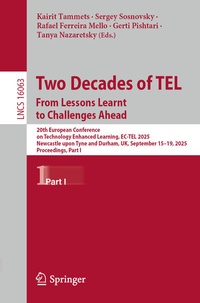
Two Decades of TEL. From Lessons Learnt to Challenges Ahead
Description

The two-volume set LNCS 16063-16064 constitutes the proceedings of 20th European Conference on Technology Enhanced Learning, EC-TEL 2025, which took place in Newcastle upon Tyne and Durham, UK, September 2025.
The total of 43 full papers, including 37 research papers, 4 blue-sky and 2 industry papers, as well as 16 demos and 32 posters papers presented in EC-TEL 2025 proceedings was carefully reviewed and selected from 195 submissions. They focus on all aspects of dynamic interdisciplinary field, bridging pedagogy, educational psychology, and digital technology.
More details
Other editions
Additional editions

Content
.- Research.
.- Detect and Remedy Deceptive Overgeneralization in Adaptive Learning.
.- Leveraging AI to Support Virtual Students in Intelligent Tutoring Systems.
.- AI-based Multimodal Biometrics for Detecting Smartphone Distractions: Application to Online Learning.
.- Detecting LLM-Generated Short Answers and Effects on Learner Performance.
.- Goal Setting Engages More Caregivers in Online Math Homework Than Instructional Support.
.- Is More Gamification Better? Evaluating Playful Interactions and Narratives for Algebra Learning.
.- Structured Prompts, Better Outcomes? Exploring the Effects of Structured Interface with ChatGPT in a Graduate Robotics Course.
.- Toward Realistic AI-Generated Student Questions to Support Instructor Training.
.- The Effect of Unplugged and Plugged-in Programming with Influencing Factor of Collaborative versus Individual Work regarding the Impact on Computational Thinking in Preschoolers.
.- Knowledge Scaffolding Recommendation System for Supervising Term Papers.
.- CRAFT: A Course Recommendation Advisor for Future Talent.
.- Reframing Computational Thinking for AI Education.
.- Empowering Equitable Learning with LLMs: Enhancing Writing Skills in Low-Resource Contexts.
.- Does feedback based on gaze and stress indicators help novice programmers?.
.- Accessible Design in Integrated Development Environments: A Think Aloud Study Exploring the Experiences of Students with ADHD.
.- Enhancing Engagement and Social Capital Through an AI-generated Summary-driven Learning Design in Online Discussion Forums.
.- Prompt vs. Supervise: A Case of Using Language Models to Assess Students' Science Explanations.
.- Automatic Large Language Models Creation of Interactive Learning Lessons.
.- Augmenting Active Learning with GenAI: Enhancement or Impairment? Evidence from a Data Visualisation Course.
.- Improving Text Readability to Support Student Comprehension and Learning: An LLM-Powered Approach.
.- Assessing Computational Thinking Using Log Data: A Scoping Review.
.- Differences in VLE adoption: longitudinal and large-scale analysis of contextual effects on French teachers' TEL practices.
.- Impact of Immediate Feedback on Students' Learning in a Virtual Reality Environment for Chemical Education.
.- Generating Video Narratives for Learning Following Subsumption Links.
.- Integrating Generative AI into Instructional Design Practice: Effects on Graduate Student Learning and Self-Efficacy.
.- Exploring the Impact of LLM-Based Scaffolding on Academic Performance and the Mediating Roles of AI Literacy and Prior Knowledge.
.- Towards Automated Characterization of Revision Events in Student Writing.
.- Enhancing Student Focus and Problem-Solving with Real-Time LLM Feedback on Compiler Errors.
.- Code-aware LLM prompting in deductive qualitative analysis: A study in multi-framework analysis of learning designs.
.- Empowering Teachers to Enhance Student High Order Thinking Skills with Artificial Intelligence Educational Tools.
.- Using Log Data to Analyze the Impact of Adaptive Support on Self-Regulated Learning in Adult Online Education.
.- Evaluating The Impact of Debriefing Techniques on Student Outcomes after CSCL Activities.
.- LLM-Generated Feedback Supports Learning If Learners Choose to Use It.
.- Automated Approaches for Concept Map Assessment: A Systematic Review.
.- Challenges and Design Opportunities for AI-based Tutoring and Assessment Software in Special Education: An Interview Study with Teachers.
.- Human Teacher vs. LLM-Generated Feedback in Secondary Education: A Comparative Study on Student Perceptions.
.- Optimizing Mastery Learning by Fast-Forwarding Over-Practice Steps.
